Eski Pano
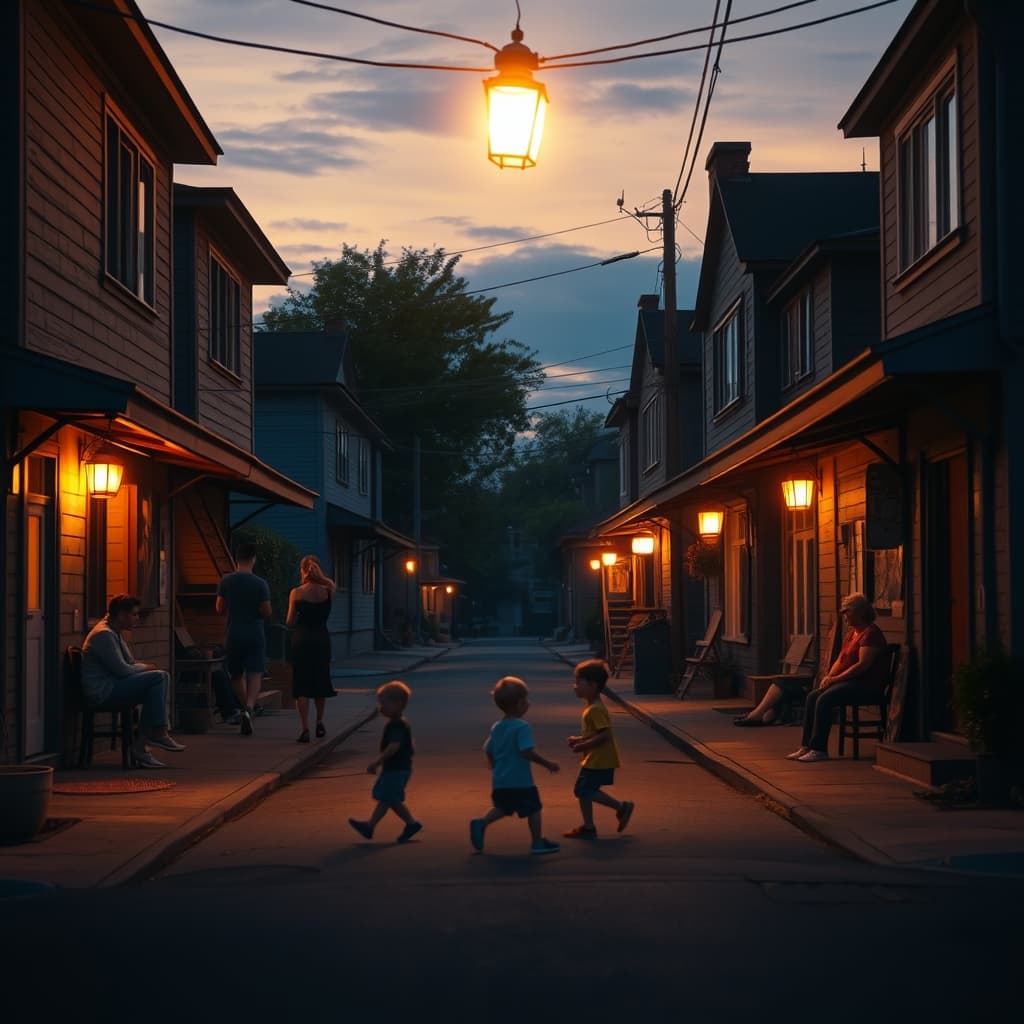
There was a time when evening did not mean the end of play for children, but simply a change in its form. When the sun withdrew, the street did not empty completely; on the contrary, the neighborhood shifted into another tone. Smells of dinner drifted from windows, mothers’ voices were heard now and then, the grocer’s shutter came halfway down, and yet once the streetlamp at the corner lit up, the game gathered itself again. The yellow circle beneath that lamp felt like the neighborhood’s invisible center. Hopscotch lines, the tight rhythm of elastic-jump games, the sound of a ball striking the pavement, the counting voices of children skipping rope, all continued a little longer around it. The streetlamp did more than provide light; it worked like an evening permission telling children and adults alike not to disperse just yet. In that way, the street became a shared home, visible to everyone and fully owned by no one.
From the perspective of neighborhood culture, this sense of a common home came from the fact that the street was not only a passageway but a shared surface of life. In older neighborhoods, evening hours were the time when doorstep life and children’s games intertwined. Women brought out stools, elders rested from the day at their thresholds, and all the while they kept half an eye on the children playing. The small illuminated area around the streetlamp became both the field of the game and the neighborhood’s circle of safety. Children moved more freely there because they knew which windows were open and which neighbors were still outside. That visibility carried affection as much as supervision. If someone fell, cologne came from one house; if someone grew thirsty, water arrived from another; when the air turned cooler, the call to come inside mixed with the light of that same lamp. The shared home was built precisely through that reciprocal act of noticing one another.
The way games stretched out under the streetlamp also taught children to feel time together with the season and the rhythm of the neighborhood. On summer evenings, as coolness settled in, the game became a little bolder and lingered through one last round, one last tag, one last count. As winter approached, the narrow band of light around the lamp grew more precious, and children strayed less beyond it. That physical circle helped set the rhythm of the game. More importantly, it kept the street from feeling like a foreign place. Every face under the light was familiar: the child from upstairs, an older brother returning from the bakery, an aunt leaning on the windowsill, another mother carrying home the last loaf from the grocer. The people of the neighborhood entered that evening scene through their own small gestures, and the children’s game occupied its center.
Sound also played a major role in turning the street into a shared home. Children’s laughter beneath the lamp, conversations at the doorway, a radio playing from far away, and the clatter of dishes from a kitchen all wove the same evening fabric. The boundary between house and street was not as hard as it is today; one spilled into the other, completed it, and carried its warmth outward. For that reason, those long game-filled evenings in the street do not belong only to children’s memory. They also preserve the neighborhood’s knowledge of living together. Street play brought children’s energy, neighbors’ attention, and the coolness of evening into one pool of light.
Today, for those who remember that scene, the streetlamp is far more than a municipal detail. It is the sign that gathered the evening spirit of a neighborhood into place. The games stretched beneath it made the street feel safe, familiar, and shared. The feeling of a common home was not always born within four walls; sometimes it emerged in those few square meters of light around the lamp. Childhood lengthened a little there, neighborliness became visible there, and the neighborhood found part of its voice there. That is why what remains in memory is not only the game, but the ability to remain together beneath the light.
The Days of Games Stretching Beneath the Streetlamp: How Did They Turn the Street into a Shared Home?