 Eski Pano
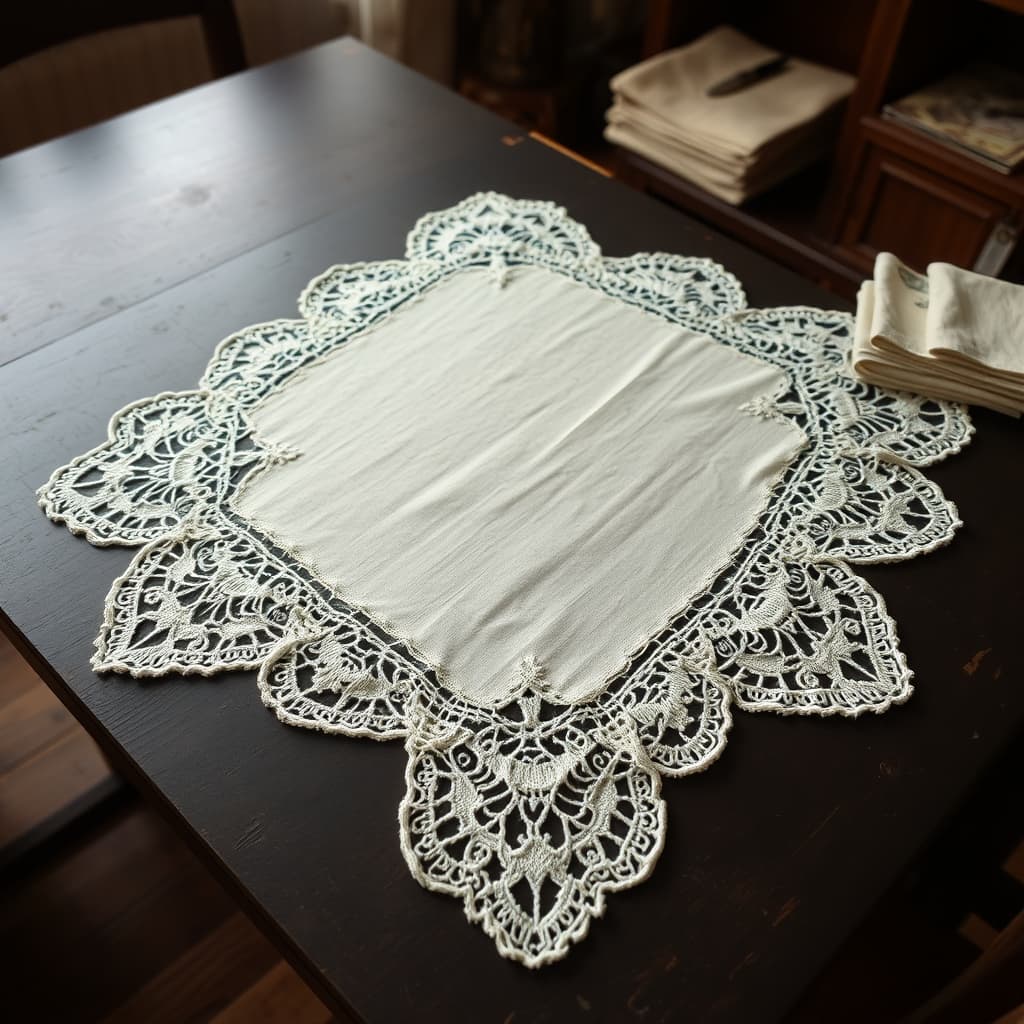
A folded lace cover might show little more than an attractive edge. A border peeping from a stack could catch a collector’s attention before the full shape was visible. Once the cover was seen open, that first impression could change: a pattern that seemed dense at the fold might surround a comparatively open centre, or a small visible motif might belong to a much larger arrangement.
The appeal of a nostalgic textile therefore begins with an encounter, not a complete identification. What catches the eye is often only the portion available at that moment. Considering the difference between folded and open views gives the collector a more concrete question than whether the lace simply looks old or beautiful.
The Border Was Not the Whole Cover
An edge could offer a repeated scallop, a pointed outline or a narrow run of motifs. These details helped form the first view, but they did not show the relationship between the outside and the centre. A cover’s overall shape could alter how that same border was understood.
A photograph limited to one corner can make comparison difficult. It might show a pleasing detail without revealing whether the object was round, rectangular or irregular. A fuller view adds information rather than merely enlarging the decorative effect. Fragile textiles require appropriate support; the story of unfolding is not a reason to pull or force a damaged piece open.
The Centre Changed the Balance
Some covers organise attention around a central motif; others make the edge more prominent. Describing what is actually visible avoids assuming one design rule for every textile called dantel. The local name does not by itself establish the technique, fibre or maker.
Seeing the centre alongside the border can explain why a cover looked different on furniture than in a folded stack. A surface beneath it might show through openings and become part of the appearance. The cover did not present its pattern in isolation; its domestic placement contributed another colour and another boundary.
The Furniture Belonged to the Visual Story
A remembered cover could have extended beyond the top of a small table or sat within the outline of a cabinet. In either case, its relationship to that surface shaped the view. A collector displaying it elsewhere might create an arrangement that the original household never used.
That new arrangement can be enjoyable without being mistaken for historical evidence. Knowing how a cover was displayed needs a photograph or a reliable account, not a reconstruction based only on its dimensions. The object’s present beauty and its documented former use are related questions, but they are not interchangeable.
A First Glance Could Become a Better Description
The collector’s initial attraction remains worth recording. Was it the border, the contrast of thread against a dark surface, or the unexpected scale when the whole cover became visible? Such an account describes the encounter honestly. It does not turn visual enthusiasm into proof of age, rarity or family origin.
An inherited story may travel with the textile, but an uncertain attribution should remain uncertain. The open pattern can tell more about the arrangement of the work than about the name of the person who made it. Recognising that limit leaves room for further evidence instead of filling the gap with a persuasive tale.
The lace cover shines differently when seen as a whole. Its attraction can lie in the relationship between a border first noticed and a centre discovered later. For the collector, that change in view is useful in itself: it turns a quick impression into an account of a particular object, with a shape, a surrounding surface and questions still open.