Eski Pano
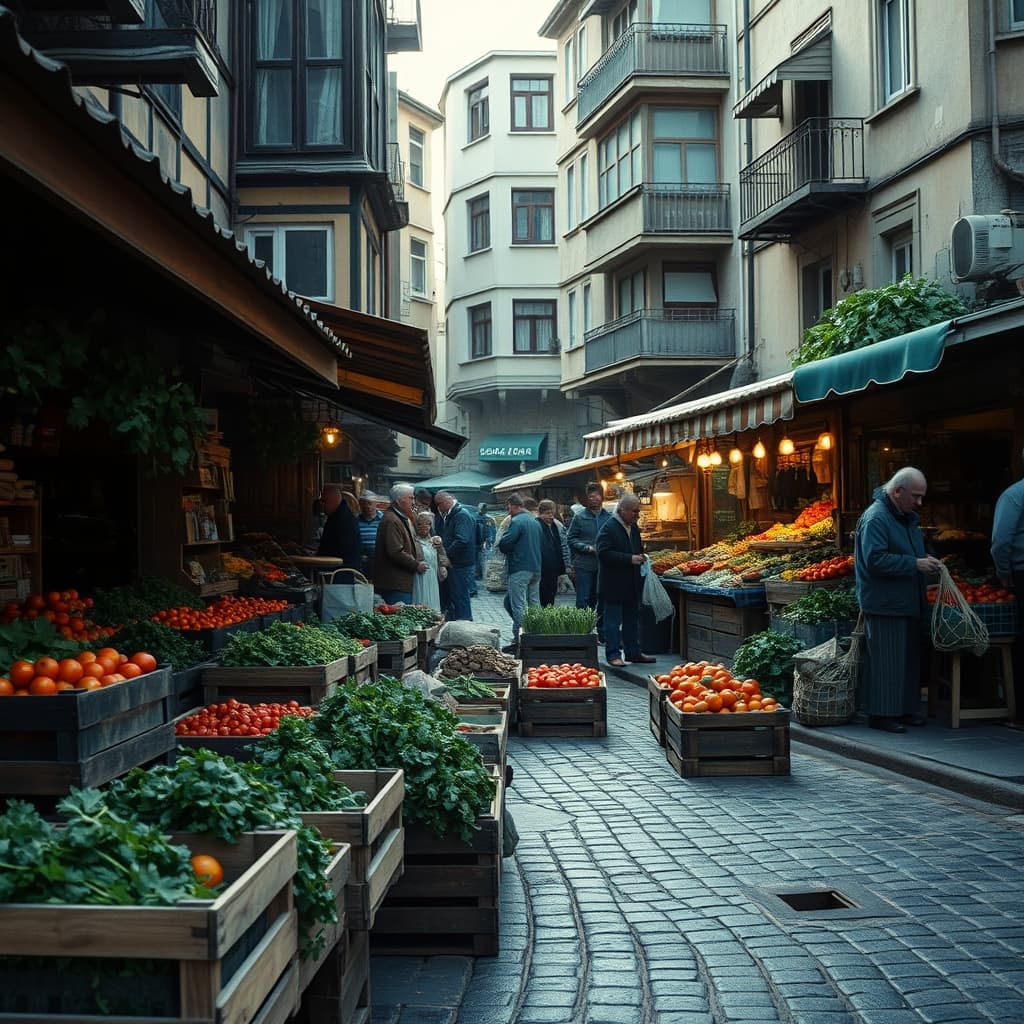
There was once a certain morning of the week when the whole mood of the neighborhood changed before sunrise. While the thin song of the kettle was still rising inside the house, the street had already begun to fill with the scrape of wooden crates, the metallic notes of stalls being assembled, and the half-awake calls of vendors clearing their voices into the day. Whoever opened the window let in not only the air, but the arrival of the market itself. Bundles of parsley laid along wet pavements, fresh herbs wrapped in newspaper, simit steaming in the cold of the morning, and neighbors carrying net bags on their arms formed one of the most familiar scenes of old city life. Those mornings were not only a time for shopping; between the stalls, the spirit of the week, the order of daily life, and the neighborhood's way of seeing itself were all set up again.
Along the trail of time, neighborhood markets were among the cultural centers of the old city as much as they were economic ones. It was no accident that old newspapers described rising prices, seasonal abundance, or the rush before a holiday by speaking of the market first. The market was where news circulated as naturally as money. Which household had a wedding coming, who had gone back to their hometown, which child had changed schools, which street had received a new tenant; much of this was learned in passing between fruit crates and fabric awnings. The small gesture of a vendor lifting the scale a little higher, the familiar tone in a buyer's voice when saying, "add a bit more," turned the market into far more than a place to purchase vegetables and fruit. It was where the city described itself anew in a daily and lively language.
One reason those mornings remain so vivid in memory is that they spoke to every sense at once. There was the scent of fresh mint and strawberries, the cool earth-like feel of wet sacks, and the rhythmic calls of vendors weaving through everything else. For children, the market was a colorful world seen while walking behind their mothers; for adults, it was a practical wisdom that gathered the whole week into shape. The meals to be cooked at home were often decided there: if the eggplants were shining, there would be frying; if the green beans were tender, olive oil dishes; if the tomatoes were fragrant, perhaps paste or menemen. The weight of the bags determined the walk home, and short calculations about prices were exchanged at apartment entrances. Even once the market was left behind, the morning continued in the kitchen, with washing, sorting, and arranging, so that the market lived not only in the street, but inside the house as well.
Today, while walking through the orderly aisles and silent checkouts of large supermarkets, what calls back those old market mornings is often something unexpected: a shout from the street, the smell of greens rushing through an open window, or the hurried step of someone carrying a net bag. That is because the neighborhood market remained in memory not merely as a place of trade, but as the heartbeat of the old city itself. Those mornings made people open the window because they announced that life was assembling outside, that the neighborhood was waking, and that the week was finding its direction. If the pulse once kept by those markets still leaves a familiar stirring inside us today, the reason is not only nostalgia. It is the memory of a way of living together that was audible, colorful, and within reach of the hand.
Mornings When Neighborhood Markets Kept the Pulse of the Week in Old City Life: Why Do They Still Make Us Open the Window So Vividly in Memory?