Eski Pano
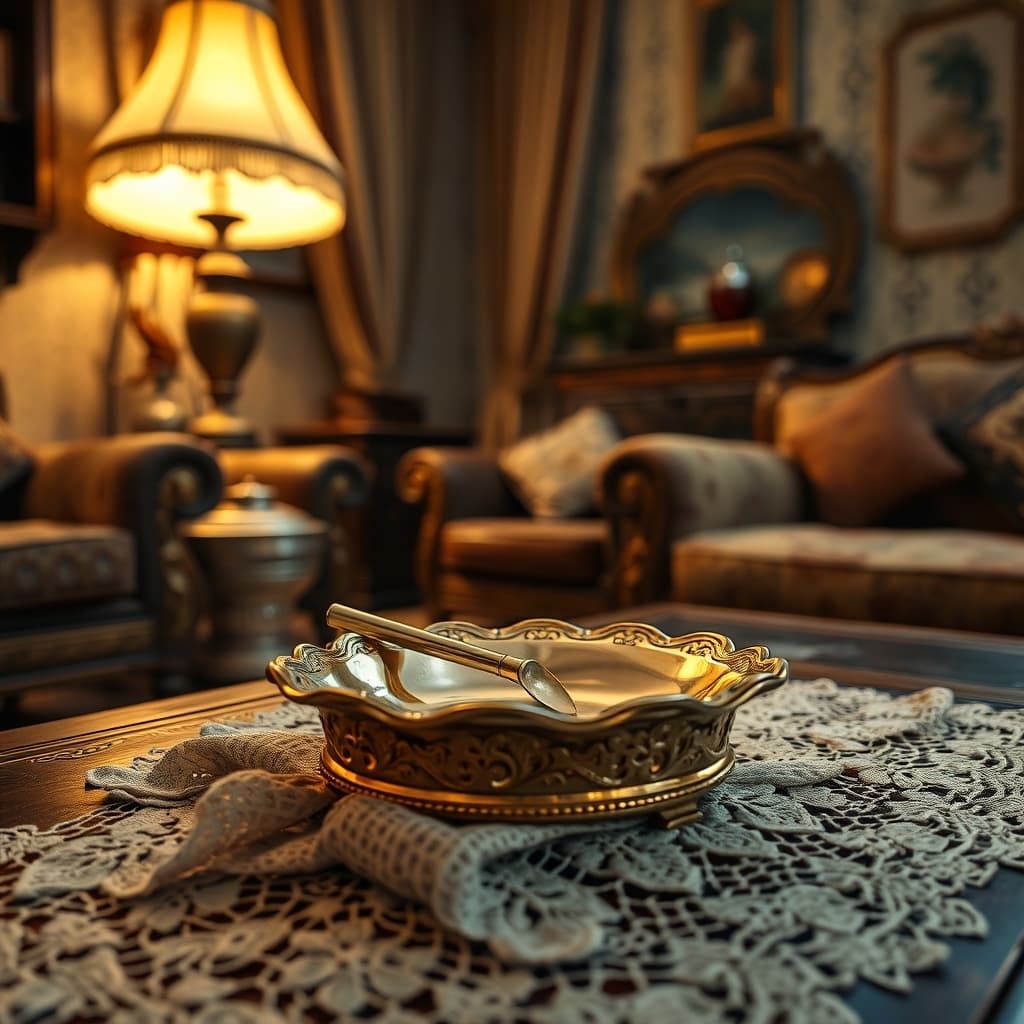
There was a time when the brass ashtray appeared to be one of the most ordinary objects in a home, yet looked at carefully, it held within it the arrangement of an era’s living room, the etiquette of receiving guests, and the everyday sense of style. A heavy brass ashtray sitting on the coffee table was not merely an object for holding cigarette ash. It completed the host’s taste, the order of the display cabinet, the seriousness of the living room, and the rhythm of hospitality. When polished, its surface returned light with a warm glow, speaking the same visual language as lace covers, walnut furniture, and crystal candy bowls. That is why, when a collector finds a brass ashtray today, it appears not as a simple metal object, but as a small time capsule carrying the atmosphere of an old living room.
From the standpoint of object stories, the charm of the brass ashtray comes from the way design and use are intertwined. Its weight, the shape that did not slip in the hand, the edges sometimes worked like a leaf or a shell, and at times the small engravings that hinted at a hotel or a ferry memory, all separated it from the rank of ordinary consumer goods. That is why collectors wandering through flea markets are not searching only for an object. They are imagining the hands that used it, the height of the table on which it stood, and the thin tea glass beside it. Brass darkens with time, yet that very tarnish makes the trace of the past more visible. Once polished, it seems as though the light of an old living room is striking the surface again. In the eyes of nostalgia enthusiasts, it shines immediately for this reason as well: not only the object itself, but the fragments of life it carries come into view.
The history of the brass ashtray is not limited to smoking culture alone. It also belongs to the way an era welcomed guests. When evening tea arrived, the coffee table was arranged, the ashtray was drawn into the proper place, and its distance from the guest’s hand was considered. Conversations moved slowly in living rooms, the radio or television remained lower in the background, and even the light turning of the ashtray from time to time formed part of that rhythm. In some homes, the brass ashtray was kept in the cabinet unused, displayed because it counted as a “good object.” In others, it appeared only on holidays or when the house filled with guests. This double meaning, value in use and value in representation, is one of the main reasons it has become a collectible today. When an object can be both everyday and ceremonial, it becomes a powerful door into the past.
Collectors follow the trace of this object partly because they are searching for a vanished etiquette of the living room. A scratched brass ashtray found in a flea market may call back an old hotel lobby, a government waiting room, or a family home with the balcony door left open on summer evenings. Objects do not speak, yet their surfaces accumulate lived experience. Small scratches, the worn felt underneath, a slight bend along the edge, all of these are silent records of use. For the nostalgia enthusiast, the real excitement lies in being able to read those records. The beauty of an object is hidden not only in its form, but in how open it is to having been lived with. That is why the brass ashtray shines at a glance: it is both an aesthetic object and a witness that has endured time.
Today, even though smoking culture, living room arrangements, and hospitality customs have changed greatly, the brass ashtray continues to live as a sign that makes the past visible. When it appears on a collector’s shelf, in the window of an antique dealer, or atop a carefully arranged desk, it brings the light of an old home with it. To understand why the past shines so quickly, one sometimes must look not at major events, but at small and heavy objects exactly like this. Cultural memory is often preserved not in the headlines of an era, but in the quiet gleam of an object that fits within the palm. The brass ashtray is one of the most familiar examples of that quiet gleam.
The Brass Ashtray and the Past Traced by Collectors: Why Does It Shine at Once in the Eyes of Nostalgia Enthusiasts?