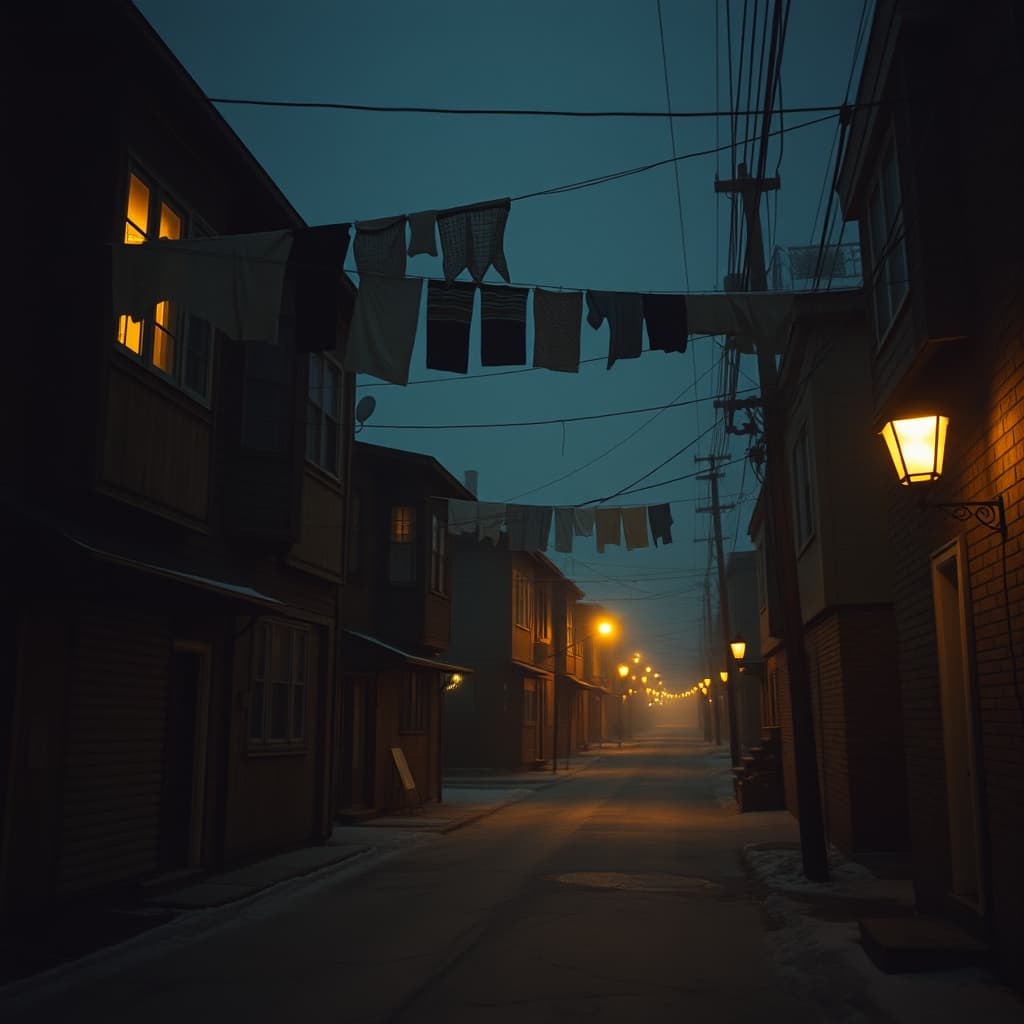
Eski Pano
There was a time when neighborhoods grew dark early on winter nights, yet their warmest scenes were built precisely inside that darkness. Clotheslines stretched above narrow streets, and where daytime sheets had hung there might remain only an empty line or a few forgotten clothespins. When the yellow light of the streetlamp fell across those lines, the neighborhood suddenly gained a frame that looked both ordinary and poetic. Smells of dinner drifted from windows, stove smoke moved slowly between rooftops, and short conversations at doorways stretched a little longer than intended. What made the scene feel warm was not physical closeness alone, but the shared sense of life arranged around objects that seemed too simple to matter.
Seen through the lens of neighborhood culture, clotheslines were quiet but powerful pieces of the everyday architecture of old districts. A rope drawn between two houses was not used only to dry laundry; it also made the boundaries and intimacy of neighborly life visible. One could sense whose sheets had already been taken down, which house was busy with children, and in which window the evening meal was being prepared. The image formed among those lines on winter nights felt warm for exactly that reason: life in the neighborhood did not disappear entirely behind closed doors, but continued to leave fine signals in the street. Domestic life remained partly private, yet never completely withdrawn from communal perception.
Another reason the scene stayed so strongly in memory was the softness of human relations woven beneath it. As firewood was carried in, children came outside one last time, or an empty plate was returned to a neighbor, the clotheslines hung overhead like a quiet ceiling for all these small motions. People lived aware of one another without intruding. A woman collecting clothespins called down to someone passing by, a child bent his head to run beneath the line, a window opened slightly, and the phrase “the tea is ready” fell into the street. Such moments show that the warmth of old neighborhoods was made not of grand events, but of small, repeated, reassuring details.
Today, in the more ordered but enclosed world of apartment living, such scenes have largely faded. Laundry moved into dryers, neighborly conversation into telephones, and the life of the street into shorter and narrower intervals. That is why, looking back, the neighborhood scene formed among clotheslines on winter nights appears not only as a nostalgic image, but as the sign of a time when living together was more visible and easier to sense. The warmth was never only the heat rising from the stove. The deeper warmth came from an environment in which life had not entirely folded inward, and people still felt one another’s presence as part of the ordinary rhythm of the evening.
Perhaps that is why old neighborhoods are remembered first not through major events, but through frames like this: a streetlamp, a few clothespins, window light visible between the lines, and a handful of voices that stayed outside despite the cold. Together they create the feeling of a lost neighborhood world. When one thinks of the warmest scene of winter nights, this is what returns: an intense closeness hidden beneath the plain surface of daily life. Even if clotheslines are absent from many streets today, the invisible sense of community they once held together remains one of the most durable parts of neighborhood memory.
Why the Neighborhood Scene Set Among Clotheslines on Winter Nights Was the Warmest Scene of Old Neighborhoods