Eski Pano
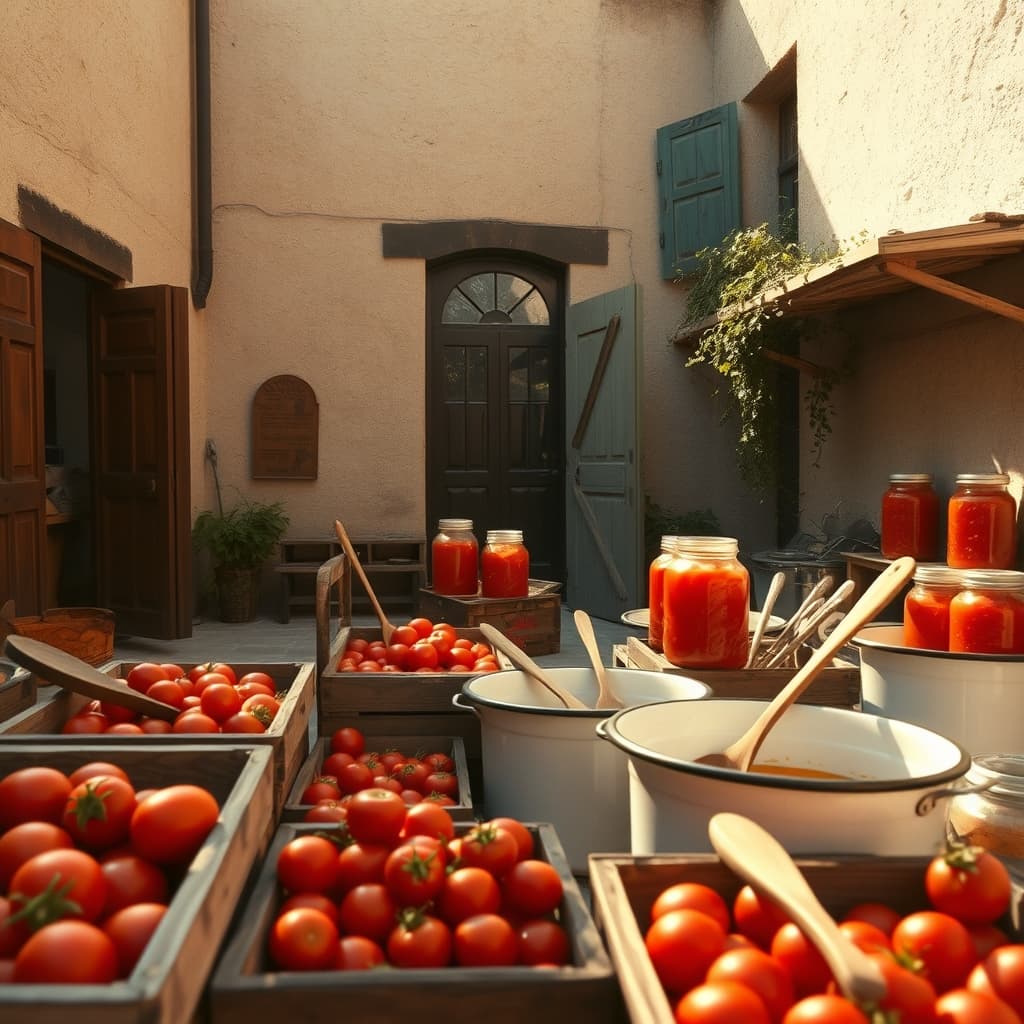
Toward the end of summer, a different kind of bustle began in courtyards, on balconies, and across flat rooftops. Tomatoes arriving in crates were washed, chopped, and placed in large basins, while a sweet-sour scent slowly spread through the house. While the sun was still strong, women prepared cheesecloths, wooden spoons, and glass jars, and children moved around this red preparation, sometimes removing tomato stems and sometimes carrying empty jars. Making tomato paste was not merely preparing food for winter. It meant renewing the family’s agreement with the season and creating a shared memory that would carry the abundance of summer to winter tables.
From the perspective of taste memory, tomato paste is one of the invisible backbones of family recipes. The flavor of a pot of beans, bulgur pilaf, vegetable stew, or soup often deepened with the paste at the tip of a spoon. Yet behind that flavor there was not only tomato. There were hours spent under the sun, redness clinging to the arm while stirring, the experience of elders who knew the right amount of salt, and the seriousness of sealing jar lids tightly. Each household’s paste was a little different. Some was darker, some saltier, some more fragrant with sun. These differences were family signatures not written in recipe notebooks, but passed from generation to generation through intuition.
The special place of paste-making days came from the way the task became a matter for the whole household rather than one person. A large basin might be borrowed from a neighbor, children were warned not to step over cloths spread in the shade, and the cleanliness of jars was checked again and again. In some homes tomatoes were pressed through a sieve, in others they were run through a meat grinder, in some places thickened under the sun, in others cooked slowly over low heat. The method changed, but the feeling remained the same: when winter arrived, every spoonful placed on the table would remember today’s labor. The color of the paste was like summer preserved before it slipped away.
These days were also times when kitchen knowledge was transmitted without formal instruction. When elders said, “Do not let the salt be too little,” “pour oil on top,” or “the jar must be dry,” they were not only giving technical advice; they were teaching the continuity of the household. Children sometimes grew bored, sometimes watched with curiosity the thin skin forming on paste drying in the sun, and sometimes laughed at their hands stained red. Those images returned years later in the scent of a dish. When a jar of paste was opened, its sharp smell summoned not only appetite, but the summer courtyard, family voices, and the bustle of seasonal preparation. That is why tomato paste built a powerful bridge between taste and memory.
Even though ready-made products fill kitchen shelves today, the special place of homemade paste in family recipes does not easily disappear. It contains more experience than measurement, more labor than ingredient, and more memory than flavor alone. Tomato paste days that left a mark show us that the kitchen was not only a place where meals were cooked, but a field of memory where seasons, generations, and neighborly relations were tied together. When a spoonful of paste enters a dish, the summer sun quietly touches the winter pot. The depth of family recipes comes partly from this: every taste carries with it the time and patience of the hands that prepared it.
Tomato Paste Days That Left a Mark: Why They Hold a Special Place in Family Recipes