 Eski Pano
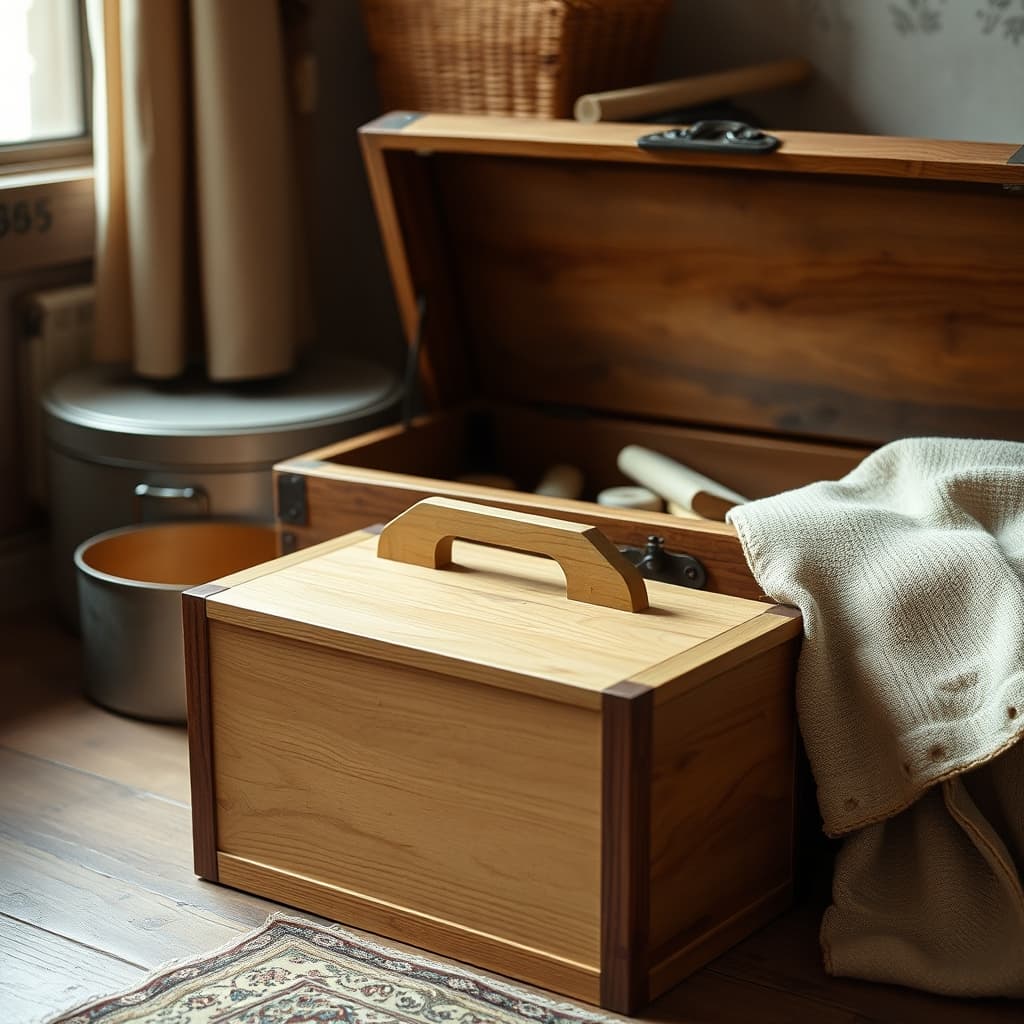
A wooden sewing box found beneath other things in a chest could first appear as a closed shape. Before its threads and tools were examined, the lid offered a surface, an outline and perhaps a handle. These visible choices belonged to the box’s domestic life as much as the contents inside it.
The object can therefore tell a story about taste without requiring a complete inventory of sewing materials. A box intended to contain useful things might also be made pleasing to see or easy to carry. Its appearance joined practical expectations with decisions about where such work belonged in the home.
A Closed Box Presented a Particular Surface
A plain lid could emphasise the grain or finish of the wood. Another might carry decoration or a shaped edge. The actual box must determine the description; no carving, painting or species of wood should be supplied merely to make an old object seem more distinctive.
The surface also had a relationship with the surrounding room. A box kept in view could be encountered between sewing tasks, while one stored in a chest might be seen only when needed. Finding it later in storage does not prove that it was always hidden there. Its earlier place needs an account or a photograph.
An apparently restrained design could be a deliberate preference, a practical purchase or simply what was available. Appearance alone cannot distinguish those explanations. The box’s taste is a question to explore, not a secure measure of the owner’s personality or income.
The Handle Connected Looking to Carrying
Where a handle was present, the box’s form offered a way to move it. Its position and shape contributed to the object’s outline even when nobody carried it. A sewing container could be recognised from across a room partly through that silhouette.
Use might leave marks around a handle or along an edge, but their cause should be described cautiously. Wear can suggest repeated contact without naming the person responsible or the exact task. A known family association and a visible mark support different kinds of knowledge.
The lid also separated the view of the box from the view of its contents. Closed, it could read as one compact household object. Open, the arrangement became more complicated. Neither view should automatically replace the other in the story of how the box was remembered.
Storage Changed What a Later Viewer Saw
At the bottom of a chest, the box entered a different arrangement from one displayed near a chair. The later viewer encountered it among stored belongings, perhaps without the furniture or textiles that once accompanied its use. The discovery supplied a new setting, not necessarily the original one.
The temptation is to make every surface carry a hidden family narrative. A more useful account begins with what the lid actually shows and what the family can support. Decorative choices, handling and storage can be kept together without pretending that the object explains all of them by itself.
A period’s taste was not confined to prestigious furniture. It could appear on a small container whose lid closed over ordinary sewing work. Looking at that lid preserves the box as something people saw, placed and moved, not only something they opened. Its outline offers the first part of the story before a single spool or button comes into view.