 Eski Pano
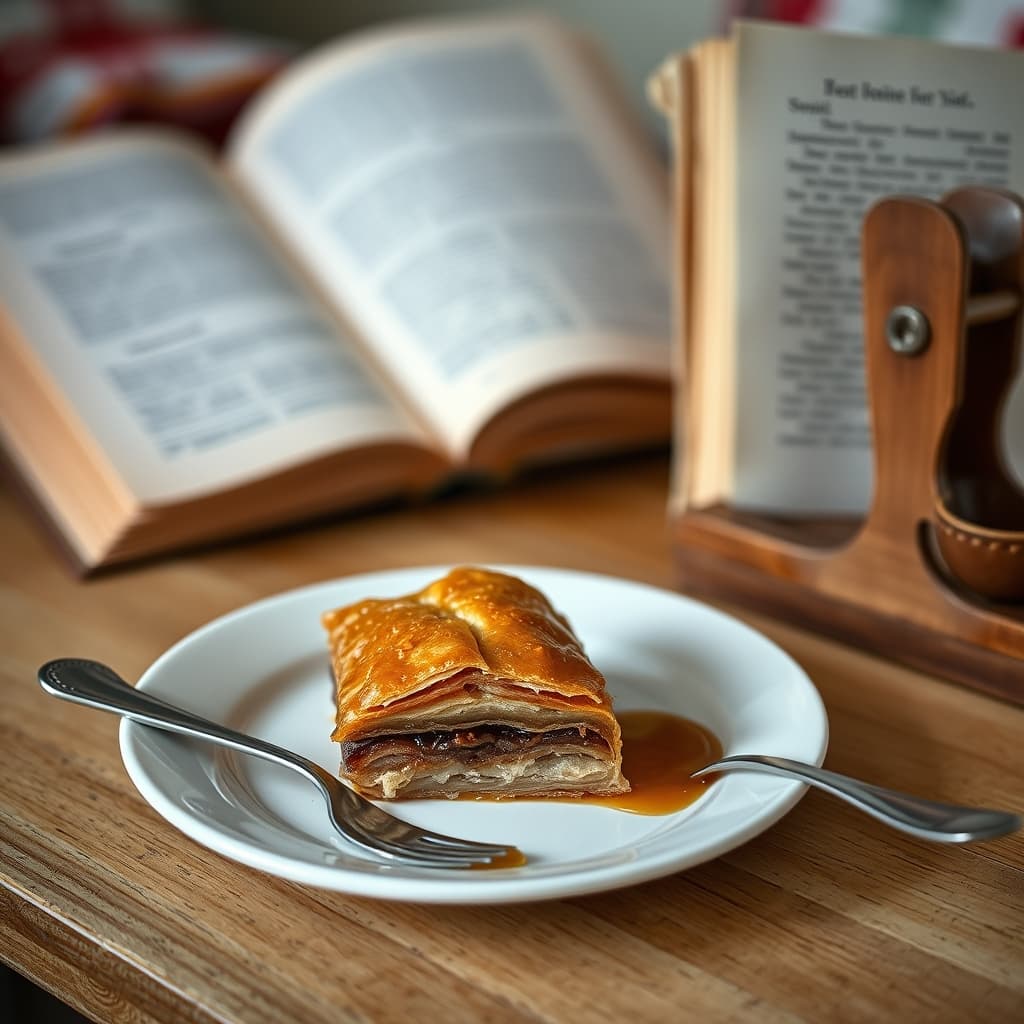
A spoon reaching towards a portion of homemade baklava after school brought a large tray down to the scale of one plate. The child did not encounter the recipe as a list of ingredients. It appeared as layers, a cut edge and a particular amount of syrup around the piece. The utensil belonged to that small arrangement.
A spoon is one possible detail of serving, not a universal rule for eating baklava. Another household might use a fork or serve it differently. The remembered plate matters precisely because it is particular. It can explain why a family recipe felt recognisable without claiming that all homemade baklava looked or tasted the same.
The Cut Edge Made the Layers Visible
Once a portion had been separated from the tray, its side could reveal a different view from the patterned top. The child could see how the layers met the filling and where the piece had been cut. The first movement of the spoon encountered that shape rather than the tray as a whole.
A remembered texture might concern the top, the lower layers or the edge nearest the plate. These distinctions are useful when comparing family accounts. One person could emphasise the surface while another remembered the softer part beneath it. They were not necessarily disagreeing about the recipe; they might be recalling different parts of a portion.
The Syrup Had a Place on the Plate
Syrup visible around the piece could become part of how the serving was recognised. The spoon might meet it before reaching another layer. The account can describe that sequence without claiming that one amount or consistency is the correct standard.
The household’s recipe and serving practice need to supply the details. A filling should not be guessed from a general memory of sweetness, and a family name for the pastry should be retained where it is known. The special place of a recipe can depend on repetition rather than on rarity or an asserted origin.
A later portion could recall the earlier one through these small relationships: the piece on the plate, the utensil beside it and the syrup at its edge. Recognition need not mean that every batch was identical. A familiar way of serving could connect variations within the same household.
School Things Still Belonged to the Afternoon
The child arriving home had other objects to put down and other tasks awaiting them. A bag, books or a change of clothes could frame the pause at the plate. The pastry was part of an afternoon continuing from school, not necessarily an exceptional celebration.
Someone had prepared and served the portion before the first spoon reached it. That person’s work belonged to the encounter even if the child remembered only the finished plate. The recipe held a place in family life through those repeated acts of making available, not through taste alone.
A recollection can also include a portion saved for someone who returned later, or a child told to wait. Such details should come from the actual household account. They show that the first reach was governed by serving and timing, rather than being an unrestricted claim on the tray.
The after-school spoon is a modest point from which to remember homemade baklava. It connects the visible layers with a familiar serving and a pause in the day. The family recipe became recognisable at that scale: not the entire tray in a kitchen photograph, but one piece offered on a plate and the particular way a child began to eat it.