 Eski Pano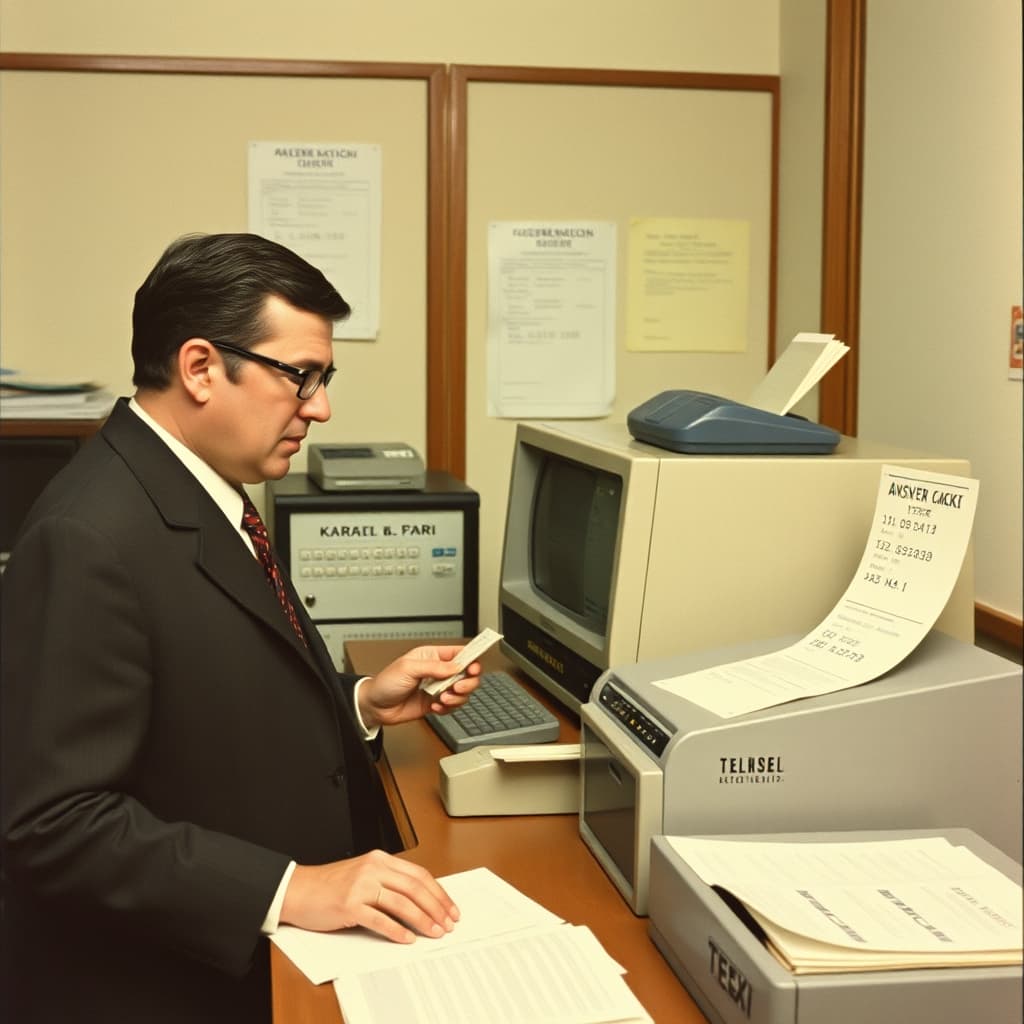
A telex message looked immediate because letters appeared at a distant machine, yet businesses trusted it only when origin, route, wording, and receipt could be reconstructed. The machine sat inside a documentary system. Subscriber identifiers, answerback exchanges, operator notes, paper tape, timestamps, delivery copies, and filing rules helped turn a transmission into a record that people could act upon.
Networks varied by country, operator, decade, character set, switching method, tariff, and institutional practice. A public telex network, private circuit, newsroom link, bank terminal, shipping office, and diplomatic service did not share identical controls. Directories, operating manuals, message forms, bills, logs, tapes, service notices, and surviving printouts establish the actual arrangement.
Answerback Identified a Machine, Not Every Author
Many terminals could transmit an answerback code when contacted, allowing the sender to check the remote subscriber and the receiver to record the calling identity. That exchange was useful but limited. It showed which terminal or line responded, not necessarily who typed, dictated, authorised, or later altered a message. Credentials and physical access still mattered.
Operators often began and ended with identifiers, dates, sequence numbers, attention lines, and confirmation requests. Standard structure reduced ambiguity across languages and noisy circuits. If a code was wrong, missing, or unexpected, staff needed escalation rules instead of guessing that a familiar company name made the message genuine.
Paper Tape Separated Composition from Transmission
Perforated tape could be prepared and checked before a line was opened, saving connection time and reducing live typing errors. It also created another copy that could be misread, damaged, reused, or taken. Tape labels, storage order, correction procedures, and secure destruction were part of information control. Holes that look abstract may encode names, prices, routes, or private instructions.
A mistyped character might be corrected in a follow-up line or by retransmitting the whole message. The archive must preserve the correction beside the original rather than silently replacing it. Sequence, operator initials, receipt marks, and related telephone calls can explain which version governed a shipment or decision.
Delivery Did Not End at the Printer
Incoming paper could be torn off, stamped, copied, placed in an envelope, carried to another department, annotated, and filed. Each handoff introduced delay and privacy risk. A successful network transmission did not prove that the intended person read it. Organisations needed delivery registers, urgent-message procedures, absence cover, and clear responsibility for acknowledgement.
Telex traffic could reveal contracts, bank details, travel, health, political activity, or personal addresses. Terminals in open offices, discarded paper, retained tape, shared codes, and unattended output created exposure. Historical access should follow legal and ethical rules, with redaction or closure when living people could be harmed. Curiosity is not automatic permission.
Mechanical conservation also requires restraint. Old terminals may contain degraded wiring, hazardous capacitors, oils, sharp tape mechanisms, and brittle insulation. They should be disconnected and examined by a qualified specialist before demonstration. A safe interpretation can use scans, recorded sound, or a modern simulation while retaining the inactive original.
A Digital Nostalgia Archive can bind one telex to its subscriber directory, answerback, sender, authoriser, operator, tape, transmission time, correction chain, delivery register, retention rule, and access decision. The excitement lay in making distance operational within minutes. Its historical value becomes clearer when the clicking machine is preserved together with authentication limits, human handoffs, confidentiality, and the evidence needed to know what actually happened.