Eski Pano
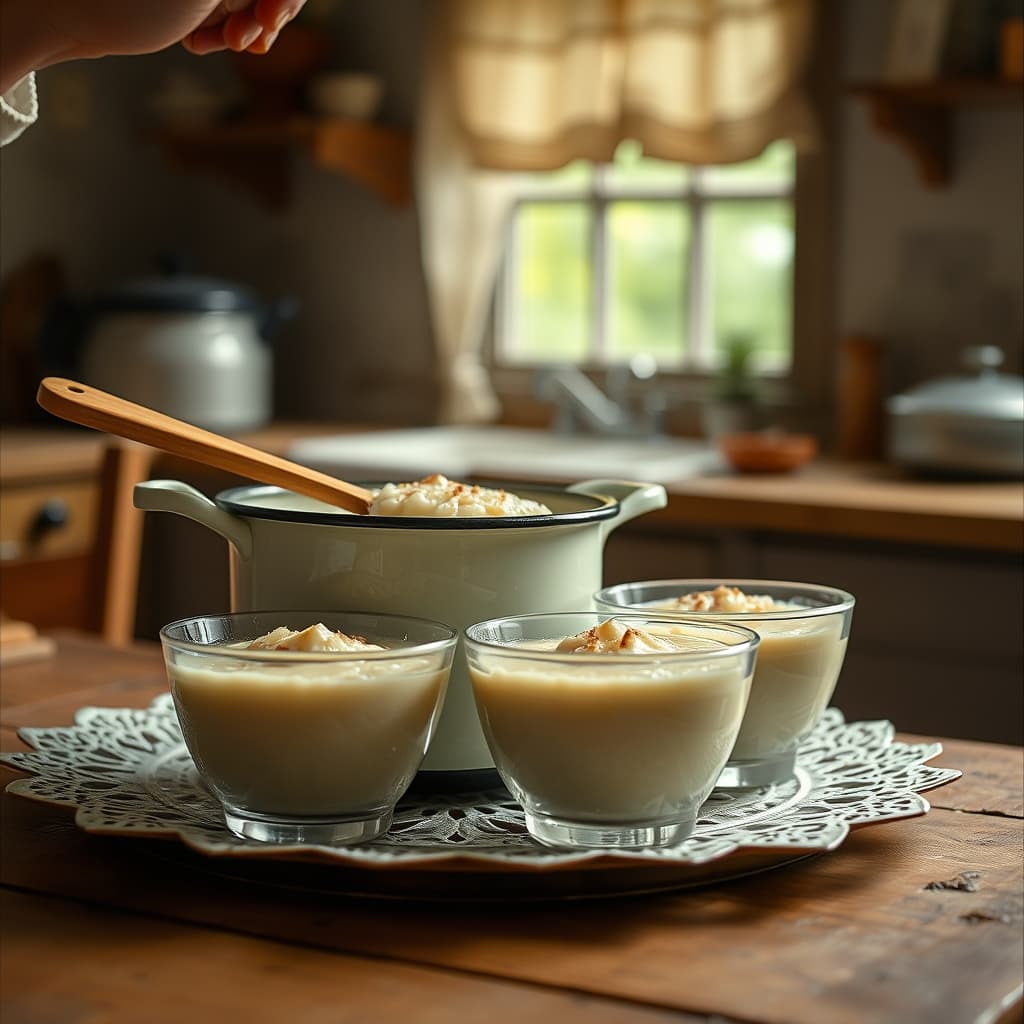
Some flavors do not remain only on the palate; they also bring back the order of the kitchen, the scent of the home, and the rhythm of time within the family. Cinnamon-scented rice pudding is exactly such a flavor. As milk slowly thickens over low heat, the circular trace left by the wooden spoon in the pot establishes the rhythm of calm time spent in the kitchen. The patient cooking of the rice, the addition of sugar at the right moment, the dividing into bowls, and the dusting of cinnamon like a fine rain are not merely steps in a recipe. They are part of the daily courtesy of old kitchen culture. That is why rice pudding is not simply a dessert, but a sign that recalls forgotten habits and turns the kitchen once more into a place of memory.
From the perspective of taste memory, rice pudding represented balance rather than display at old tables. It was a dessert made from familiar ingredients, yet impossible to prepare carelessly. One had to stay near the pot so the milk would not rise too high, follow the texture of the rice, avoid too much heat, and resist haste while letting the bowls cool. That careful process reminds us of periods when time in the kitchen was lived not through speed, but through rhythm. Today, in the shadow of packaged sweets and hurried consumption, many small domestic habits that have faded become visible again during the making of rice pudding. Tapping the spoon against the side of the pot to judge thickness, scattering cinnamon by hand, setting aside one bowl for a neighbor, or deciding who should receive the top layer of cream all belong to the old life of the home.
It is no coincidence that the scent of cinnamon strengthens this act of recollection. Smell is among memory’s most persistent pathways. Even when rice pudding is not baked, the atmosphere formed by warm milk and cinnamon together recalls childhood evenings, pre-holiday preparations, or the calm that followed crowded family meals for many people. In older kitchens, that scent often accompanied enamel pots, glass bowls, and trays edged with lace. Food was prepared not only for nourishment, but also to demonstrate household order and hospitality. Rice pudding possessed a simple yet elegant representative power within that world. It suited every home, pleased nearly every age, and settled more deeply into itself as it cooled.
Another reason it keeps old kitchen culture alive is that it preserves a way of sharing. Rice pudding was rarely only an individual indulgence; it existed within a system of distribution among many people. Bowls were lined up on the kitchen counter, one reserved for an elderly neighbor, one for a guest, one placed in the refrigerator for the children. Sometimes cinnamon was dusted into a small pattern on top, and sometimes the prettiest bowl was sent next door. These modest gestures showed that food was a means of creating social connection. The value of a dessert lay not only in its taste, but in with whom, in what order, and with what care it was shared. Cinnamon-scented rice pudding recalls forgotten kitchen habits precisely through this relational dimension.
When a bowl of rice pudding is placed before us today, what moves us is not only the familiar taste. More powerful is the culture of slowness, attention, and sharing standing behind it. Old kitchens were not merely places where food was made. They were spaces where family rhythm, hand skill, and everyday elegance were formed. Cinnamon-scented rice pudding reminds us that this culture can still be kept alive. Some recipes carry not only ingredients across time, but also behavior, a feeling for time, and a domestic ethic. For that reason, rice pudding is not a forgotten dessert. It is a memory of old kitchen discipline that can still be lifted with a spoon.
Cinnamon-Scented Rice Pudding: How Does It Recall Forgotten Kitchen Habits and Keep Old Culinary Culture Alive?