Eski Pano
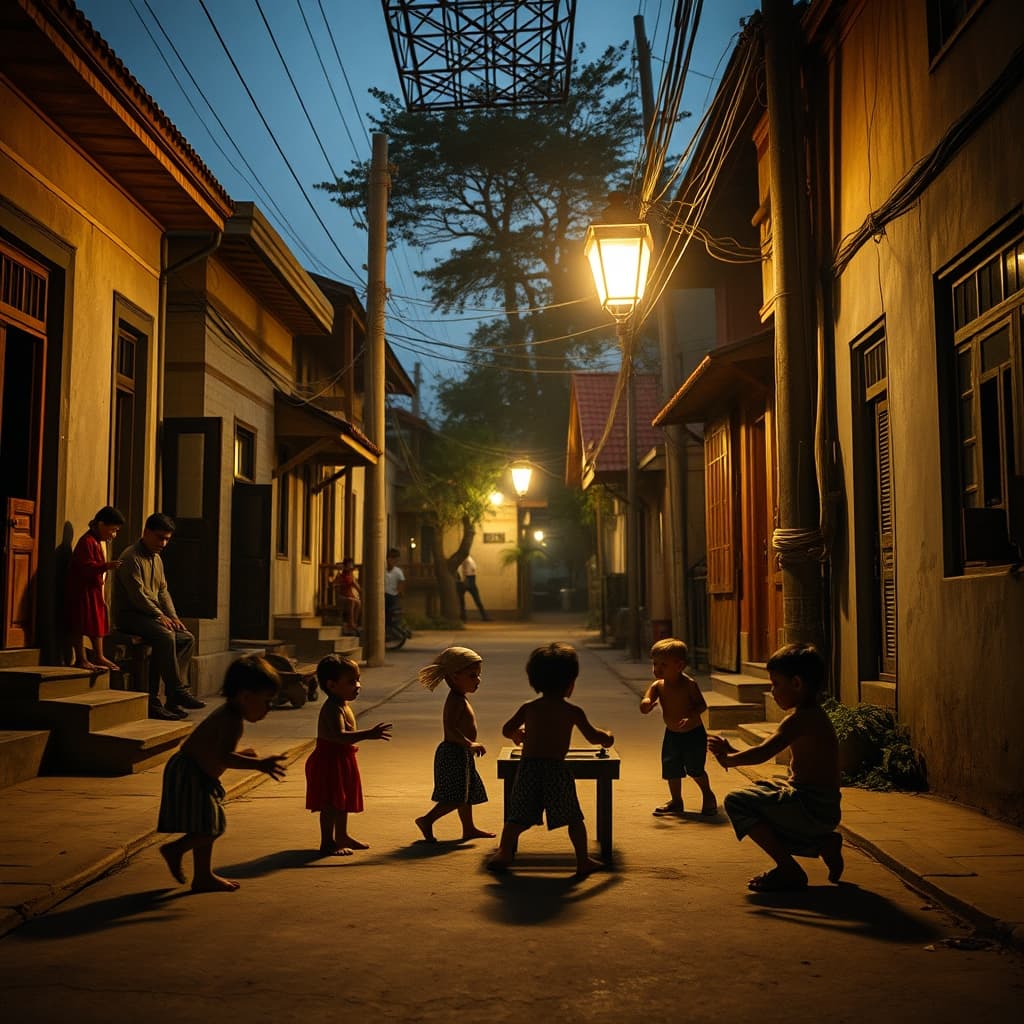
In the neighborhood, evening was often understood less from the color of the sky than from the lighting of the street lamp. The light did not arrive all at once, but with a slight flicker, and at precisely that moment the children’s game seemed to enter one more round. Even if they knew they would soon be called home, the children who had spent the day playing hopscotch, marbles, dodgeball, or hide-and-seek always found a way to stretch the last few minutes. The space beneath the street lamp was a safe threshold between the end of play and the beginning of night. There the neighborhood remained visible, and the eyes of adults still rested on the children. For that reason, those extended game hours were not only entertainment, but the quiet education through which a generation formed its fundamental sense of trust in the world.
From the perspective of neighborhood culture, those hours of play offer one of the liveliest images of communal life. In old streets, a child was known not only by family, but by the whole environment. The grocer at the corner, the woman seated at her doorstep, the grandfather watching from the window, or the neighbor knitting on a summer chair together formed an invisible circle of supervision. That watchfulness was protective rather than oppressive. Children’s noise, running, falling, and rising again were accepted as part of the natural order of life; when needed, a warning, a glass of water, or a small consolation could be found at once. The street lamp seemed to symbolize that shared protection. With its light, it illuminated not only the road, but childhood entrusted to many hands.
What nourished the feeling of safety was not only physical closeness, but the rhythm of repeated daily life. Everyone knew more or less who would come outside at what hour, in which corner a certain game would be set up, and whose voice would call from the window when darkness thickened. Predictability formed an invisible support for the child. Boundaries were drawn not by rigid walls, but by habit. The sentence “Come in when the lamps are lit” was a social sign more effective than a clock. Within that frame, a child could run, shout, race, and hide with ease because the way back, the familiar faces, and the voice leading home were all known. In the old neighborhood, security was built not through grand declarations, but through such small repetitions.
The fact that games stretched under the street lamp also shows that childhood was lived collectively, not only individually. Children of the same age group created a common world amid the smell of dishes leaving different houses, the radio heard from afar, and the occasional calls of mothers. The loser tried again the next day, a quarrel softened after a short while, and the younger child was usually granted some tolerance. In many ways, the play space served as an introductory classroom to social life. Waiting for one’s turn, following rules, learning how to object, looking after a friend, and stopping a game when it was time to go home were all early rehearsals for later human relations. The sense of safety was therefore nourished not only by being protected, but by belonging to a community.
When we remember those days now, what we miss is not only the game itself, but the surrounding trust that made play possible. The minutes prolonged beneath the street lamp offered a social frame within which a child could explore the world without feeling entirely alone. The neighborhood held the child like an invisible yet solid net, teaching through everyday life how freedom and limit could coexist. That is why those days remain bright in memory for a whole generation. Safety became a concrete experience through houses with open doors, neighbors known by name, children whose voices were answered, and streets where play could last a few minutes longer under the light.
The Days When Games Stretched Under the Street Lamp: How They Nourished a Generation’s Sense of Safety