 Eski Pano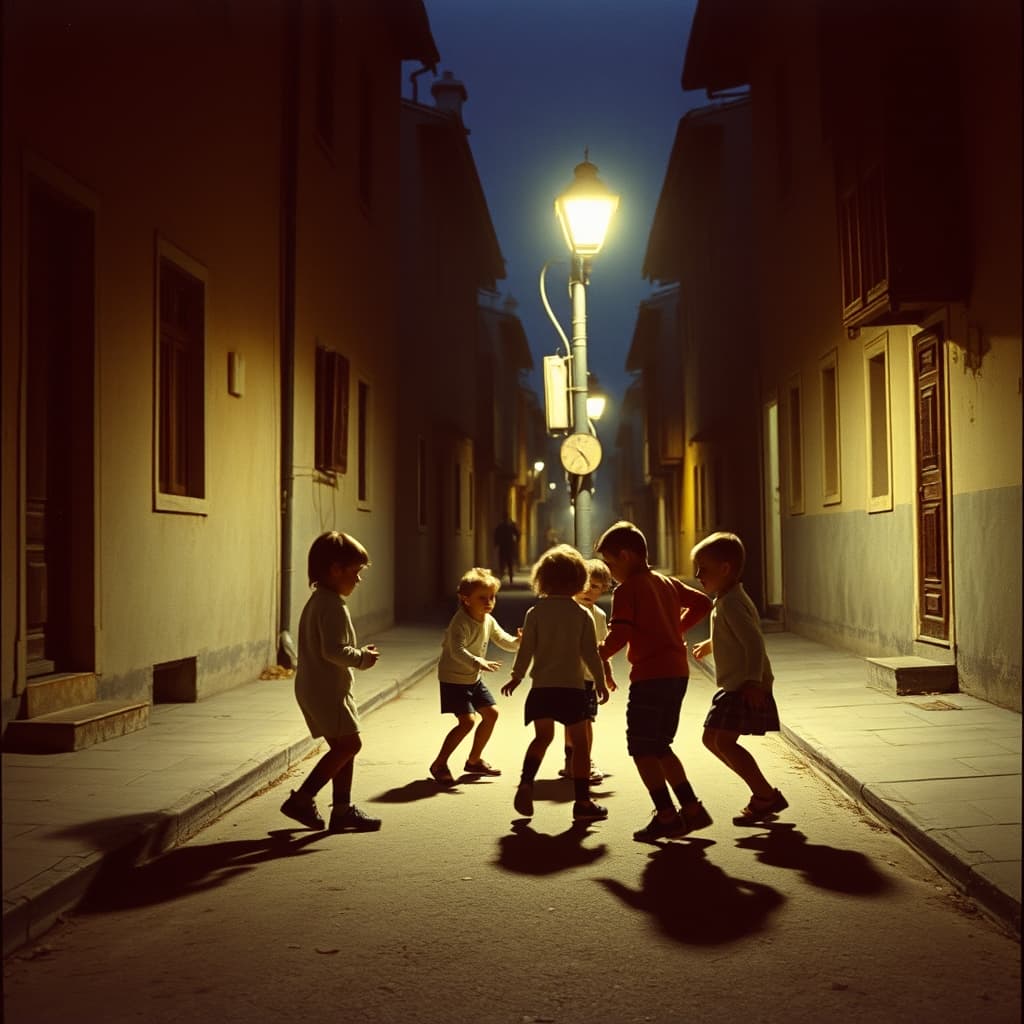
Under a streetlamp, evening play acquired a visible centre. The brightest ground suggested where a ball could be followed, a face recognised and a child called by name. Beyond that circle, details became harder to read. The lamp did not turn the street into a safe room; it created a boundary that children and adults interpreted while daylight receded.
Lighting strength, street layout, traffic and building positions varied, so one neighbourhood’s memory cannot define a generation. The useful question is how a particular pool of light changed behaviour. It could extend play for a short time, make supervision easier from a doorway and provide a familiar point at which the group gathered or separated.
The Bright Ground Changed the Game
Players adjusted to what they could see. A game might become smaller, slower or concentrated beneath the lamp. Objects crossing into shadow were harder to retrieve, and uneven surfaces could disappear from view. The illuminated patch was therefore not merely scenery; it influenced rules, movement and the decision to stop.
Children also negotiated position. The centre offered better visibility, while edges might be occupied by younger players or spectators. That arrangement could include or exclude. A fond recollection of “everyone under the lamp” should be tested by asking who actually played and whether age, gender or household rules kept others away.
Being Visible Was Not the Same as Being Safe
Adults could glance from windows, balconies, doors or nearby shops and recognise familiar children. This distributed attention contributed to trust, but it was inconsistent. A visible child could still face traffic, conflict, cold or a poorly lit route home. The lamp helped observation; it did not replace direct care or safe public design.
Trust was also relational. Adults knew which child belonged to which household, children knew who might carry a message, and repeated encounters gave warnings meaning. These networks could fail, and some residents may have felt watched rather than protected. Preserving neighbourhood culture means retaining both comfort and constraint.
The Light Became a Clock Without Showing Time
The lamp turning on, darkness deepening or a parent’s call could signal the final phase of play. Different homes set different limits. One child left early, another stayed because an older sibling was present, and the group changed before the last game ended. This was not a universal curfew but a series of household decisions visible in public.
Weather shortened or transformed the routine. Damp ground reflected light, wind discouraged standing still and cool air made a cardigan useful, but seasonal details should come from the remembered setting rather than be attached mechanically to a publication date. A photograph can show clothing and surface conditions; it cannot tell us the exact rule for going home.
Map the Edge, Not Just the Lamp
An oral-history map can mark the post, doorways, traffic route, shop and places beyond which children were not allowed. Ask where adults stood, how players crossed the road and what ended the session. This turns a glowing memory into a spatial account. It also reveals which paths were inaccessible or felt unsafe.
Current documentation involving children requires consent and privacy. Do not publish precise routines, names or addresses. Historical images should likewise be described cautiously; a bright streetlamp does not prove that the photographed neighbourhood offered equal freedom to every child.
What the lamp supported was a temporary, negotiated commons. Its pool of light made some movements legible and left others uncertain. Evening trust grew from recognition, repeated rules and the expectation that someone would notice a problem—not from illumination alone. Recording those limits preserves the warmth of the scene without converting it into a myth of effortless safety.