 Eski Pano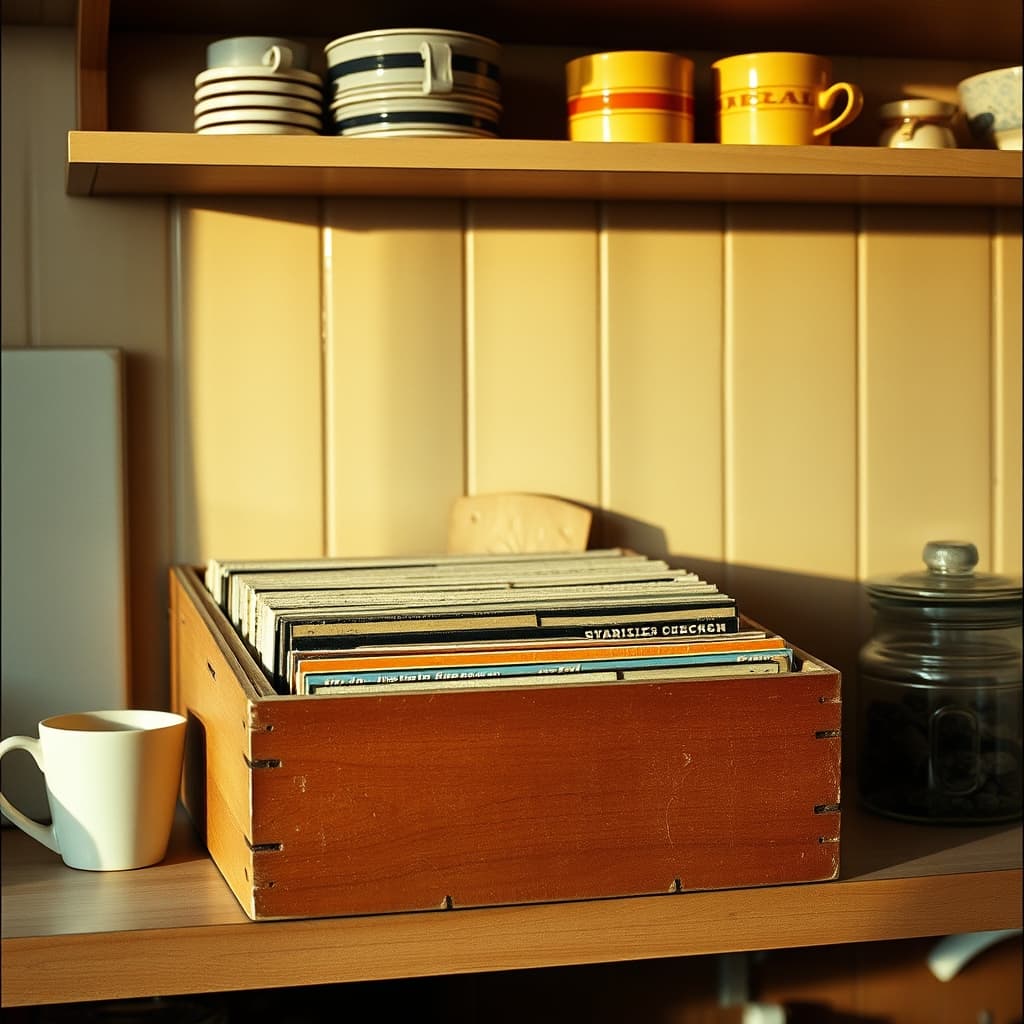
A record box on a kitchen shelf was not necessarily misplaced. In homes where rooms served several purposes, music lived close to daily work. The player might stand on a cabinet in the adjoining room, while frequently chosen discs remained within reach above cups, jars, or folded cloths. The arrangement joined cooking, conversation, radio listening, and recorded music without giving any one activity a dedicated room.
The box itself organised more than objects. Records might be grouped by performer, mood, owner, or frequency of use. A handwritten divider, shop sticker, torn corner, or changed sequence could reveal how the collection was navigated. Yet such clues require restraint. A worn sleeve proves handling, not the identity or emotion of every listener. Good archival description separates observation from family testimony and later interpretation.
A Container Shaped by Repetition
Record boxes appeared in wood, fibreboard, cardboard, plastic, and metal, with handles, lids, hinges, or open tops. Their dimensions reflected the discs they held and the need to carry weight without bending. Damage often gathered at the base and corners. A loose handle might show repeated movement between rooms; a faded side might record years facing a window.
Labels deserve close attention. A name can indicate ownership, but it may also belong to a shop, school, club, or later collector. Numbering can preserve a private catalogue whose key has been lost. Rather than removing stickers during cleaning, document them with photographs and transcriptions. Even an incorrect old label forms part of the object's history.
Why the Kitchen Shelf Was Risky
Convenient storage could expose records to heat, moisture, cooking grease, dust, and direct sunlight. Vinyl can warp when held at an angle or subjected to excessive heat. Paper sleeves absorb moisture and odours, while tightly packed records can suffer abrasion. A shelf above a stove or near a sunny window may explain damage that looks mysterious once the box enters a collection.
Preservation begins by changing the environment without erasing evidence. Records should stand vertically with stable support in a cool, dry place away from strong light and heat sources. Clean inner sleeves made from suitable materials can protect discs whose original paper sleeves are fragile. Original sleeves, inserts, labels, and the box should remain associated even if they require separate protective enclosures.
Selection Made the Collection a Family Archive
A record collection became meaningful through choice. Someone decided what to buy, borrow, keep, play at breakfast, or reserve for guests. Children learned which sleeves they could touch and how to hold a disc by its edges. Adults disagreed about volume or sequence. A record heard repeatedly during kitchen work could become connected to recipes, seasons, and voices without containing any of those things itself.
Playback history can be studied through spindle marks, fingerprints, groove wear, repaired sleeves, and notes, but playing a fragile disc also involves risk. Dirty equipment or a damaged stylus can harm the recording. Before use, collectors should inspect both disc and player, clean with appropriate methods, and consider professional digitisation for rare or unstable material.
The record box becomes an heirloom not simply because it is old, but because relationships remain intact: disc with sleeve, sleeve with annotation, collection with container, and object with verifiable memory. A romantic story about a box resting beneath a plane tree is less valuable than a precise account of where it stood, who labelled it, and how it was used. By preserving those connections, a modest kitchen shelf can be understood as part of a working family archive, where music was stored beside ordinary life rather than outside it.