Eski Pano
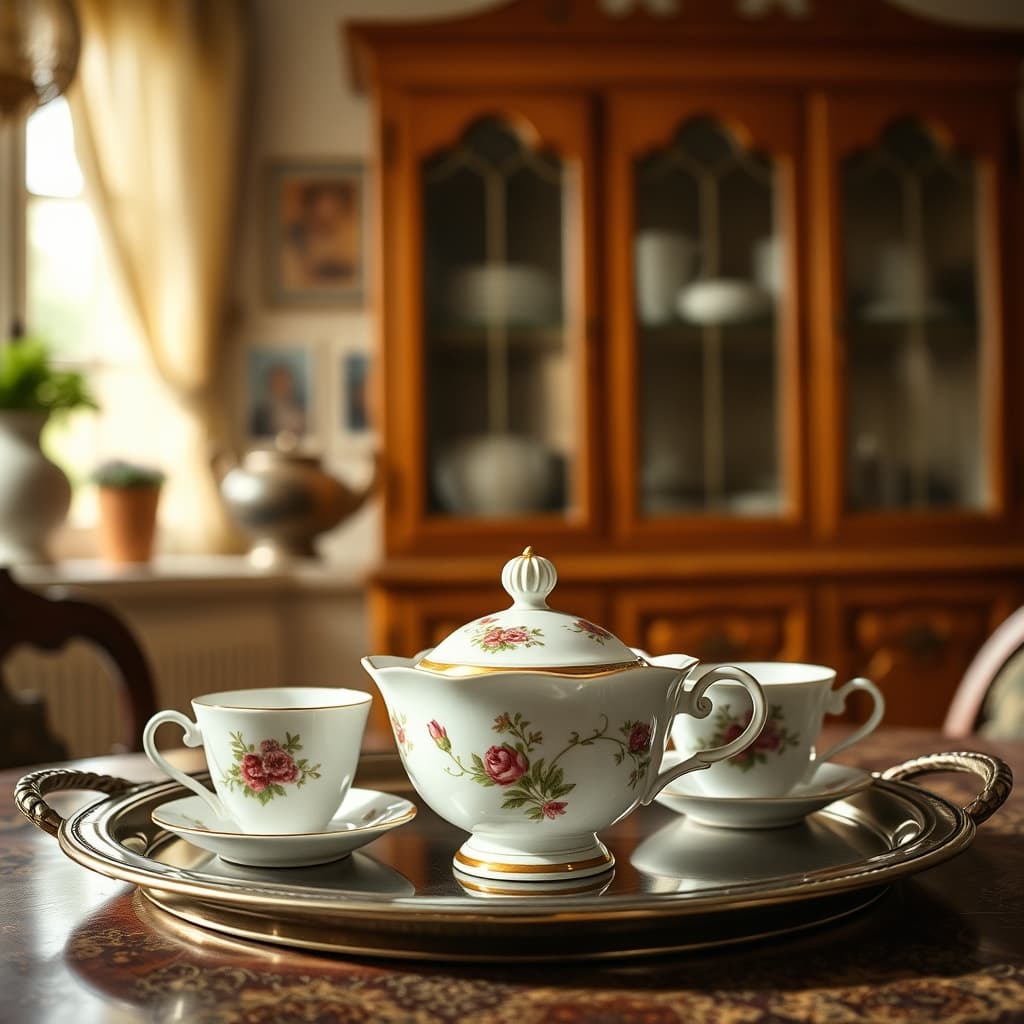
Some objects stand in the most visible place in a home without making any noise, yet they become the most stable witnesses of family history. The porcelain sugar bowl was exactly such an object. Resting in the glass cabinet of the living room or on the neatest corner of the dining table, it lived on the fine line between daily use and display. Even when the gold trim on its lid had slightly worn away, the delicacy of its handle and the floral designs upon it continued to receive special attention in many homes. The sugar bowl was not merely a container for sugar. It was a small but powerful symbol of care shown to guests, of the importance attached to tea time, and of the idea of an orderly home. That is why it was among the objects wrapped most carefully in newspaper during moves.
From the perspective of object stories, the sugar bowl was one of those items that placed an era's sense of taste directly into daily life. The porcelains used in homes reflected not only material means, but aesthetic expectation. Fine workmanship, raised edges, pastel roses, or delicate gold lines suggested that appearance mattered alongside use. Serving tea was not regarded as a simple necessity, but as a scene of domestic refinement. Even the way the sugar bowl sat upon the table belonged to that scene. It was expected to match the cups, to have its own small place on the tray, and never to be without its spoon. This attention shows that the taste of the period was built not on excess, but on measured elegance. People valued small harmonies more than large displays.
Its transformation into a memory accompanying the home through moves becomes meaningful for the same reason. The way an object is packed while leaving one home reveals the meaning placed upon it by a family. Heavy furniture is dismantled, curtains are taken down, books disappear into boxes, yet the porcelain sugar bowl often receives a separate package and a softer wrapping. Its breaking would feel not merely like the loss of an item, but like the loss of a sign of continuity within the home. In the new house too, its placement is rarely delayed. The rugs may still be unrolled and kitchen shelves not yet arranged, but once it takes its familiar place in a cabinet corner or beside the tea tray, the house begins to look more like home. Its presence says that although the space has changed, habit continues.
The way it reflected an era's taste was hidden not only in its form, but also in its use. When guests arrived, sugar cubes might be lifted with tongs; the household might use loose sugar daily but bring out the porcelain sugar bowl for special moments; children might be warned not to open its lid without permission. All of this enlarged the object's social role. It was no longer simply a tabletop item, but part of the choreography of domestic behavior. Elegance was often learned in exactly this way: through how an object was held, where it was placed, and for whom it was brought out. Despite its small size, the sugar bowl became a carrier of the home's dream of class, manners, and beauty. That is why even the smallest crack upon it could sometimes be discussed as long as a family story.
When we ask today why the porcelain sugar bowl appears so touching, the answer lies largely in its sense of continuity. It was like a small center that kept its existence with graceful insistence through years when homes were moved, curtains changed, and sofas replaced. Perhaps the taste of an era can be read most clearly in such objects: useful but not showy, decorated but not excessive, fragile yet never abandoned. The porcelain sugar bowl did not accompany the home through moves as a thing alone. It also carried an idea of what a home should be. It showed that order, elegance, and memory could meet beneath a single lid.
The Porcelain Sugar Bowl and the Memory That Accompanied the Home Through Moves: How Did It Reflect the Taste of an Era?