Eski Pano
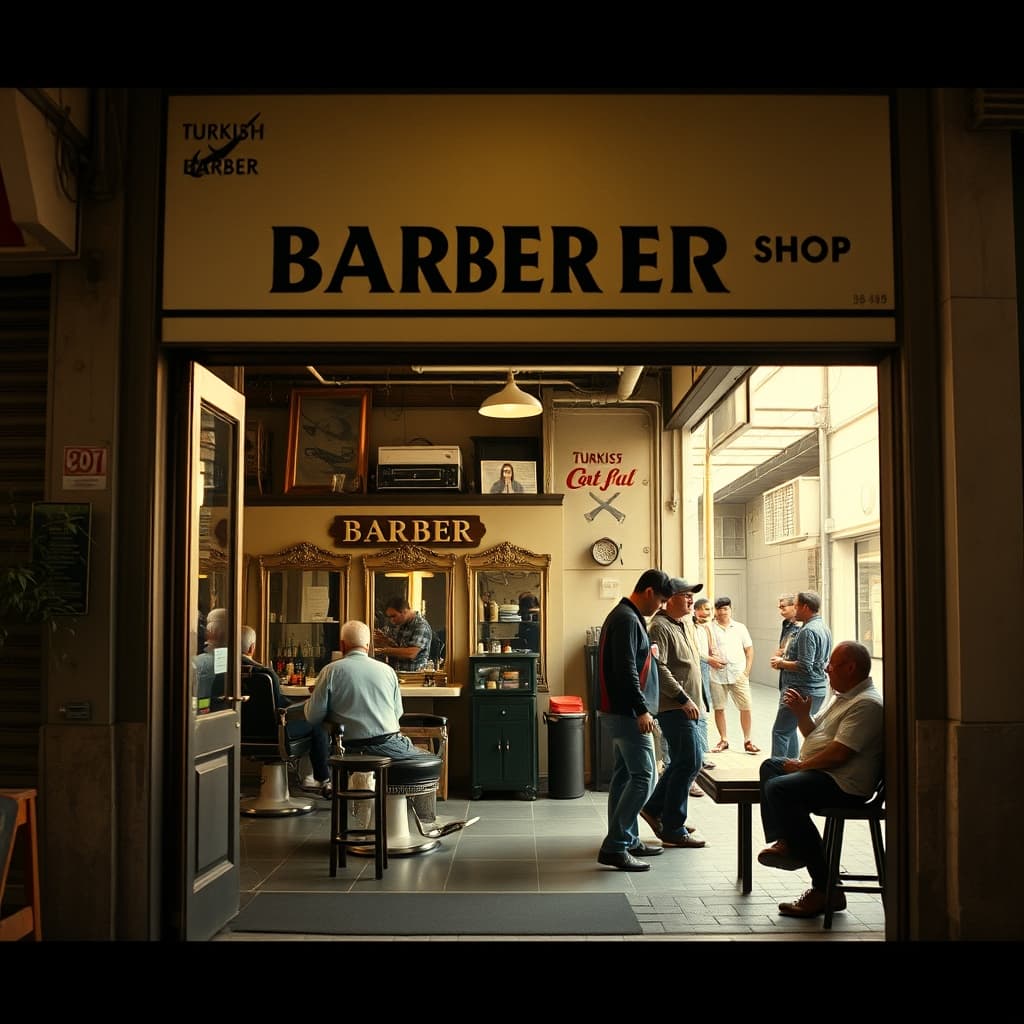
In the neighborhood, some shops were more than places where purchases were made, and the barber stood at the front of them. With faded hairstyle photographs on the window, the smell of aftershave inside, chairs lined up before mirrors, and sentences constantly interrupted and resumed, the barber shop carried the rhythm of the day outward. The door did not always close completely, and the matters discussed inside could spread as far as the pavement. While one customer was being shaved, another would enter, offer greetings, and sit down, joining the conversation even before his turn arrived. For that reason, the days when talk spilled out of the barber shop belonged not only to haircuts and shaves, but also to the neighborhood's way of hearing itself. People renewed not only their appearance there, but their ties of familiarity.
Within neighborhood culture, the barber's privileged place came from being a semi-public meeting point. A coffeehouse gathered a broader crowd, but the barber shop created more frequent and more personal contact. This is exactly where the bond with neighborhood tradesmen began to deepen. The barber knew not only a customer's hair, but also his family, his work, the son away in military service, or the grandchild preparing for exams. Such knowledge did not arise from curiosity as much as from continuity. Going to the same shop for years meant placing one's face and story into the neighborhood's shared archive. The barber shop was often among the first places where one heard when the greengrocer next door opened his shutters, when prices changed at the bakery, or when a move or wedding was taking place on the street. In this way it functioned as a node through which news and warmth moved across the local network of tradesmen.
The fact that conversation overflowed from the barber created a neighborhood warmth that exceeded the physical limits of the shop. In summer, the stool placed outside the door, the customers waiting outdoors when there was no room inside, and the small talk continuing after the shave turned the place into an extension of the street. Children came beside their fathers, watched themselves in mirrors, looked curiously at the cologne bottle, and learned without realizing it how the barber carried his scissors. Young men listened to the language of the shop while changing their hairstyle for the first time, and older men stopped by not only for grooming but to hear a few human sentences. This continuity showed that the relationship with neighborhood tradesmen was not based on need alone. The barber was like a keeper of memory, holding the pulse of the area without formalizing it.
Trust played a decisive role in strengthening the bond with tradesmen. The razor approaching the throat, the scissors moving around the head, the face covered in foam are moments in which a person inevitably yields himself to the barber. That surrender depends not only on technical skill, but on familiarity. The phrase "as usual" is a short summary of a silent agreement accumulated over years. One trusts not only the barber's hand, but also his word, and he in turn knows not only how his customer likes to be shaved, but also when silence is needed and when humor is welcome. Such a relationship reflected outward toward other shopkeepers as well. The butcher, tailor, or grocer mentioned in the barber shop automatically became part of that shared chain of trust. In this way the neighborhood connected itself shop by shop.
It is not difficult today to understand why those days of conversation spilling from the barber are remembered with longing. There, conversation was not a way of killing time, but a natural way of existing together. People did not know one another through quickly consumed fragments of information, but through repeated encounters. The mirrors in the barber shop reflected more than faces. They multiplied the neighborhood's tendency to turn toward itself. That is why the bond with local tradesmen could grow so strong. Hearing the same voices, speaking the same names, lingering a little in the same place strengthened the daily fabric of a community. The conversation that spilled from the barber onto the street was the neighborhood's own warm and self-sustaining language.
The Days When Conversation Spilled Out of the Barber Shop: How Did It Strengthen the Bond with Neighborhood Tradesmen?