Eski Pano
Some shops in old cities repaired more than objects; they repaired time itself. The watchmaker, the radio repairman, the small electrician, and the camera technician at the corner of narrow streets remain in memory for that reason. The Polaroid camera belongs exactly to that layer of remembrance. Whoever held it was not simply holding a device that took pictures, but also the thrill of waiting, the slow emergence of an image, and the nervous joy of adding one more moment to a family album. The unusual phrase "hope growing clearer with every turn of the antenna" seems to gather the whole spirit of analog life into a single feeling. In those years, many things really were adjusted by hand, corrected by instinct, and brought into focus through patience. The Polaroid was the machine of that patience, that curiosity, and that small miracle.
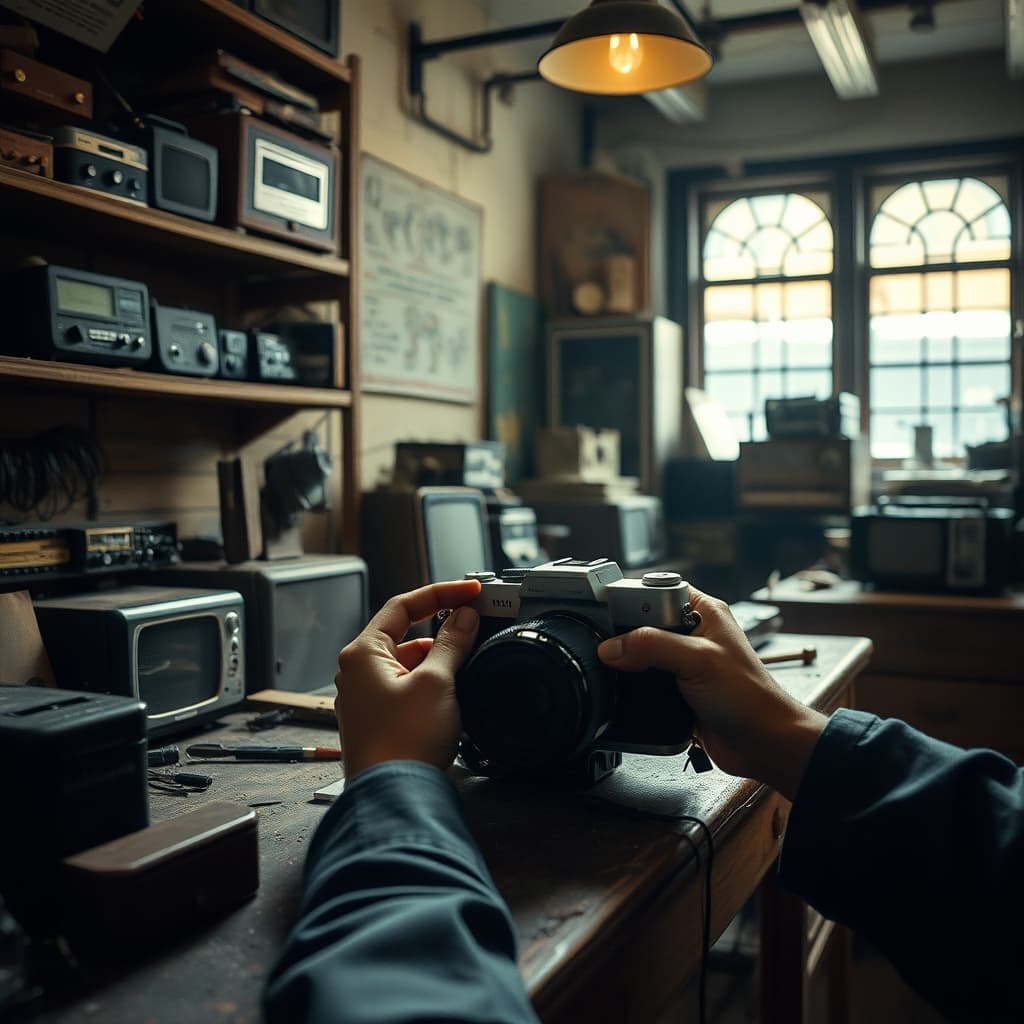
As technological heritage, the Polaroid mattered not only because it delivered an immediate result, but because it placed a memory into the palm as a physical object. A photograph was taken, and then everyone watched the same sheet of paper in silence, waiting to see how the image would settle onto its surface. This was a visual ritual utterly different from the speed of digital life. Sometimes the light was wrong, sometimes the film jammed, sometimes the battery weakened, sometimes the focus drifted, yet none of these flaws made the device worthless. On the contrary, they turned it into a technology that worked together with human hands. That is where the repairmen at the edge of old city life entered the story. They straightened hinges, cleaned lenses, opened the mechanism with care, and returned to the owner the feeling that the camera could keep going a little longer. In that way the object avoided the trash heap and continued to produce new memories through a repaired and extended life.
Part of the reason the Polaroid found a second life in repair shops was the emotional value attached to it. A family wedding portrait, a holiday morning group pose, the final frame taken with a son about to leave for military service, or a summer evening picture of neighborhood friends with their arms over each other's shoulders turned the camera into more than an ordinary device. When it broke, throwing it away was not easy, because what seemed damaged was not only a mechanical part, but a habit of making memory visible. A Polaroid left on the repairman's counter waited among other old things: tape decks with cracked lids, projectors with dead lamps, radios with fractured voices. Among them, the Polaroid carried the feeling that yesterday's photograph might still be drying. The repair performed on it was therefore emotional as much as technical.
If this scene at the edge of old urban life remains so vivid now, it is because repair itself was once a culture. The master listened not only to the object, but to its story on the customer's face. "It belonged to my father," "this was our childhood camera," "my daughter's first pictures were taken with this" became more important than screws and springs. The repairman responded accordingly. Sometimes he explained things at length, sometimes he lowered his voice while polishing the lens with a cloth, and sometimes he said, "it will not be like new, but it will live." That sentence may be one of the clearest summaries of the old repair culture. The aim was not perfection, but continuity. The second life of the Polaroid was born from exactly that insistence on continuation.
Today photographs may be taken quickly and forgotten just as quickly. Yet what keeps the Polaroid and the repairmen who revived it alive in memory is not only the image itself, but the labor surrounding it. Bringing the camera back to life was not just a technical success. It was a small victory proving that patience, craftsmanship, and loyalty to memory still had a place in the old city. That is why the Polaroid still feels as though it belonged to yesterday. Its story is not merely about an outdated object. It is about a feeling people refused to abandon when the mechanism failed.
Polaroid Camera: As Hope Growing Clearer with Every Turn of the Antenna Explains Why It Found a Second Life in the Hands of Repairmen at the Edge of Old City Life as If It Happened Yesterday