Eski Pano
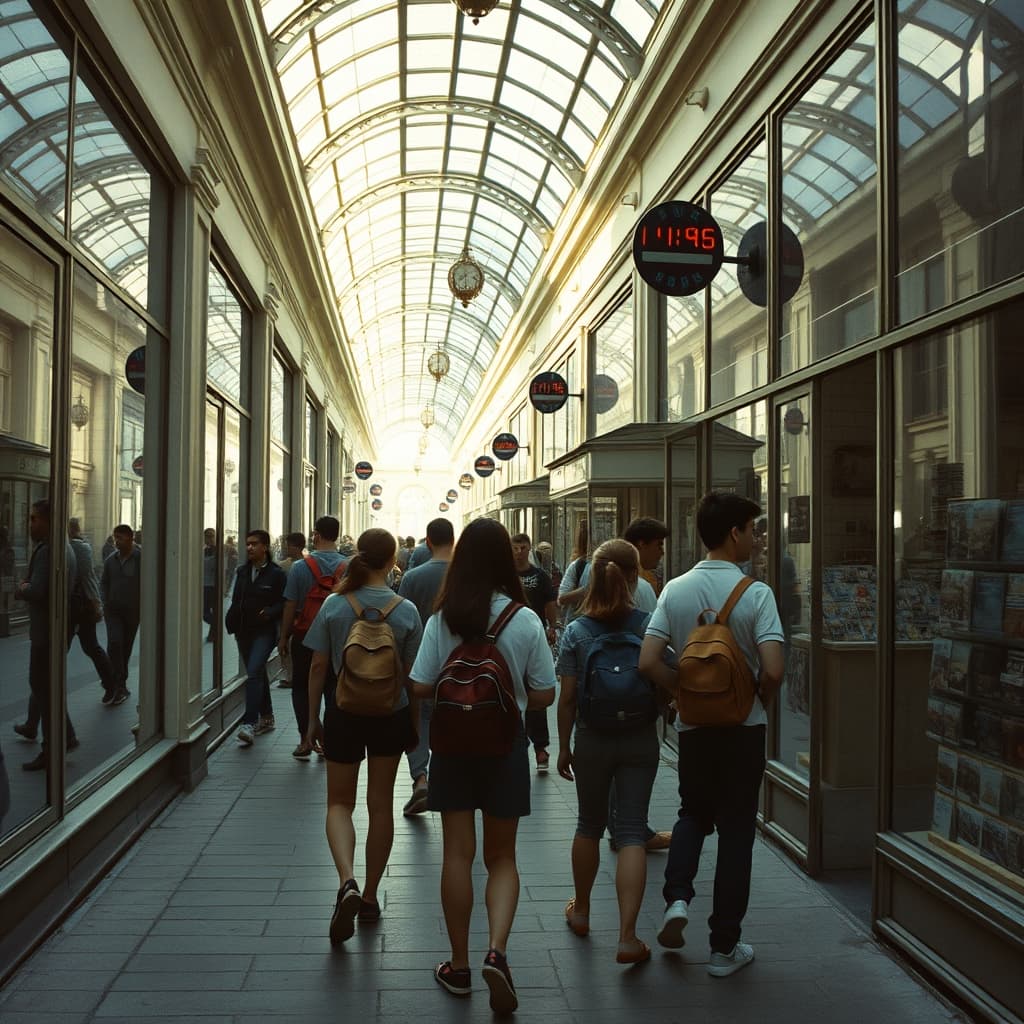
There was a time when the hour after school was not merely an interval for going home; it was a stretch of time in which youth slowly blended into the city and growing up began almost unnoticed while looking into shop windows. Once the bell rang, children and teenagers spilling into the streets would often avoid heading straight back to the neighborhood and instead draw a slight curve toward the arcades in the city center. The moment they stepped into those glass-roofed passages, the sound of the wind outside softened, shoe soles echoed more clearly on the stone floor, and mixed scents rose from the shops. A faint leak of music from cassette sellers, the paper-and-pencil smell of stationers, the metallic tone of tiny watch repair shops, the calm turn of revolving doors, all these details transformed school fatigue into another mood at once. Lingering in those arcades meant that youth had found itself a small stage.
Seen through the trace of time, that habit remains in urban memory as more than a way of wandering; it appears as a refined lesson in public life. Arcades were neither entirely street nor fully interior. Precisely that in-between condition offered young people a measured way of getting acquainted with the city. In that half-enclosed world, where adults stood at their shop counters, where the gaze of tradesmen felt familiar rather than harsh, and where objects displayed behind glass opened a field of imagination, the young learned to test their own steps. They looked at notebook covers, leafed through new magazines, and sometimes entered only to cool off or escape the rain. Yet the real matter was not shopping, but the right to linger. Arcades were places where looking without hurry, speaking a few minutes longer with a friend, and shaking off the weight of the day before reaching home were accepted as natural.
The phrase window-opening mornings belongs to this memory for a reason. The mornings of those years, especially in the days between spring and summer, were mornings when curtains were parted at home, classroom windows were opened, and the outside air was invited indoors during recess. On such days, the after-school hours stretched even longer, and young people did not want to keep themselves immediately within the walls of home. These walks, moving between the shaded coolness of the arcades and the brightness outside, also made visible the season’s bond with the city. The cleanliness of the morning still remained on them, while the crowd of the approaching evening slowly thickened. In those delicate transitional hours, youth felt neither as protected as childhood nor as burdened as adulthood; it stood somewhere in the middle, light and curious.
Another reason the arcades left such a deep mark is that they built memory not only through image, but through rhythm. Walking the same route again and again, stopping before the same display, seeing the steam of the same simit seller, waiting for a friend in front of the same bookshop, all this created an emotional tie with the city. Many people today remember their youth less through a neighborhood street than through the interior light of an arcade, the echo in a stairwell, or the pale daylight falling from a glass ceiling. Youth is often fixed in memory not by great events, but by small repetitions like these. The schoolbag growing lighter on the shoulder, pocket money being counted with care, the sudden realization of time after lingering too long in front of a record shop, all of these were written into the city’s personal calendar.
Looking back now, those after-school hours spent in arcades seem like a quiet summary of the days that warmed a generation. The reason they opened such a deep mark in urban memory lies not only in the time spent there, but in the emotional density of that time. Youth had found, in those half-shadowed passages, a measured freedom for itself. In places that were neither fully uncontrolled nor fully closed, friendship, curiosity, shyness, enthusiasm, and the act of growing up blended into the same walk. That is why window-opening mornings and after-school lingering in arcades are still remembered together: both belonged to the same seasonal feeling that lightened the heart, made the city more livable, and made youth more unforgettable.
In the Days That Warmed a Generation, When Lingering in Arcades After School Mingled with Youth: How Did Window-Opening Mornings Leave a Deep Mark on Urban Memory?