Eski Pano
There was a time when the most striking things in technology shops were not always the large devices, but the quiet helper objects standing beside them. The record cleaning brush was one of these. With its fine bristles, its handle fitting neatly into the palm, and often its velvet surface, it was an unassuming object, yet it represented the delicacy of the relationship people had with sound. For a generation that waited for the picture to sharpen as the antenna turned and tried to catch a beloved song through the crackle of the radio, that little brush was never merely a tool for dust. It belonged to the belief in clarity, to the analog elegance of systems that required care. Records resting on a table in mornings that smelled of notebooks, the turntable that would spin again in the evening after school, all these details placed the object quietly inside everyday life.
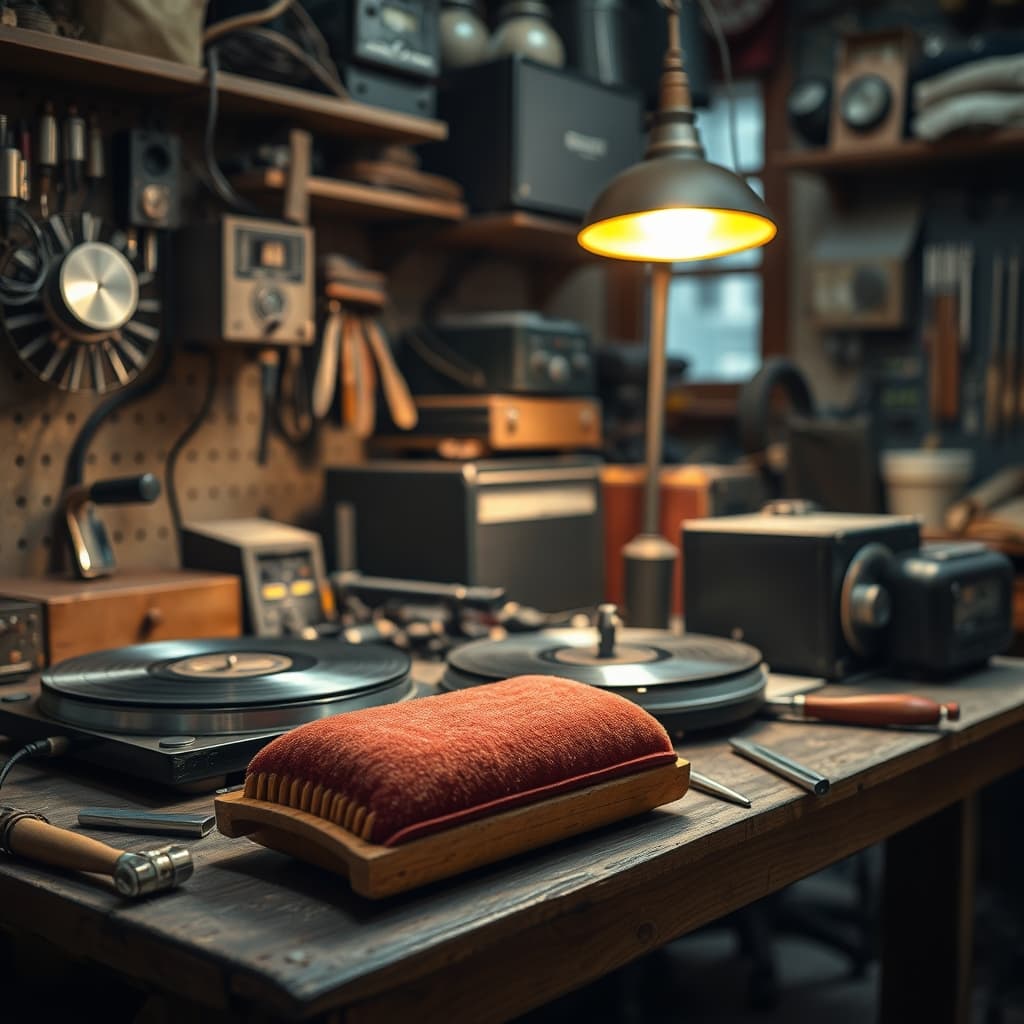
From the perspective of technological heritage, the deeper story of the record cleaning brush lies in the second life it found in the hands of repairmen. In older urban life, an object whose first task was over was not expected to go straight into the trash. Repairmen, radio technicians, and small electronics masters formed an in-between generation that gave objects a second meaning. Over time, the record brush became material not only for home listeners but also for repair benches. Its soft, controlled touch proved useful on dusty circuit surfaces, around turntable needles, and in narrow spaces where fine dirt gathered. Craftsmen used it sometimes for its original purpose, sometimes by adapting it to a different cleaning need. In that way, a small tool made for music turned into one of the quiet assistants of repair culture.
The fact that this transformation settled gently into urban memory was no accident. Cities used to be remembered not only through large innovations, but also through small repair scenes. In electronics shops opening onto narrow streets, antenna adjustments, the smell of solder, the warm surface of tube radios, and shelves lined with tiny tools stood side by side. While a customer waited for a device to be restored, the brush would appear for a moment between the technician’s fingers above the bench. At that moment, technology ceased to be merely machinery and was understood as a living arrangement that required maintenance and attention. The hope that sharpened as the antenna turned came partly from here: from the belief that something could work again, that sound could become clear again, and that what had broken had not entirely disappeared.
The second life of the record cleaning brush also reveals the ethic older generations built with objects. The value of a thing was determined not only on the day it was purchased, but by how long it could remain useful. For that reason, small tools entered a circulation from home to shop, from shop to repair table, and sometimes back to the home again. The velvet surface of the brush, its ability to lift dust without scratching, joined with the patient movements of a technician’s hand to make visible a culture that was not hurried in its approach to technology. In that culture, maintenance mattered as much as use. Preserving a device was part of daily knowledge, just as much as turning it on.
Today that little brush may seem insignificant to many people, yet for those who remember older city life it carries the discipline of another era. The record cleaning brush gathers together the patience felt while turning an antenna, the order of notebook-scented mornings, and the second chance repairmen gave to objects. That is why it entered urban memory not with noise, but as a fine line. Sometimes what remains is not the large machine itself, but a small tool that quietly collected an era’s hope, care, and desire to make things work again.
Record Cleaning Brush: Explaining Why It Found a Second Life in Repairmen’s Hands, Settling Gently into Urban Memory Amid the Hope That Sharpened as the Antenna Turned