 Eski Pano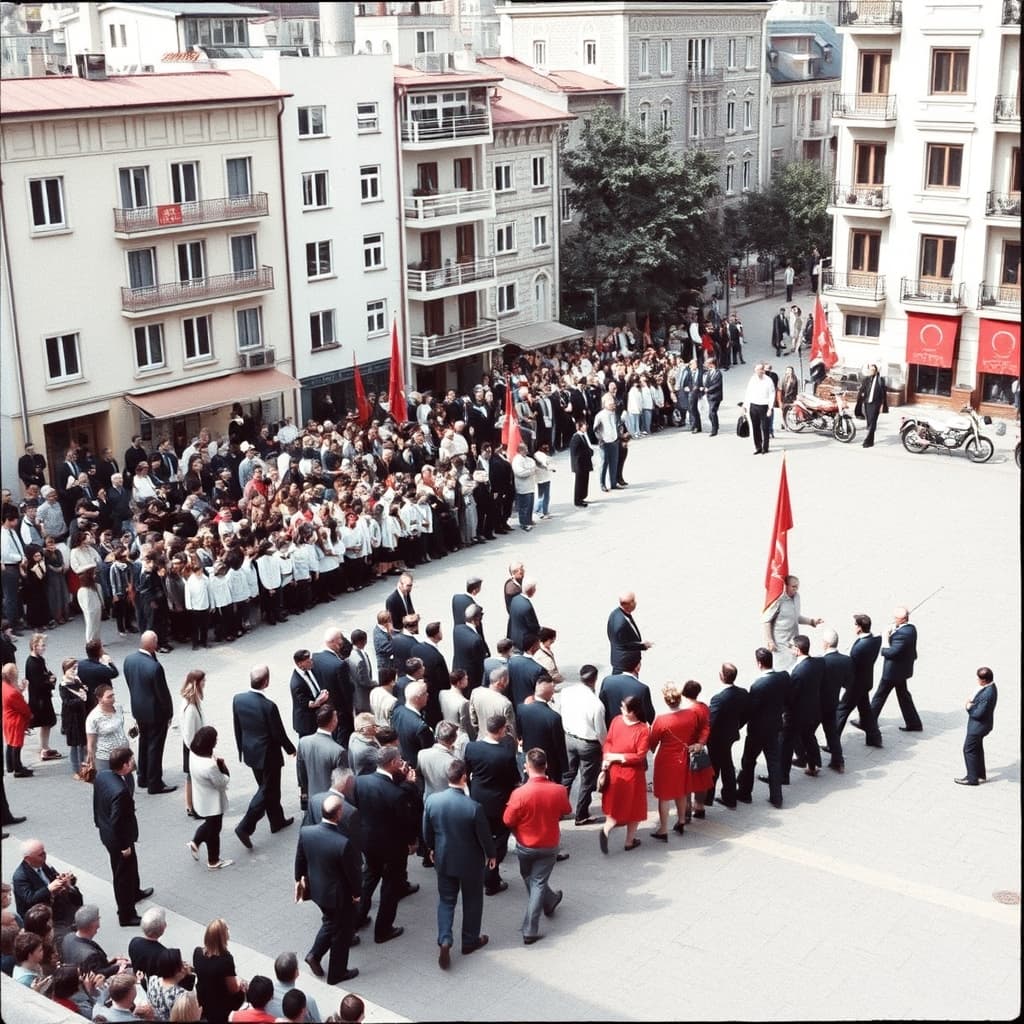
An official ceremony could make a familiar city square feel newly important. Barriers redirected traffic, flags and banners altered façades, a band tuned near the municipal building, and school groups waited in carefully arranged lines. Residents gathered at windows and pavement edges. The excitement came not only from the occasion but from seeing everyday space reorganised into a public stage.
Ceremonies varied by country, city, political period, institution, and purpose. National days, commemorations, official visits, inaugurations, military observances, school events, and civic anniversaries used different protocols. One photograph of a parade should not be assigned a date merely because flags are visible. Programmes, newspapers, municipal minutes, insignia, weather, uniforms, architecture, and transport restrictions must be compared.
The Square Became a Choreographed Route
Organisers selected arrival points, speaking platforms, wreath locations, marching directions, audience zones, and exits. The position of a monument or government building often shaped the sequence. Sound systems had to carry speeches without overwhelming nearby streets. A map of the route reveals institutional priorities and also the practical negotiation between ceremony, commerce, public transport, and residents.
Preparation involved municipal workers, cleaners, electricians, carpenters, drivers, police, medical teams, musicians, teachers, printers, photographers, and many others. Rehearsals could begin days earlier. Children and employees sometimes participated as part of institutional duty rather than personal enthusiasm. Naming this labour prevents the finished scene from appearing spontaneous or universally experienced in the same way.
The Audience Created Its Own Memory
Spectators found shade, lifted children for a better view, carried folding stools, bought snacks, and compared the programme with earlier years. Balconies provided informal viewing galleries. Family photographs often show the crowd more honestly than official images because they capture waiting, distraction, weather, and encounters at the edge of the event.
Participation was unequal. Ticketed stands, official enclosures, dress expectations, working hours, policing, gender conventions, distance, language, and disability access shaped who could approach. Rough surfaces, long standing, heat, cold, and inaccessible toilets made attendance difficult. An inclusive history asks not only who appears at the centre, but who watched from far away or stayed home.
Records Must Be Read beyond the Caption
Official photographs often favour symmetry, leaders, uniformed groups, and full grandstands. Press images may emphasise scale or drama. Private photographs can be misdated, while later captions compress several events into one memory. Researchers should retain original captions as evidence but add corrections transparently, citing the source and level of certainty rather than silently rewriting the record.
Public ceremony also needs responsible crowd planning. Clear routes, structural checks, weather measures, emergency access, safe electrical installation, accessible viewing, and reliable transport information protect participants. Loud sound, aircraft, fireworks, animals, and road closures require additional assessment. Historical reconstructions should meet current safety standards rather than reproduce risky practices for visual authenticity.
Squares changed after ceremonies passed through them. New monuments, widened roads, pedestrianisation, redevelopment, trees, lighting, and demolished buildings altered both protocol and public viewpoint. Repeat photography from verified positions can show how authority and daily life occupied the same ground across decades. It can also reveal when a remembered square has been confused with another location.
A Digital Nostalgia Archive can connect programmes, route maps, invitations, banners, municipal files, school records, music lists, traffic notices, photographs, films, and oral histories from workers and spectators. Official ceremonies remain vivid because institutions, families, and streets met in one concentrated scene. Preserving that scene means keeping excitement beside logistics, participation beside exclusion, and the polished platform beside the labour that assembled it.