Eski Pano
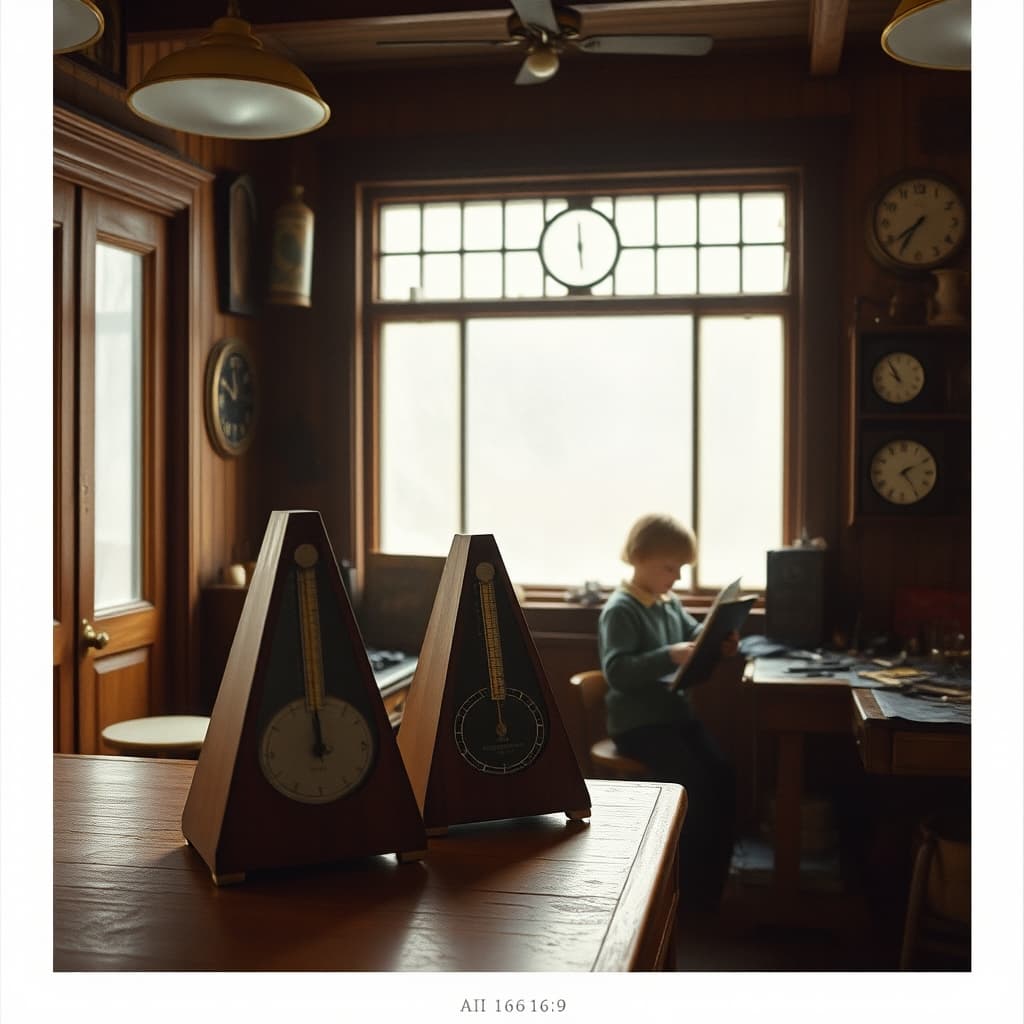
There was a time when certain sounds became sharper inside a home during winter days. The soft murmur of the stove, distant footsteps from the street, shapes drawn by fingers on fogged glass, and the steady tick-tock of a mechanical metronome on a table all gathered in the same room. These were the hours when a child studying music leaned elbows onto the desk and tried to keep up with the beat, while someone in the next room sewed, and glances resting against neighbors’ windows watched the heavy winter light outside. In those interiors, the metronome was not merely a tool for keeping tempo. It was a small machine that measured time, gathered concentration, and tied household silence to an invisible frame. Even years later, when it broke, it was rarely thrown away at once. More often it was carried to a repairer’s bench, because that ticking held not only music, but also the discipline and domestic order of an era.
From the perspective of technological heritage, the second life of the mechanical metronome tells a deeper story about the relationship between analog engineering and repair culture. Its spring mechanism, pendulum weight, fine gears, and unwavering rhythm made it valuable in both technical and emotional terms. In many homes, it was less visible than a piano or a violin, yet it still stood at the center of practice hours. When it stopped working, what was lost was not only function; it was as if a regular breath inside the house had been interrupted. Old repairers did not handle the metronome like a disposable object, but like a mechanism with character. They examined the crack in the wooden case, the balance of the pendulum, the resistance of the spring inside, and with patience restored its rhythm through a screw, a cleaning, or a small adjustment. That is why the metronome’s second life reveals not just craftsmanship, but the faithful bond an earlier generation kept with its objects.
Within the neighborhood, that culture of repair moved quietly yet powerfully. A child tapping the winter mist on a window could notice a neighbor entering the repair shop carrying a brown case, and inside that shop, among clocks, lamps, radios, and small musical tools, the metronome would find its place. The repair bench was often not where technology went to age, but where it returned to life. The mechanical metronome stood there not merely as a functioning object, but as a representative of domestic discipline, patience, and a search for order. Its steady rhythm was linked to the seriousness children learned while practicing, to the meticulousness of music teachers, and to the care families showed toward hard-earned possessions. Each repaired metronome therefore meant more than the mending of an object; it extended, a little longer, the measured rhythm of past life.
It is no accident that interest in the mechanical metronome has grown again today. Digital applications may be faster and more accessible, but they do not carry the revived weight of an object in a repairer’s hand, the warmth of a wooden surface, or the tangible time spread by a tick-tock through a room. The metronome’s second life reminds us that old technologies gain meaning not only through use, but also through their ability to be repaired. During winter hours spent leaning toward neighbors’ windows and tapping fogged glass, that rhythm sounding quietly behind children also shaped a generation’s sense of attention and patience. For that reason, the mechanical metronome is not just an aid to music practice. It is one of the most graceful witnesses of an analog world that lived by being repaired.
Hours Spent Beside a Mechanical Metronome: It Explains Why It Found a Second Life in the Hands of Repairers While Leaning Against Neighbors’ Windows and Tapping Winter’s Fogged Glass as It Passed