Eski Pano
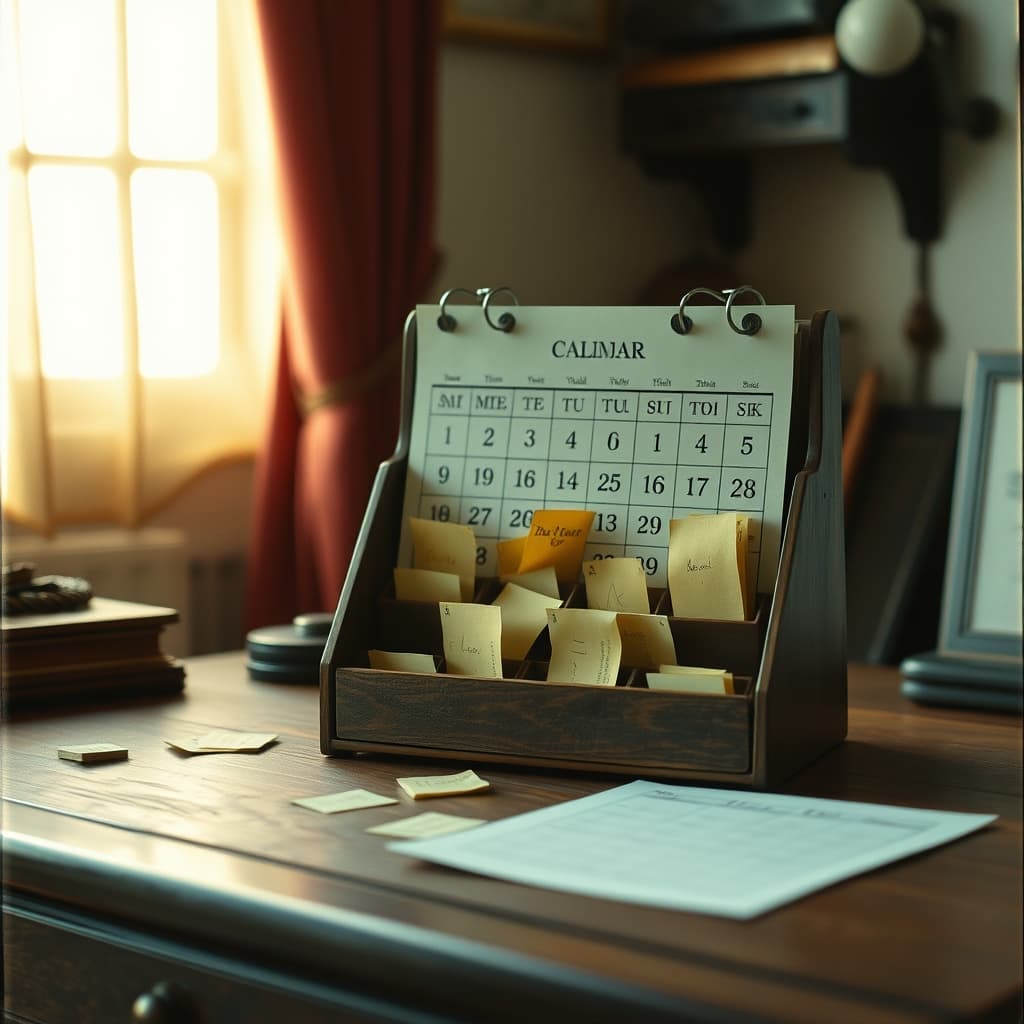
Some objects are not large, yet the moment one looks at them they call back the time of an entire room. The desk calendar holder is such an object. When it emerges from the bottom of a chest, from among yellowing letters, drawer cloths, and small household items set aside long ago, it appears simple at first glance. Yet the slight wear on its metal feet, the narrow slot where the date cards once stood, and the quiet trace of days that used to rest upon it lift it out of ordinariness. Even if its pages are long gone, the holder remains, because it is not merely an apparatus that carried dates. It is an elegant witness to the way time was once arranged inside the home. That is one reason it shines immediately in the eyes of those who love nostalgia.
From the perspective of object stories, the desk calendar holder recalls an older balance between use and aesthetics. There was a time when desktop objects were chosen not only to function, but to give order and character to a space. A pen stand, an inkwell, a small paperweight, and a calendar holder together established the discipline of a work corner or sitting room. It might stand on a father's desk at home, on an accountant's counter in a shop, or on a small side table beside the telephone. Turning the page each morning was a quiet gesture announcing that the day had begun. For that reason, the holder symbolizes more than utility. It carries a daily rhythm belonging to an older understanding of time, from years when even looking at the date was more tactile and more ceremonial.
Its delicate story begins precisely in the fact that it survived at the bottom of chests. Such objects are often kept not merely because they were never thrown away, but because someone sensed they might one day be remembered again. During a move they were wrapped in newspaper; while clearing a drawer someone would say, "let's keep this too." Even after their fashion had passed, if they were not broken they continued to be stored. Years later, when a chest is opened, the calendar holder suddenly appears, and the person who finds it remembers not only the object, but the domestic order surrounding it. In which room did it stand? Who turned the page every morning? Were notes left beside it? How did the red numbers of holidays look? Its delicate story is made of such small details. The object itself is light; the time it summons is heavy.
One reason nostalgia enthusiasts are drawn to it so quickly lies in the restraint of its design. It is not showy, and for that very reason it feels trustworthy. Brass, aluminum, or Bakelite touches; a form that is simple yet balanced; sometimes rounded feet, sometimes a linear face that carried lettering: all speak of a period when an object of use also bore aesthetic discipline. Today digital calendars operate invisibly, while the desk calendar holder made time visible and touchable. Tearing off a page or turning a card told both the hand and the mind that a day had passed. That physical contact is one of the strongest sources of its nostalgic power. When a person looks at such an object, one sees not only an old design, but a slower-moving time.
The answer to why a desk calendar holder discovered in an old chest shines so quickly today lies in the fact that it carries memory in a form both modest and dense. It is neither a grand antique nor a completely useless remnant. On the contrary, it is a small object that once carried one of daily life's simplest rituals with aesthetic seriousness. That is why, when we look at it, domestic order, desk-side quiet, morning light, and a life advancing one turned page at a time all become visible together. The lovers of nostalgia see that brightness not on its surface, but in the feeling of time leaking through it. With its delicate story rising from the bottom of a chest, the desk calendar holder reminds us that sometimes the smallest things are the clearest summary of an era.
The Desk Calendar Holder and the Delicate Story Emerging from the Bottom of Chests: Why Does It Immediately Shine in the Eyes of Nostalgia Enthusiasts?