Eski Pano
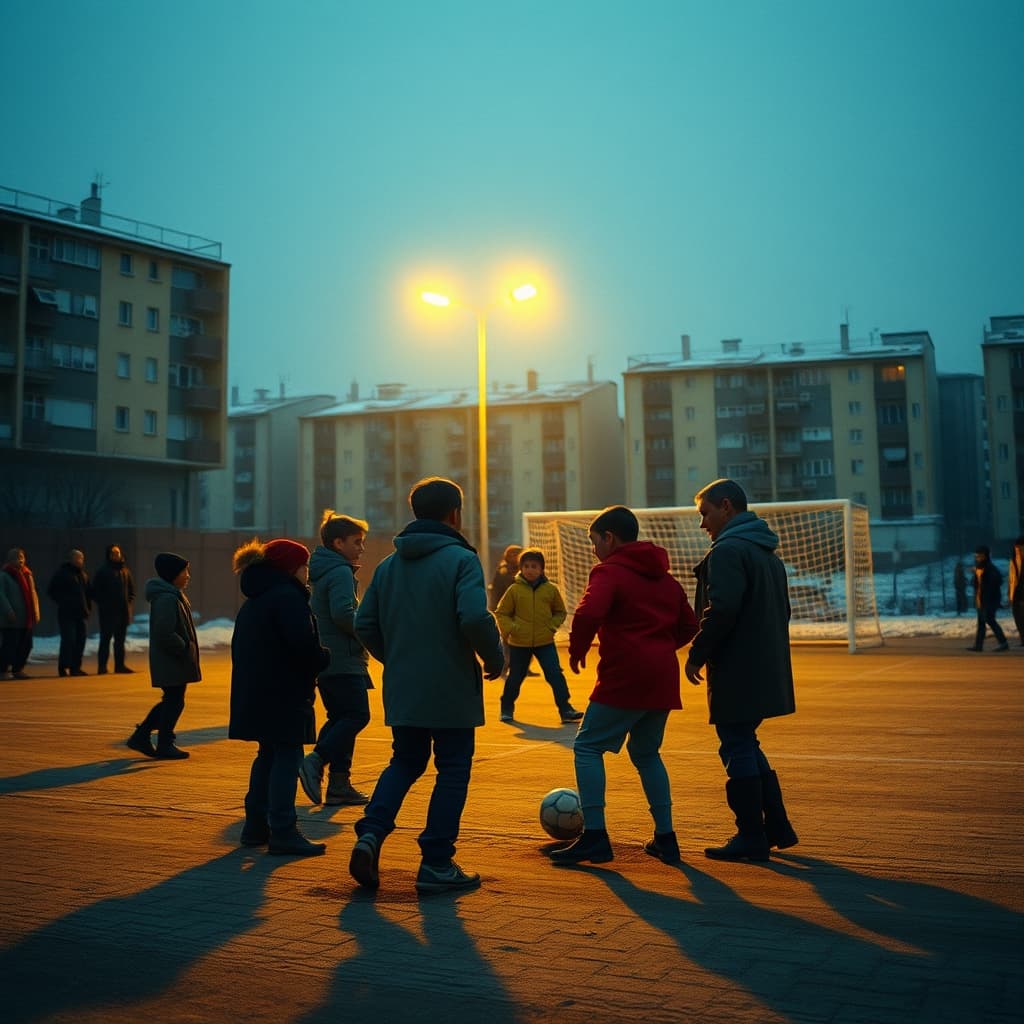
There was a time when winter evenings fell early, and the yellow light of street lamps spread like a fine mist through apartment alleys and empty lots. While the dust of the day's neighborhood match still clung to the edges of children's shoes, the story of one disputed goal became the real game of the evening. One child said the ball had crossed the line, another insisted it had bounced back from the wall, and another swore it had touched the post together with the goalkeeper's hand. That goal stopped being a mere position in play and turned into a shared memory scene, retold beside the stove, at building entrances, in front of the grocer, and on the school road the next day. The reason it was never erased from childhood memory lies precisely there: that moment produced a feeling of sharing and belonging larger than the game itself.
Within neighborhood culture, these disputed goals reveal that children were not only playing football; they were also learning how to argue, persuade, object, and build a common narrative. In neighborhood matches there was often no real goal line, no referee, and no proper uniform. Stones became goalposts, a wall corner counted as the line, and sometimes the edge of the pavement served as a boundary. Rules were not always fully set before the match; they were often shaped through negotiation during play. For that reason, the question of whether a goal counted was never only about the score. It concerned a sense of justice, relations of friendship, and the spoken law of the neighborhood. Children were building a world of their own and defending the fairness of that world with their own voices.
What makes these memories of winter nights special is also the feeling added by season and setting. Darkness had already fallen, mothers had called from windows, hands had turned cold, yet the effect of the game had not dissolved. Even after returning home, the match continued in the mind. One child's coat still carried the smell of sweat, another had the mark of a fall on the knee, but each remained fixed on that final moment. It was retold at dinner to an older brother, debated again with a neighbor in the stairwell, and reenacted in the schoolyard the next morning almost like a live radio broadcast. In this way, the disputed goal ceased to be a single instant and became part of the ongoing narrative of the neighborhood. It changed slightly with every retelling, and for that very reason it lasted.
The reason such goals never vanished from memory also lies in how vividly childhood experienced justice and drama. The controversies of large stadiums belonged to the distant world of spectators, but the goal in the neighborhood match existed inside one's own breath, run, and fall. That made it more real. Sometimes one team would complain for weeks that the goal had never really counted; sometimes the desire for a rematch carried into the next game. Hurt feelings entered, laughter entered too. Yet all of this taught children how to live together, compete, and reconcile. The disputed goal was more than an uncertain moment of play. It was a small rehearsal for social life.
Today, in a world of digital games, recorded footage, and clear rules, those old neighborhood matches seem even more precious. What remains in childhood memory is not only football, but a sense of justice formed through their own words, a legend they created together, and the communal thrill of winter nights. No one can now prove for certain whether the ball crossed the line or not. But that uncertainty is exactly what made it unforgettable. The contested goals of neighborhood matches carry the incomplete yet vivid world of childhood. A story born from ambiguity leaves behind a memory as powerful as friendship itself. And some nights, even when the final score is forgotten, the argument over that one goal continues to light the whole neighborhood.
The Contested Goals of Neighborhood Matches on Winter Nights: Why Were They Never Erased from Childhood Memory?