Eski Pano
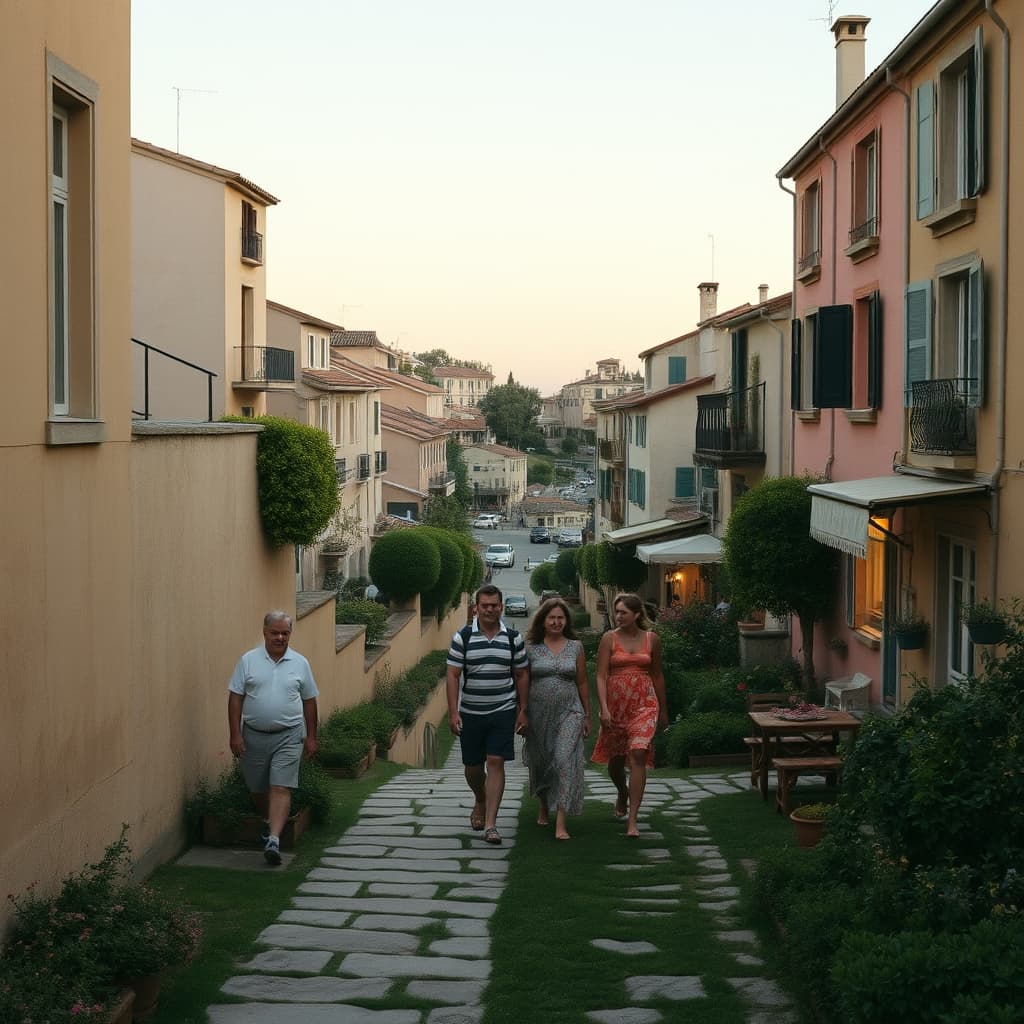
There was a time when a summer evening began not by the clock, but by the softening of the light. In coastal towns, as the sun withdrew from the sea, the stone paths in front of houses did not cool at once, but kept the day’s warmth in a fine and patient way. People did not hurry at that hour. Windows were opened, curtains swelled gently, the sound of plates being cleared came from kitchens, and in the gardens a scent rose that mixed damp earth with linden. What people called the evening walk was never just a walk. It was the daily discipline of summer itself, the town quietly taking its own pulse. Families moving toward the shore, fathers speaking more slowly inside white shirts, children with ribbons tied into braided hair, and mothers carrying a small bag all stepped into the street as if answering the same invisible call. Those summers seem brighter in memory partly because they moved according to a shared rhythm.
Seen through the trace of time, evening walks were almost the social calendar of old coastal towns. People who had withdrawn all day into work, home, or shop became visible again with the evening coolness. Benches along the waterfront, the pavement passing in front of the tea garden, and faint music coming from a municipal loudspeaker built the public life of the town without noise. Linden blossoms in the gardens, or the shade of trees carrying that scent, gave those walks an almost ceremonial softness. One person greeted another, a nod answered in return, children ran a little ahead and then returned to the pace of their families. The spirit of those old hours lies exactly there: time was not something to be consumed, but the vessel of an evening felt together.
The reason this ritual remains so bright in memory is not only the view of the sea. What moves us more deeply is the way small details of ordinary life completed one another. The mild iodine scent coming from the water mingled with honeysuckle falling over garden walls, with linden, and with the smell of courtyard stones newly splashed with water. The tailor making a final adjustment before closing the window display, the sound of an ice-cream seller’s metal scoop, and the chairs outside the coffeehouse inching closer to the street all gathered the town into the same evening feeling. For children the walk carried the hope of ice cream or soda; for the young it offered the possibility of glances exchanged from afar; for adults it was a way of quietly loosening the fatigue of the day. The gardens were therefore not mere decoration, but living spaces that shared the feeling of evening with the street. Turning to the scent of linden, they softened the passage between home and public life and made people feel that summer was truly being lived.
Looking back now, the reason those summers appear brighter is hidden in that measured richness. Life was not easier, yet the value of evening was more clearly felt. People did not end the day before a screen, but in the street and on one another’s faces. The evening walk was a silent text through which the town rewrote its memory every day. The linden scent drifting out of gardens, the shadows lengthening by the shore, and the familiar faces passing along the same road at the same hour tell us that what is longed for is not only beauty, but belonging. Perhaps that is why those summers seem more luminous from a distance. What shone was not only the sunset, but those hours in which people were visible to one another, and the gardens turning to the scent of linden remain the most graceful memory of that shared visibility.
Summers in Those Old Hours That Carried the Spirit of the Era, When Evening Walks in Coastal Towns Turned into a Ritual: Why Do Gardens Turning to the Scent of Linden Look Brighter in Memory?