Eski Pano
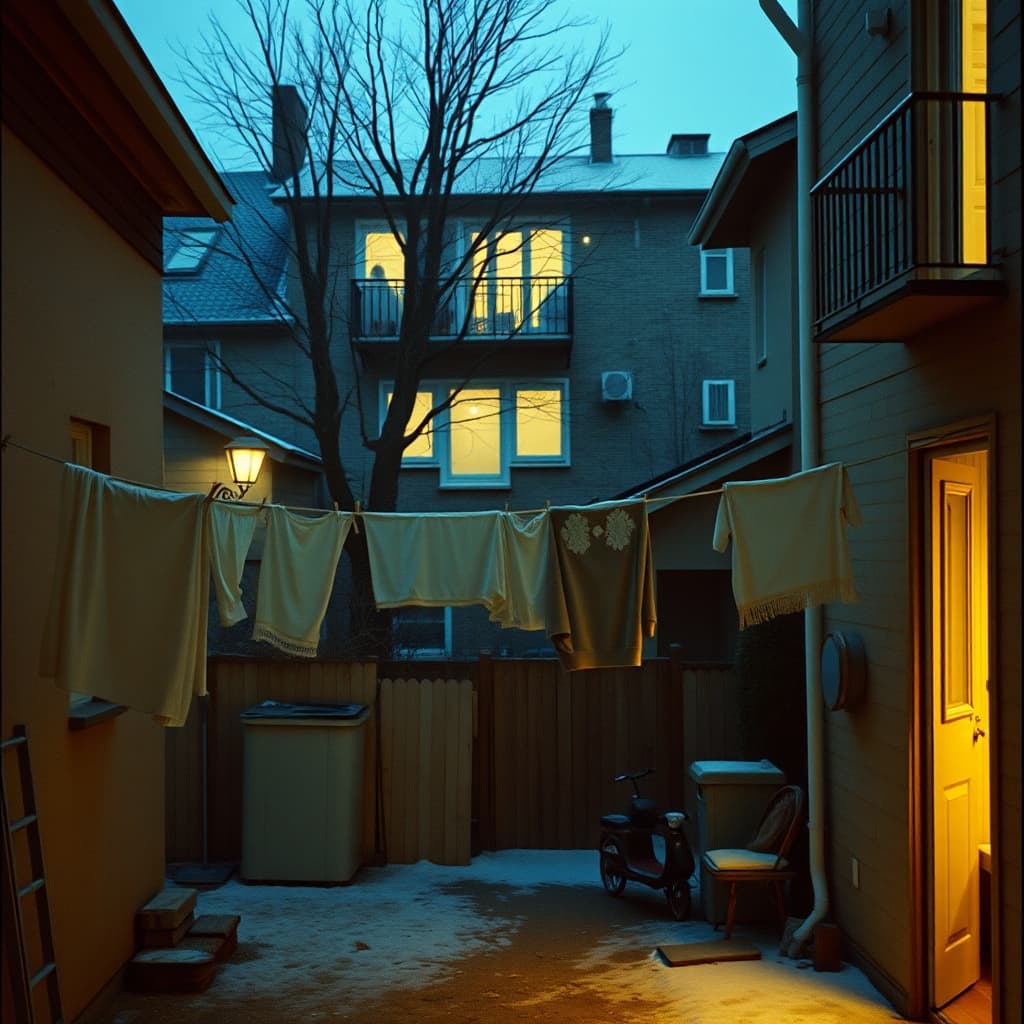
There was a time when winter nights fell early, and the clotheslines stretched between apartment gaps and courtyard houses continued to carry the traces of daytime life. As the damp cold of evening settled on the paving stones, the stiffening edges of wet sheets, the slight movement of children’s sweaters in the wind, and the yellow glow of balcony lamps gave the neighborhood a different kind of closeness. Food aromas leaking from windows, a radio heard from far away, and short sentences exchanged at doorsteps gathered around that image. At those hours, the clotheslines were not merely an extension of housework; they were like visible lines of neighborhood life itself. Every hanging piece of fabric left a small sign of how the day had passed inside that home, and the neighborhood knew one another precisely through such ordinary details.
From the perspective of neighborhood culture, the warmth of old districts depended greatly on this visible everydayness. Unlike today’s closed apartment life, domestic labor did not remain fully outside the street. Women calling out to one another while collecting the last laundry at dusk, a neighbor warning that rain was coming, children continuing their games by bending beneath the lines, all built the shared rhythm of the quarter. Even if the winter night was harsh, these small contacts warmed the atmosphere. In a sense, the clotheslines made visible the invisible tie between homes; the order of one household was not entirely separate from the attentive awareness of another. The neighborhood’s warmest scene was formed exactly there: everyone continued with their own life while naturally taking the presence of others into account.
Part of the reason this image remains unforgettable lies in the simplicity of old neighborhood aesthetics. A red child’s scarf seen among white sheets, the steam of shirts newly lifted from an enamel basin, dim light touching the wall, and the occasional click of clothespins carried a more authentic poetry than today’s designed nostalgia images. This was because the scene required no special effort to be arranged; it rose from lived life itself. On one side tea brewed on the stove, on the other side there was the rush to collect the laundry before it froze. For neighborhood residents these were ordinary tasks, yet that very ordinariness created the warmth of older life. People sensed not exactly what the other household was eating or wearing, but the rhythm in which life was flowing.
The winter view formed among the clotheslines also held a special place in childhood memory. For children, passing under those lines was like moving through a small labyrinth; for adults, it was one of the final duties that said the day was not yet over, though the home was being gathered back into itself. Sometimes a hand reached out to help a neighbor bring down a sheet hung too high. Sometimes clothespins ran short, and a few were borrowed from the next door. These tiny exchanges remind us that what made the old neighborhood warm was not grand acts of solidarity, but small acts of help. Human ties were built not through large declarations, but through simple phrases such as, “If it’s still on the line, I’ll take it down.” For that reason, the clotheslines carried not only cloth, but also a sense of trust.
Looking back now, it becomes easier to understand why the neighborhood scene formed among clotheslines on winter nights appears so warm in memory. That scene represented a way of living in which neighbors were aware of one another without becoming a burden to one another. There was no hard boundary between home and street; one person’s light, another’s voice, someone else’s laundry, and another’s warning all belonged to the same evening. Part of the warmth of old neighborhoods came from here: from the fact that while everyone lived their own life, they still produced a shared atmosphere. However sharp the winter cold might be, the everyday image swaying among the clotheslines turned the neighborhood into a place warmed by human hands. What remains in memory is exactly this: a deep feeling of neighborliness rising out of ordinary work.
Why the Neighborhood Scene Formed Among Clotheslines on Winter Nights Was the Warmest Scene of Old Neighborhoods