 Eski Pano
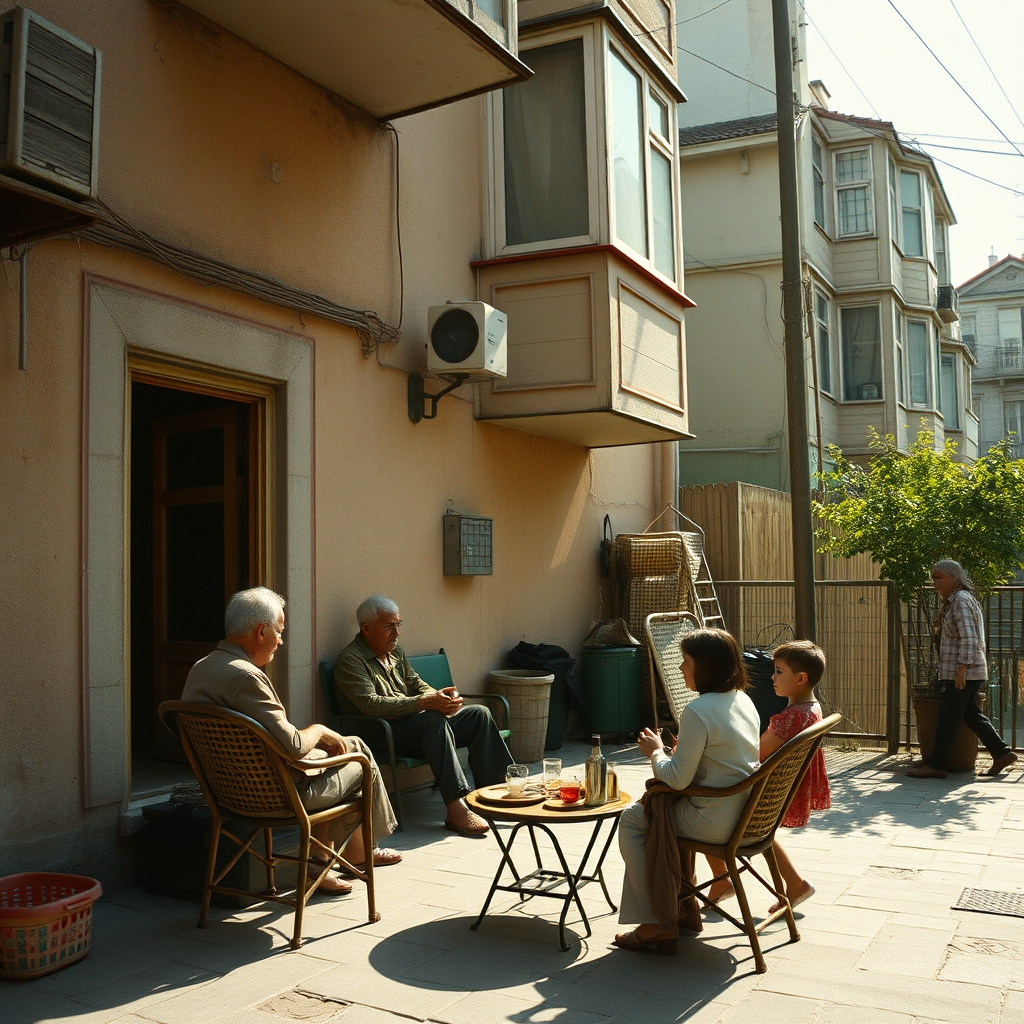
Some forms of safety are born not from grand declarations, but from small scenes repeated again and again. Doorstep conversations lived within such a scene. Especially on holidays, when the slowness of afternoon spread into the street, entrances to apartment buildings and the spaces before houses turned into semi-public sitting rooms. Mothers settled onto thin cushions or chairs, fathers joined the talk with their sleeves slightly rolled, and children built games around the edge of the conversation. No one organized a formal gathering, yet everyone carried the natural ease of being there. The street ceased to be the place where the home ended and became instead a wider threshold across which a feeling of safety could spread. The leisure of holiday days did not harden that closeness. It softened it further.
Within neighborhood culture, doorstep conversations were among the liveliest scenes in which neighborliness became visible. In holiday hours, when daily chores lightened and urgency lessened, people did not merely greet one another. They read one another's condition. Who had bought new shoes, whose child had just recovered from illness, in which home pickles were being prepared, who would soon travel to the hometown, all this was learned not through formal information but through conversations that were half ordinary and half emotional. Their real power lay in creating a closeness that watched over rather than controlled. When a child played in the street, more than one pair of eyes noticed. When an older person passed the door, they were not left alone. Even someone returning home late was met by a familiar voice. Part of the sense of safety was nourished by this mutual awareness that continued without announcing itself.
The reason these scenes remain so strong in the memory of one generation is that doorstep conversations did not belong to adults alone. Children grew up around those circles. They learned the tone of each neighbor's voice, which aunt handed out sweets during the holiday, which uncle would bring out a small stool in the late afternoon. Through repetition, the neighborhood was taught not as a map, but as a collection of characters. Conversations held in the laziness of a holiday day gave people, in moments when time felt more abundant, the chance to confirm one another's existence. That is why the doorway was more than an architectural line. It was a safe transition space between the interior of the house and the street. For a child, the street felt braver when a mother's voice could still be heard a few steps away. For an adult too, the proof of not living alone could be found there every day.
The nostalgic power of these scenes comes from the fact that they accumulated through ordinary repetition rather than great events. A tray of tea being shared, someone calling upstairs for another chair to be brought down, a conversation about whether the watermelon was cool enough, a piece of radio news immediately discussed at the doorway, none of these appears by itself as a major memory. Yet years later, they are exactly what seems to have formed the ground of safety. Safety does not come only from locked doors. It also comes from environments where one's name is known, one's absence is noticed, and one's voice is recognized. Doorstep conversations provided this in the plainest form of everyday life. The loose time of holiday days gave people room to make room for one another.
To ask today how these conversations nourished a generation's sense of safety is really to ask how social warmth is built through small practices. Doorstep conversations worked not through grand ideals, but through simple continuities: being visible, greeting, listening, asking after one another. The neighborhood became a living organism precisely through those repetitions. That is why what remains in memory is not only the topics once discussed, but the atmosphere conversation itself created. In the leisure of holiday days, that half-shadowed, half-bright world formed at the doorway taught a generation that the street was not a place of solitude. The roots of safety sometimes grew exactly there, in the few meters between the threshold and the pavement.
Doorstep Conversations in the Leisure of Holiday Days: How Did They Nourish a Generation's Sense of Safety?
🇹🇷 Kapı Önü Sohbetleri Tatil Günlerinin Rehavetinde: Bir Neslin Güven Duygusunu Nasıl Besledi
🇵🇹 Conversas À Porta no Sossego dos Dias de Folga: Como Alimentaram o Sentimento de Segurança de uma Geração
🇬🇧 Doorstep Conversations in the Leisure of Holiday Days: How Did They Nourish a Generation's Sense of Safety?
🇹🇷 Kapı Önü Sohbetleri Tatil Günlerinin Rehavetinde: Bir Neslin Güven Duygusunu Nasıl Besledi
Bazı güven duyguları büyük sözlerden değil, tekrar eden küçük görüntülerden doğar. Kapı önü sohbetleri de böyle bir görüntünün içinde yaşardı. Özellikle tatil günlerinde, öğleden sonranın yavaşlığı sokağa yayıldığında, apartman girişleri ve ev önleri yarı kamusal birer oturma alanına dönüşürdü. Anneler ince minderlere ya da sandalyelere ilişir, babalar gömlek kollarını biraz kıvırmış halde ayakta lafa karışır, çocuklar konuşmaların çevresinde oyun kurardı. Kimse büyük bir toplantı düzenlemezdi; ama herkes orada olmanın doğal bir rahatlığını taşırdı. Sokak, evin bittiği yer olmaktan çıkar, güven duygusunun yayıldığı geniş bir eşik haline gelirdi. Tatil günlerinin rehaveti de bu yakınlığı sertleştirmez, tam tersine yumuşatırdı.
Mahalle Kültürü içinde kapı önü sohbetleri, komşuluğun görünür hale geldiği en canlı sahnelerden biriydi. Günlük işlerin biraz hafiflediği, acele duygusunun azaldığı tatil saatlerinde insanlar birbirini yalnız selamlamaz; birbirinin hâlini okurdu. Kim yeni ayakkabı almış, kimin çocuğu hastalıktan yeni kalkmış, hangi evde turşu kurulmuş, kim memlekete gidecek, bütün bunlar resmi bir bilgi akışıyla değil, kapı önünde kurulmuş yarı gündelik yarı duygusal konuşmalarla öğrenilirdi. Bu sohbetlerin asıl gücü, denetleyen değil gözeten bir yakınlık yaratmasındaydı. Çocuk sokakta oynarken birden fazla göz onu fark eder, yaşlı biri kapının önünden geçerken yalnız kalmaz, eve geç dönen biri bile tanıdık bir sesle karşılanırdı. Güven duygusu biraz da görünmeden süren bu karşılıklı fark edilişten beslenirdi.
Bir neslin hafızasında bu kadar güçlü yer etmesinin nedeni, kapı önü sohbetlerinin yalnız yetişkinlere ait olmamasıdır. Çocuklar o halkaların çevresinde büyür, hangi komşunun ses tonunun nasıl olduğunu, hangi teyzenin bayramda şeker dağıttığını, hangi amcanın akşamüstü taburesini dışarı çıkaracağını öğrenirdi. Bu tekrar, mahalleyi harita değil karakterler toplamı olarak öğretirdi. Tatil günü rehavetinde kurulan sohbetler, zamanın daha bol hissedildiği anlarda insanlara birbirinin varlığını teyit etme imkânı verirdi. Kapı eşiği bu yüzden mimari bir sınırdan fazlasıydı. Ev içiyle sokak arasında güvenli bir geçiş alanıydı. Bir çocuk için birkaç adım ötede annesinin sesi duyuluyorsa sokak daha cesaret verici görünürdü. Bir yetişkin için de yalnız yaşamadığını bilmenin gündelik kanıtı orada bulunurdu.
Bu sahnelerin nostaljik gücü, büyük olaylarla değil, sıradan tekrarlarla birikmesinden gelir. Bir tepsi çayın paylaşılması, biri yukarıdan sandalye indirsin diye seslenilmesi, karpuzun serin olup olmadığının konuşulması, radyoda duyulan bir haberin hemen kapı önünde yorumlanması... Bunların hiçbiri tek başına büyük anı sayılmaz. Ama yıllar sonra düşünüldüğünde güven duygusunu kuran zemin tam da bu küçük olaylar olur. Çünkü güven, yalnız kilitli kapılardan değil; insanın adının bilindiği, yokluğunun fark edildiği ve sesinin tanındığı çevrelerden doğar. Kapı önü sohbetleri bunu günlük hayatın en sade biçimiyle sağlıyordu. Tatil günlerinin gevşek zamanı, insanlara birbirine yer açma fırsatı veriyordu.
Bugün bu sohbetlerin bir neslin güven duygusunu nasıl beslediğini sormak, aslında toplumsal sıcaklığın hangi küçük pratiklerle kurulduğunu anlamak demektir. Kapı önü sohbetleri, büyük ideallerden çok basit sürekliliklerle çalışıyordu: görünmek, selam vermek, kulak vermek, hatır sormak. Mahalle tam da bu tekrarlarla yaşayan bir organizmaya dönüşüyordu. O yüzden hafızada kalan şey yalnız konuşulan konular değildir; konuşmanın kurduğu ortamdır. Tatil günlerinin rehavetinde kapı önünde oluşan o yarı gölgeli, yarı aydınlık dünya, bir nesle sokakta yalnız olmadığını öğretti. Güven duygusunun kökü bazen tam da burada, kapı ile kaldırım arasındaki birkaç metrelik mesafede büyüdü.
🇵🇹 Conversas À Porta no Sossego dos Dias de Folga: Como Alimentaram o Sentimento de Segurança de uma Geração
Algumas sensações de segurança nascem não de grandes discursos, mas de pequenas imagens repetidas. As conversas à porta viviam dentro desse tipo de cena. Principalmente nos dias de folga, quando a lentidão da tarde se espalhava pela rua, as entradas dos prédios e as frentes das casas se transformavam em áreas de convivência meio públicas, meio domésticas. As mães se acomodavam em almofadas finas ou cadeiras, os pais participavam da conversa com as mangas da camisa um pouco dobradas, e as crianças inventavam brincadeiras ao redor daquele círculo. Ninguém organizava uma reunião formal, mas todos carregavam a naturalidade de estar ali. A rua deixava de ser o lugar onde a casa acabava e virava um limiar mais amplo por onde o sentimento de segurança podia se espalhar. O sossego dos dias de folga não endurecia essa proximidade. Ao contrário, tornava tudo mais macio.
Dentro da cultura de bairro, as conversas à porta eram uma das cenas mais vivas em que a vizinhança se tornava visível. Nas horas de folga, quando as tarefas diminuíam e a pressa perdia força, as pessoas não apenas se cumprimentavam. Elas percebiam o estado umas das outras. Quem tinha comprado um sapato novo, cujo filho acabara de sair de uma doença, em que casa estavam preparando conservas, quem logo iria viajar para a cidade natal, tudo isso era aprendido não por um fluxo formal de informação, mas por conversas meio cotidianas e meio afetivas. A verdadeira força desse hábito estava em criar uma proximidade que cuidava sem vigiar. Quando uma criança brincava na rua, mais de um olhar a percebia. Quando uma pessoa idosa passava pela porta, não seguia sozinha. Mesmo quem chegava tarde em casa encontrava uma voz conhecida. Parte do sentimento de segurança era alimentada por esse reconhecimento mútuo que continuava sem se anunciar.
O motivo de essas cenas terem permanecido tão fortes na memória de uma geração está no fato de que as conversas à porta não pertenciam só aos adultos. As crianças cresciam ao redor desses círculos. Aprendiam o tom de voz de cada vizinho, qual tia distribuía doces no feriado, qual senhor colocava o banquinho para fora no fim da tarde. Pela repetição, o bairro era aprendido não como um mapa, mas como um conjunto de personagens. As conversas formadas no clima preguiçoso dos dias de folga davam às pessoas, em momentos em que o tempo parecia mais abundante, a chance de confirmar a presença umas das outras. É por isso que a soleira era mais do que uma linha arquitetônica. Era uma zona segura de passagem entre o interior da casa e a rua. Para uma criança, a rua parecia mais corajosa se a voz da mãe ainda podia ser ouvida a poucos passos. Para um adulto também, a prova cotidiana de que não se vivia sozinho podia ser encontrada ali.
A força nostálgica dessas cenas vem do fato de terem se acumulado por repetições comuns, e não por grandes acontecimentos. Uma bandeja de chá dividida, alguém chamando do andar de cima para descer mais uma cadeira, a conversa sobre a melancia estar ou não bem fresca, uma notícia do rádio comentada imediatamente na porta, nada disso parece, isoladamente, uma grande lembrança. Mas, anos depois, é justamente esse conjunto que parece ter construído o chão da segurança. A segurança não nasce apenas de portas trancadas. Ela também nasce de ambientes em que o nome da pessoa é conhecido, sua ausência é notada e sua voz é reconhecida. As conversas à porta ofereciam isso na forma mais simples da vida cotidiana. O tempo frouxo dos dias de folga dava às pessoas espaço para abrir espaço umas às outras.
Perguntar hoje como essas conversas alimentaram o sentimento de segurança de uma geração é, na verdade, perguntar como o calor social se constrói por pequenas práticas. As conversas à porta não funcionavam com grandes ideais, mas com continuidades simples: aparecer, cumprimentar, ouvir, perguntar como vai. O bairro se transformava num organismo vivo justamente por meio dessas repetições. Por isso, o que fica na memória não são apenas os assuntos comentados, mas o ambiente criado pelo próprio ato de conversar. No sossego dos dias de folga, aquele mundo meio sombreado e meio iluminado que surgia à porta ensinou a uma geração que a rua não era um lugar de solidão. Às vezes, a raiz da segurança crescia exatamente ali, nos poucos metros entre a soleira e a calçada.