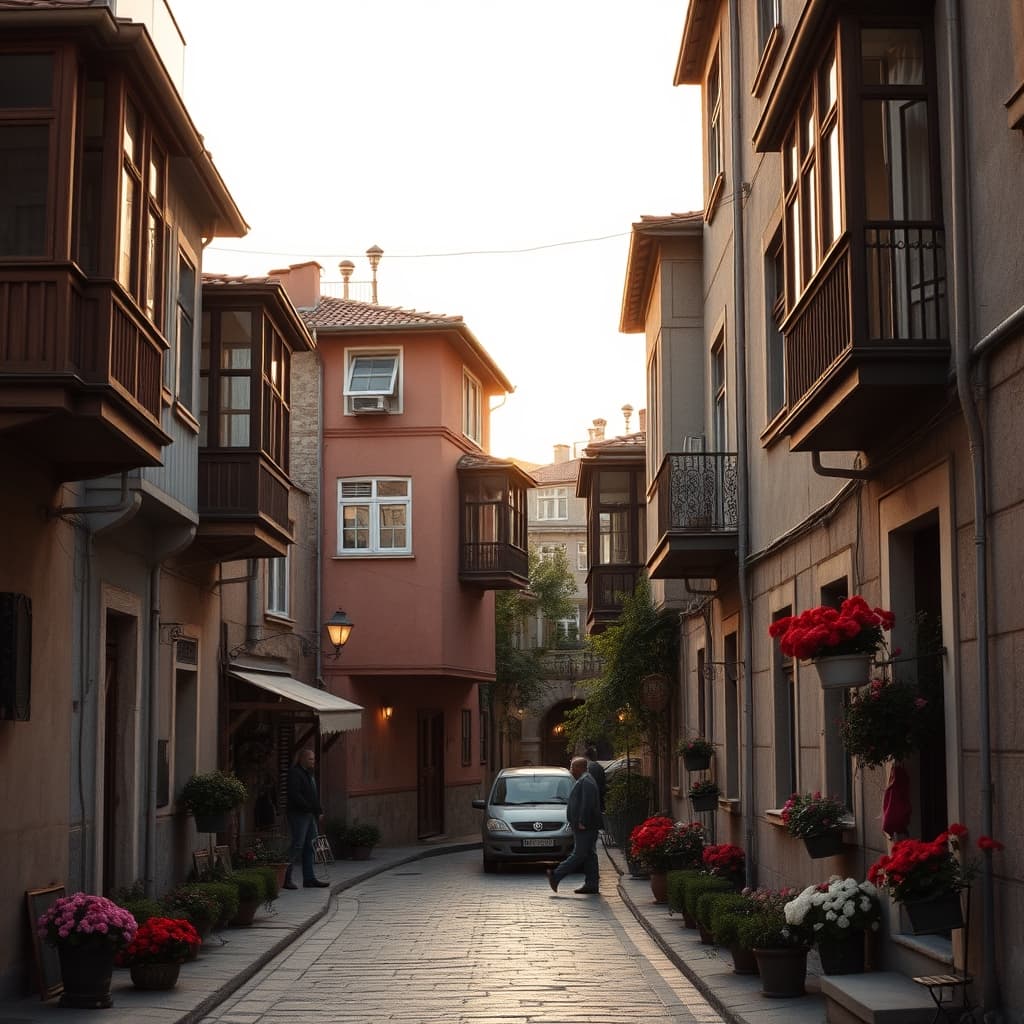
Eski Pano
There was a time when the arrival of morning in the city was understood not only by sunrise, but by the opening of windows one after another. While the stone pavements still carried the coolness of the night, lace curtains moved behind the projecting bay windows and geraniums in tin pots trembled lightly above the street. First came the small sound of a teaspoon from one kitchen, then the lid of a copper pitcher closing in another house, and from farther away the footsteps of someone returning from the bakery. Before the neighborhood was fully awake, women exchanged greetings from their windows, children left their schoolbags by the door, and the grocer's apprentice delivered bread in a basket. These mornings were among the most vivid rituals of old urban life. Perhaps that is why they remain so alive in memory: at that hour, everyone touched the lives of others from a distance, yet with warmth.
Seen along the trail of time, the neighborhood's first apartment buildings marked not only an architectural change, but a threshold that altered the rhythm of daily order. Courtyard houses where sounds traveled freely from room to room slowly gave way to taller buildings rising floor by floor. People living on the same street still knew one another and still exchanged greetings, yet voices withdrew toward stairwells, brief encounters at apartment entrances, and new forms of contact established from balconies. The closeness once created by shelling beans together in the yard, hanging laundry on the roof, or filling pitchers at the shared fountain became new habits shaped by doorbells, caretaker rooms, mailboxes, and the collective cleaning of staircases. This change was not felt as a harsh break, but as a neighborhood language slowly shifting into another register.
Yet what remains in memory is not only the intimacy that was diminished. The first apartment mornings recall an in-between era when the old order of neighborliness had not been erased, but was still searching for ways to adapt. The woman on the first floor handing a pot upward to the family above, milk bottles left at apartment doors, newspapers discussed in the entrance hall, and the short exchanges at the landing after a trip to the market were the small scenes of this new order. The mornings that made people open their windows are vivid for this very reason: a window was opened not only for air, but to feel the pulse of the street. Who had fallen ill, who had gone back to their hometown, in which flat engagement preparations had begun, which child had grown old enough for high school; much of this was learned between facing windows. Even as the city expanded, the neighborhood tried to preserve itself through this delicate web of voices and glances.
The transformation brought by the first apartment buildings also changed domestic life in quieter ways. With corridors, balconies, entrance halls, and more clearly divided rooms, the movements of families followed another pattern. Hosting guests shifted into more formal sitting rooms; kitchen smells drifted at times downward and at times upward; children began to linger in front of the building or on stair landings instead of in courtyards. Even so, neighborliness did not retreat entirely behind closed doors. Someone cleaning windows in the morning calling out to the next balcony, borrowing an empty jar for pickles, or gathering laundry together when rain arrived suddenly were the kinds of small help that prevented apartment life from turning cold. What kept those memories bright, then, was not only the place itself, but the mutual attentiveness that survived even as the place changed.
When we think of those mornings today, what comes to mind is not the rise of concrete, but the human faces standing at window ledges. The era of the first apartment buildings belonged to a climate of transition in which the city modernized without wholly abandoning neighborliness. Neither the old courtyard life continued intact, nor did the loneliness of later years fully settle in. What remains vividly alive is the human warmth of that passage. The mornings that opened windows remind us that urban life is never made of walls alone. The smell of a pot carried between floors, a greeting rising from below, and short sentences passed from balcony to balcony all tell of the last graceful ways in which old neighborly order found room within a new life. That is why the period is not only remembered today, but missed.
The Period When the Neighborhood's First Apartment Buildings Changed the Old Order of Neighborliness in Old City Life: Why Are the Mornings That Opened Windows Still So Vivid in Memory?