Eski Pano
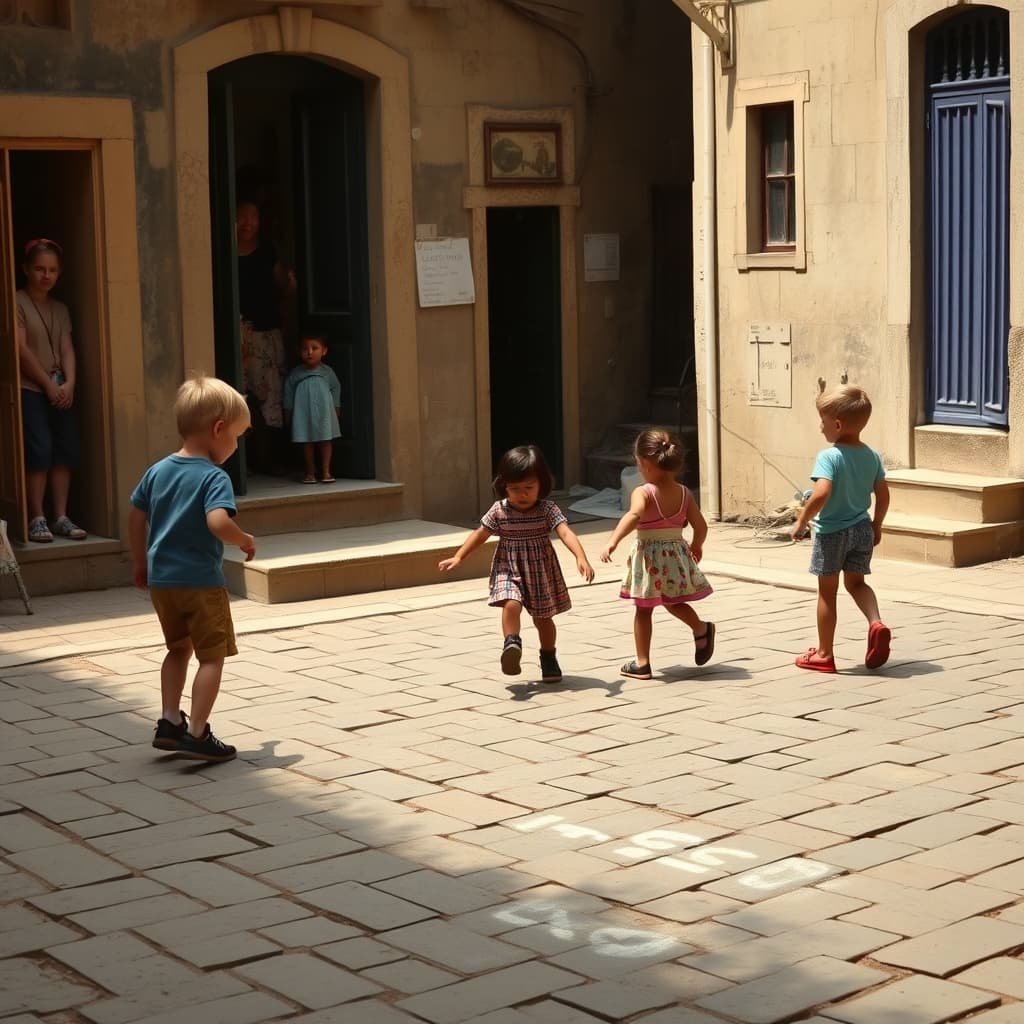
In old neighborhoods, the paving stone was not merely a surface for children to walk on; once marked with chalk, it became a small world opening into play. Hopscotch lines quickly appeared in the morning or the coolness of late afternoon, numbers were written inside the squares, a suitable stone was chosen, and the game began. Balancing on one foot, not stepping on the line, waiting for one’s turn, and watching a friend’s jump were among the simplest yet liveliest lessons of childhood. Those hours did not disappear from memory because the street became an open notebook of play where body, voice, and friendship were learned together.
From the perspective of neighborhood culture, hopscotch was one of the games through which children turned the street into a safe and shared space. Elders looked from windows or doorways, shopkeepers became used to the chalk lines before their stores, and a passerby might wait for the game to end before walking around the edge of the pavement. This small tolerance was the invisible permission the neighborhood granted to children. A pavement marked for hopscotch joined not only the rhythm of children, but the rhythm of the whole neighborhood. Chalk dust, shoe sounds, laughter, and small objections mixed with the daily music of street life.
One reason hopscotch remained in children’s memory is that the game was both simple and demanding. A stone, a few lines, and some free time were enough; yet the game contained patience, balance, turn-taking, fairness, and gentle competition. As a child jumped from one square to another, the body was tested, but so was courage. Stepping on the line and returning to the start, losing a turn, or accepting a friend’s reminder of the rules taught the rules of shared play at an early age. Sometimes younger children waited to enter the squares drawn by older ones, and sometimes the older children made the game easier and included them. In this way, the pavement became a place where even differences in age softened through play. For this reason, hopscotch was not only entertainment, but a childlike rehearsal for living together within the neighborhood.
Another thing that made the hours on the pavement unforgettable was the temporary nature of the game’s traces. When rain fell, the lines disappeared; when evening came, chalk dust scattered under shoes; the next day the game was drawn again. This transience strengthened memory rather than weakening it. Children knew they were rebuilding the same game each time, yet each line, stone, and jump carried the atmosphere of a different day. Hopscotch drawn on the street was not a permanent structure, but through repetition it became a ritual settled in neighborhood memory.
When we remember hopscotch-drawn pavements today, we are really remembering times when childhood could safely spread into the street. The game required no expensive toys or special spaces; it was built on the shared ground of the neighborhood. Those hours ended when the lines faded, friends were called home, and the street lamp came on, yet they remained open in children’s memory. Hopscotch taught a child the limits of the body, the rules of friendship, and the shared joy of the street all at once. That is why a few chalk lines are still enough, many years later, to call back an entire neighborhood.
Why the Hours Spent with Hopscotch-Drawn Pavements Never Disappeared from Children's Memory