 Eski Pano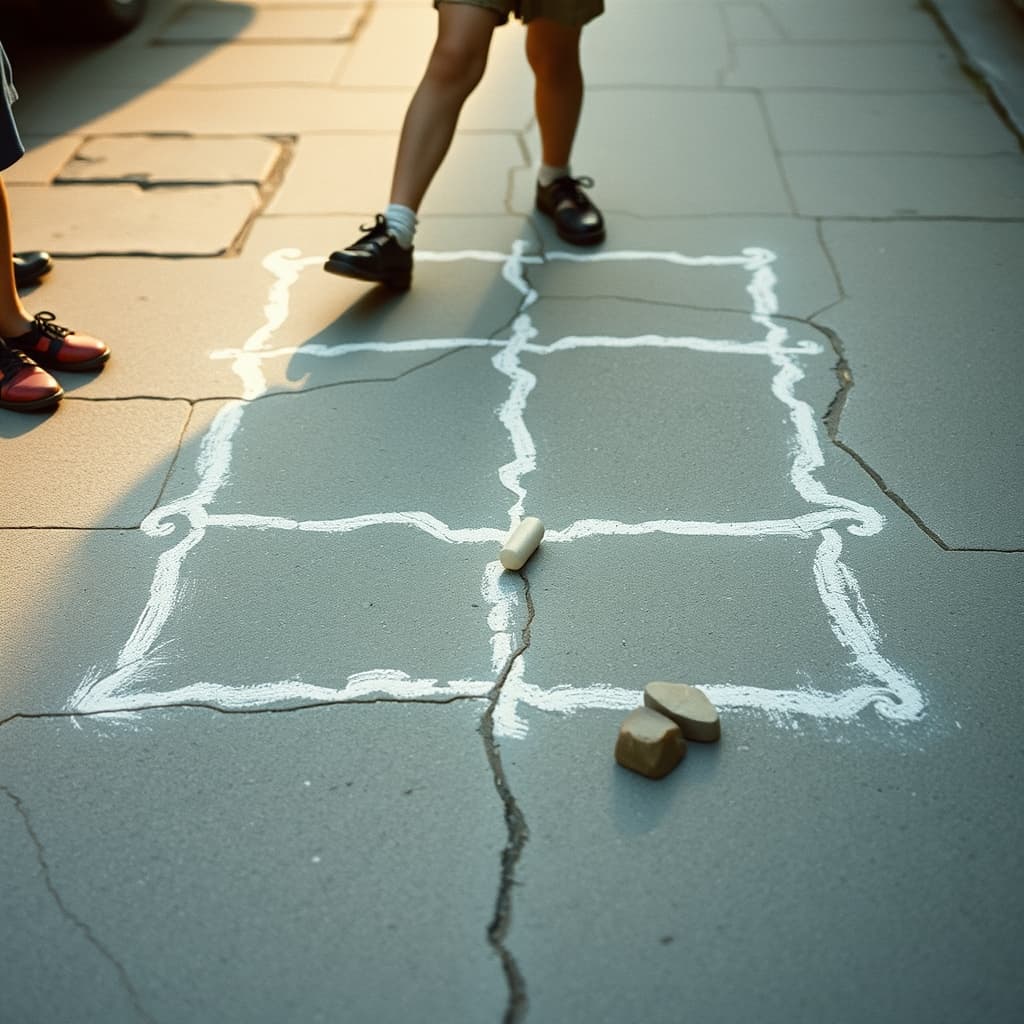
A hopscotch grid turned a small stretch of pavement into measured space. Children drew boundaries, assigned an order and tested whether a foot or marker had crossed a line. The hours remembered around the game were built from repeated judgements about distance, balance and fairness—not simply from a chalk picture.
Layouts and names vary across neighbourhoods and cultures. Even children on nearby streets may have used different numbers, shapes or rules. An archive should record the grid that people actually remember rather than replacing it with a standard diagram.
Drawing the Grid Was the First Round
The pavement determined what could be drawn. Cracks, kerbs and slopes changed the size and alignment. A short piece of chalk required economical lines; another material could leave a different mark. Choosing the direction also affected pedestrians and nearby doorways.
The person drawing acquired temporary authority, but others corrected proportions or negotiated squares. This preparatory work taught that a game space was made collectively and could be challenged before play began.
The marker added another geometry. A flat stone, tile fragment or other small object had to land inside a boundary without touching it, then be avoided and recovered during the route. Materials differed from place to place and should be recorded rather than romanticised. Sharp, heavy or culturally sensitive objects should not be introduced merely to make a reconstruction look old.
Counting Became Movement
Numbers were not only read; they were crossed by jumps, pauses and turns. A child judged how far to reach and how to return without disturbing the marker. Different bodies met the same grid differently, making adaptation and exclusion possible.
Balance, footwear and surface condition affected play. A child who struggled might receive another turn, a modified rule or impatience. Warm memory should include the informal decisions through which fairness was created—or denied.
Players also learned distance through their bodies before they could explain it as measurement. They shortened a stride near a line, turned on one foot and anticipated the return path. That practical knowledge changed as children grew or as the grid was redrawn. An adult reconstruction should not assume that today’s larger body can reproduce the scale and difficulty remembered from childhood.
Rain Edited the Pavement
Chalk faded under feet and weather. Lines were strengthened, redrawn or moved. The temporary nature of the grid meant that memory often outlasted the physical evidence. A photograph can preserve one version but cannot prove it remained unchanged all afternoon.
The shared pavement also had other users. Players paused for residents, deliveries or shop activity and sometimes faced complaints. The grid made a claim on common space, not permanent ownership. Its survival depended on negotiation.
Archive Rules Alongside the Drawing
Ask a former player to sketch the grid and explain a full turn, including errors, disputes and how a winner was decided. Record local vocabulary exactly and attribute variants. Avoid correcting the account to match a published rulebook.
Present-day documentation involving children requires consent and privacy. A reconstructed grid can be photographed without showing identifiable minors or precise routines. Label it as reconstruction, especially when colours and proportions are chosen for display.
Hopscotch remained in childhood memory because its geometry was lived. Lines became permission, numbers became movement and a disappearing drawing held a social agreement for as long as the group accepted it. Preserving the rules with the grid keeps that knowledge from being reduced to a decorative pavement motif.