Eski Pano
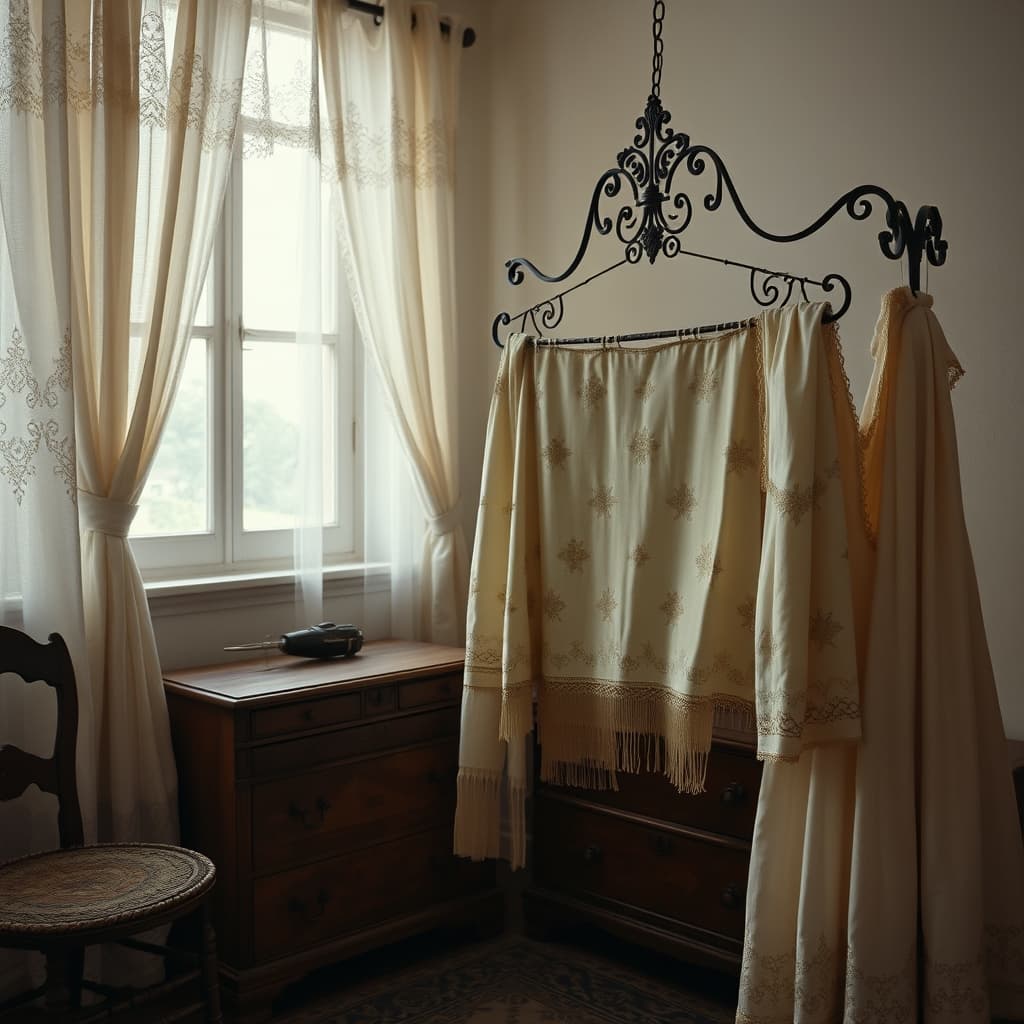
Some objects do not merely occupy space in a home. They hold time, gather silence, and carry the dream of days not yet lived. The wrought-iron hanger was one of those objects in older houses. Especially in dowry rooms, among lace covers, embroidered bundles, and the patient expectation mingling with the scent of mothballs, it stood upright with a quiet dignity. At times a fabric prepared for a bridal fitting was hung upon it, at times pressed nightgowns, at times only a cloth revealing its own emptiness. Yet even that emptiness had meaning. In the curved iron of the hanger, the outline of a future home waited silently. When light entering through the room's window cast the shadow of the wrought iron onto the floor, the object ceased to be only metal and became part of a family story woven through patience.
As an object story, the wrought-iron hanger carries an aesthetic and social meaning beyond simple use. Iron heated in fire, hammered into curves by a craftsman's hand, and eventually placed in one of the most intimate corners of a home becomes something more than furniture. Such hangers often bore flower, leaf, or spiral motifs; the iron itself was hard, yet its shape appeared gentle. That contrast suited the spirit of the dowry room perfectly. The room itself was both tangible and imagined, holding folded linens, boxed towels, lace preserved for years, and signs of a life still to come. The wrought-iron hanger stood as the visible spine of that waiting.
The reason it still carries the trace of craftsmanship and patience lies not only in the way it was made, but in the cultural world in which it was used. The dowry room was a place of accumulation and preparation. Each object grew in meaning over time, was carefully protected, and held its known position. Every item hanging from the stand represented hand labor: a towel edged with needlework, a dress sewn at home, fabrics covered so their pressing would remain smooth. For a young woman, the room marked the uncertain but hopeful threshold of the future. For a mother, it meant the wish to complete an order built through effort. For a grandmother, it continued a discipline inherited from her own time. In that way, the wrought-iron hanger gathered the patience of three generations along the same quiet line.
Today such pieces are sometimes treated as decorative nostalgia, but the meaning they once held was deeper. More than the weight of garments, the hanger seemed to carry the weight of awaited days. The silence of the room, the opening and closing of the chest lid, the smell of soap mixed with mothballs, the slight movement of the curtain by the window all created a rhythm around it. Craftsmanship was present not only in the hand that shaped the iron, but also in the women's labor that ordered the room, preserved the objects, and carried years with care. That is why the wrought-iron hanger appears now not simply as an elegant form, but as a sign of domestic discipline, preparation, and the seriousness of quiet waiting.
The answer to why the hanger still feels so moving today lies exactly there. It represents one of the modest ways human beings once resisted time. In an age of fast consumption and quickly changing objects, its curves remind us of the endurance of things made by hand, while its place in the dowry room recalls that waiting was not always a lack. It was a form of making meaning. If a hanger standing in the corner of a room can still speak so much about craftsmanship, patience, and family memory, then the objects of the past were never merely objects. They were cultural documents that learned to speak softly.
The Wrought-Iron Hanger and the Waiting That Grew in the Dowry Room: Why Does It Still Carry the Trace of Craftsmanship and Patience?