Eski Pano
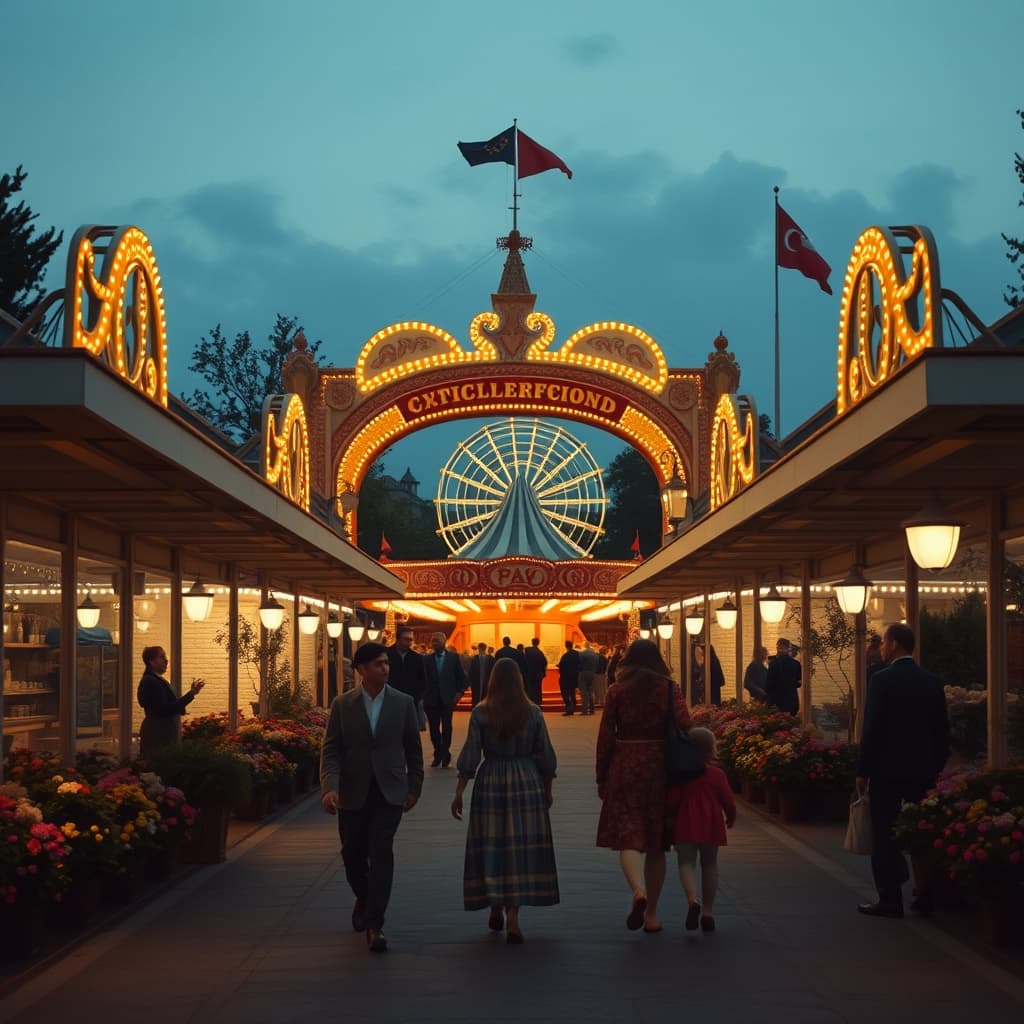
There was a time when the most exciting season in a city was marked on the calendar not merely as spring or summer, but as the days when the fair would arrive. Even before posters were fully pasted onto walls, before trucks appeared around the grounds, neighborhood children had already begun talking about which swing ride would come, which pavilion would glow with light, and which stalls would sell bright sweets. The fairground was never just a place built for amusement. It was a great stage on which the country showed itself to itself. People who walked there through flower-scented streets stepped out of the measured flow of daily life and into a brighter, more curious, more collective dream. As coolness settled over the late afternoon, mothers straightened their children’s collars, fathers slowed their steps a little, and the family walk toward the fair resembled a small holiday procession.
Seen through the trail of time, fair seasons were rare moments when the desire for modernization in urban life and the habits of neighborhood life became visible at once. In these spaces, valued by municipalities, chambers of commerce, and local newspapers, there were not only amusement rides, but also new machines, sewing machines, radios, tractors, glassware, book stands, and regional products on display. For that reason, the fair was not only the outward face of a city, but a mirror showing how the people living there imagined the future. On one side stood the feeling of modernity under bright bulbs; on the other were paper cones of sunflower seeds, evening walks made as a family, and the everyday restraint of saying, “Let’s stroll a little first.” While the country entered the display window, neighborhood manners walked beside it.
The quiet habits that survived into the present were gathered at exactly that threshold. People dressing in the late afternoon and stepping out not aimlessly but to be seen together and to walk together; the idea that looking at a display window meant not only consumption but shared curiosity; the habit of first seeing something new in a crowd and then discussing it at length once back home; children being held by the hand, yet still granted the right to wonder, all belonged to the subtle inheritance left by fair seasons. The flower-scented streets are not an empty ornament in this memory. The road to the fair often passed through parks, garden walls, and pavements freshly watered at dusk. The harder density of the city and the scent of the neighborhood walked side by side, and social life revealed itself in that passage.
Another reason these seasons remain vivid in memory lies in their arrangement of sound and light. Loudspeaker announcements rising in the air, the distant creak of a Ferris wheel, the full click of soda bottle caps being opened, the movement around the cotton-candy stand, the brief seriousness of families posing for photographs, everything felt as orderly as an exhibition and yet as familiar as a neighborhood evening. People did not go only to be entertained; they also went to test where they stood within the flow of time. Which object counted as “new,” which toy looked “urban,” which music could hold a crowd together: the fairground was like a quiet laboratory for all of this. When people returned home, a few tickets, a small balloon, or a brochure might remain in their pockets, but what truly stayed was the habit of moving among crowds with a courteous sense of closeness.
Today the old splendor of fairgrounds has faded in many cities, yet the habits they left behind have not disappeared entirely. The desire to stroll in squares on weekends, the tendency to experience the family evening walk as a small ceremony, the reflex of visiting a newly opened shop or exhibition not only to see it but also to talk about it, all carry something of those days. Fair seasons left the country more than bright lights. They also left the grace of looking together, walking together, and carrying a measured joy through the street. That is why flower-scented streets are still remembered. Passing through them toward the fair was, in truth, a way of bringing a country’s everyday elegance onto the stage.
In the Dusty Shelves of Memory, the Seasons When Fairgrounds Became the Nation’s Showcase: What Quiet Habits Did Flower-Scented Streets Leave to Today?