 Eski Pano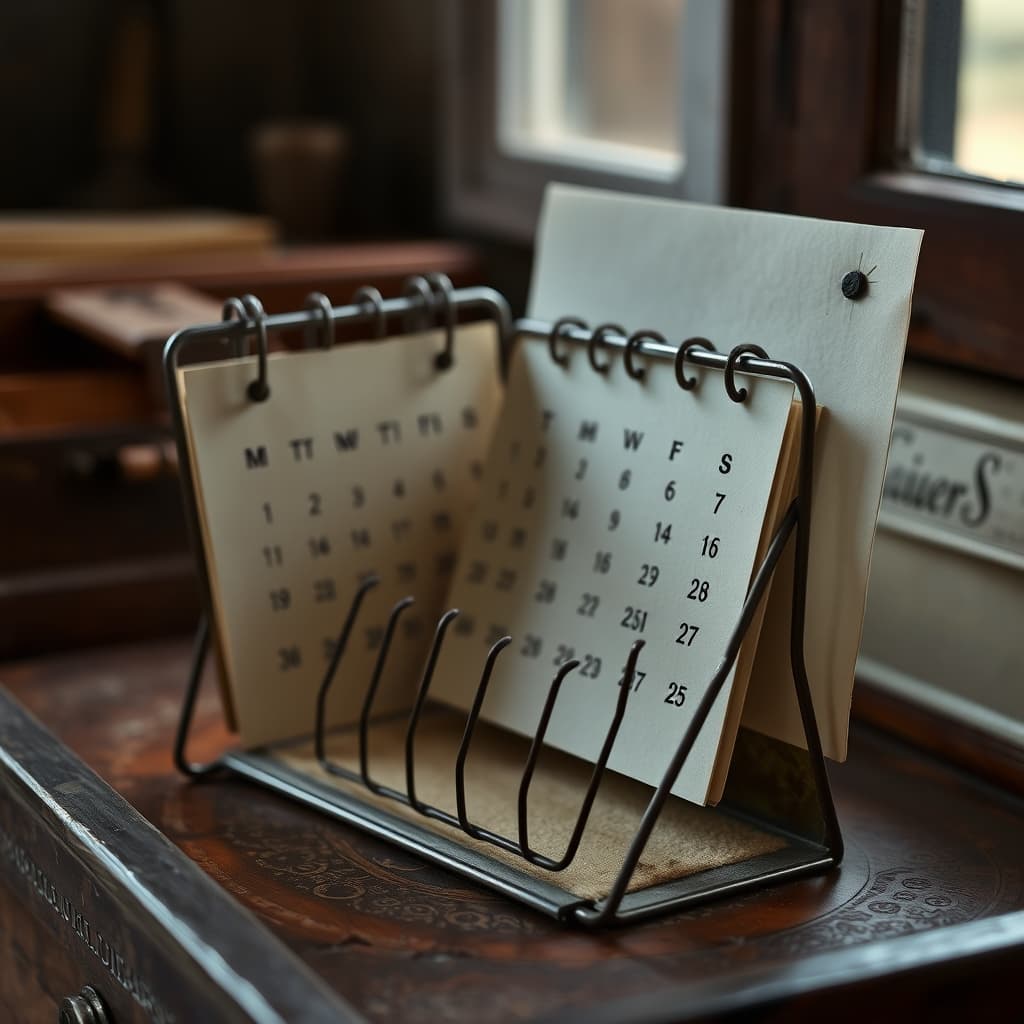
An empty desk calendar holder found at the bottom of a chest has lost the part that once made it immediately useful. There is no current date to consult, perhaps not even a surviving leaf. What remains is the structure that held time in view: a base, a support, a hinge or a pair of fittings. For a collector, this absence can be more informative than a neatly completed display, because it makes the object’s construction visible.
Not all desk calendars worked alike. Some held replaceable paper blocks, others used loose cards, rotating elements or sliding pieces. A holder should not receive a missing mechanism simply because a similar object online appears complete. Begin with its actual fittings and dimensions, then compare supported examples. The name calendar holder is a starting description, not a full identification.
Where the Paper Met the Hardware
A clip, pair of holes or narrow channel can suggest how paper was attached. Wear near those points may reflect repeated replacement or handling, but it does not identify a year. Tiny paper remnants might reveal thickness or colour without preserving a readable date. Photograph them in place before removal or cleaning, especially if they are trapped beneath a fitting.
A complete replacement block can make the object attractive and useful again, yet it also changes what viewers see. Label modern additions and retain any original fragments separately. Restoration and documentation serve different purposes; a convincing reconstruction is not evidence that the missing pages originally looked that way.
The Underside Has a Different Story
Turn the holder only with suitable support and examine its base. Felt, rubber, screws, joints and marks can explain how it rested on a desk. A changed foot or added pad may show adaptation rather than original manufacture. Metal colour alone does not prove an alloy, and a heavy base does not automatically indicate age or expensive craftsmanship.
Dust lines, scratches and discolouration can also distinguish display from storage. A chest might have protected the holder while exposing it to pressure, damp or contact with other objects. These possibilities need assessment, not a ready-made tale about an abandoned office. A surviving family account may connect the piece to a desk, but the condition itself cannot name the person who used it.
A Date Display Could Also Advertise
Some calendar holders carried a company name, decorative scene or commemorative detail. When present, that information may identify a distributor or occasion rather than a maker. Record the wording accurately and research it separately. Do not assume a commercial mark proves employment or that a family received the object as a gift.
The holder’s position mattered too. On a reception counter it addressed visitors; on a private desk it supported personal routine. An account of where it stood can therefore explain more than ornament. Ask who changed the leaves and whether old pages were discarded, saved or reused. Different households may remember the object’s role more clearly than its purchase.
Missing Dates Are Not Missing Value
A catalogue entry can preserve dimensions, construction, condition, marks, provenance and uncertainty without supplying an invented complete past. Photograph all sides and maintain a scale. If the object is unstable, seek material-specific care rather than polishing mixed surfaces or forcing seized joints. Decorative appeal should not erase the evidence that makes the piece worth studying.
A modern date inserted for display can be useful if clearly distinguished from the historical material. The same applies to an exhibition photograph: show the empty holder as well as any reconstruction. This gives viewers the opportunity to understand the gap rather than mistaking a curator’s decision for a recovered original.
The empty holder ultimately records a small interface between paper and furniture. It kept changing dates at a steady angle while the desk accumulated other work. Its missing leaves need not be replaced by a sentimental biography. The hinge, worn fixing and underside pad already tell a precise story about how a modest object made passing days visible—and how it survived after that daily job ended.