Eski Pano
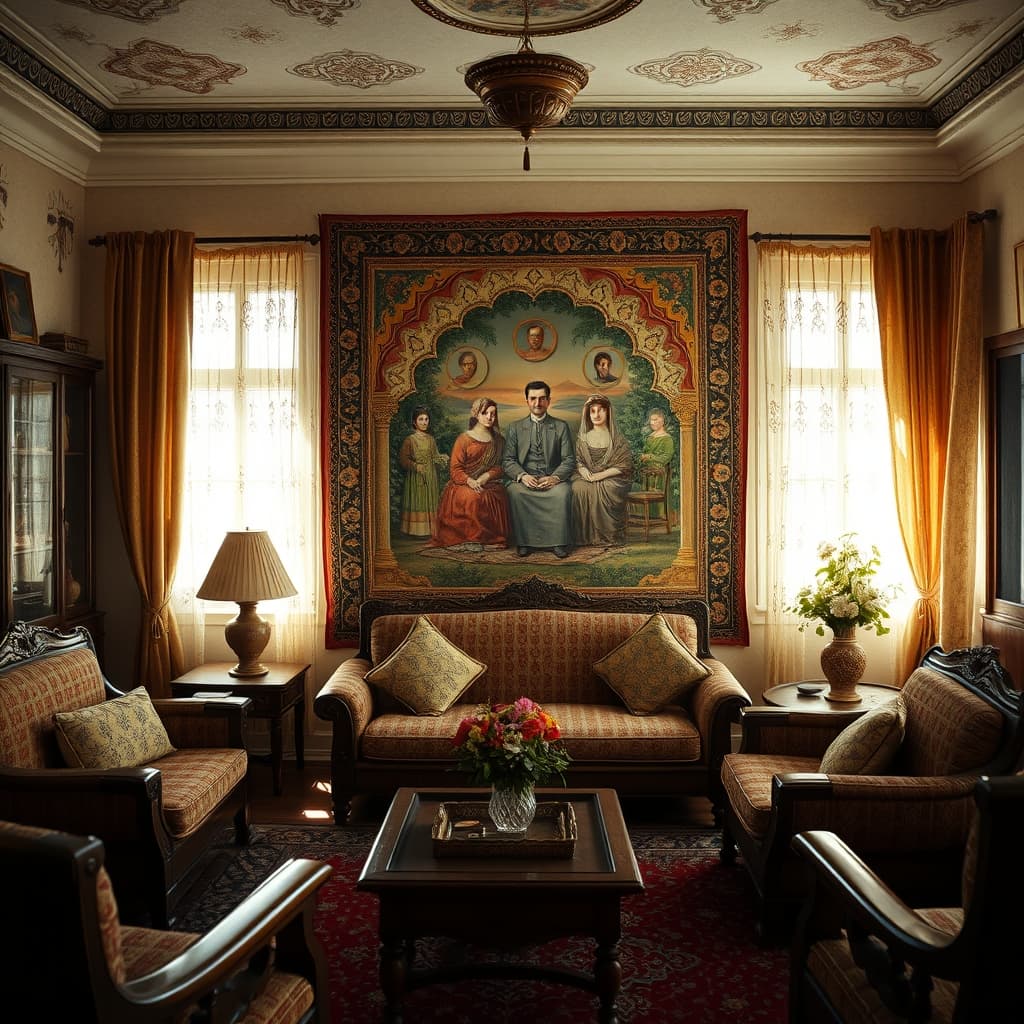
There was a time when one of the quietest yet most striking witnesses inside a home was the wall tapestry. Hanging in the main room, it seemed to exist not merely to cover an empty surface, but to make the memory of the house visible. Sometimes it showed a forest with deer, sometimes a pavilion framed by cypress trees, and sometimes patient geometric motifs woven in careful repetition. During the day it softened the window light, and in the evening it added a composed depth to the room along with the warmth of the stove. For children it might have looked like an ordinary object always present in the background, yet as the years passed, holiday photographs taken in front of it, guest conversations held beneath it, wedding preparations, and family silences all revealed that it was never a simple decoration. The reason it turned from an object into an heirloom as it passed from hand to hand begins exactly there.
From the perspective of object stories, the wall tapestry belongs to that class of things that live less through function than through the meanings they accumulate. It often entered a home as part of a dowry, sometimes came out of a grandmother's chest, and sometimes arrived as a special gift from a relative living in another city. What made it valuable was not only its weaving technique, its harmony of colors, or its design. It also mattered which walls it had looked at for years, which generation had grown up beneath it, and what family conversations it had silently accompanied. That is why taking it down from one wall and carrying it into another home was never experienced as an ordinary move. It felt as if a period, a sense of taste, and even a family voice were being carried along with it. With every transfer it did not wear out; its density of memory increased.
Part of what turned it into a family legacy was the fact that it stood at the center of domestic arrangement. Porcelain in the display cabinet could break, tablecloths could change, and sofa fabric could wear out and be replaced, but the wall tapestry often remained in place for years. That stillness gave it the power to gather the time of a house. For a child, the pattern behind a grandfather's armchair might later bring back the feeling of childhood in an instant. For a bride, the tapestry seen on the wall of the house she entered for the first time might be the detail that slowly turned an unfamiliar place into something intimate. If, after the elders of a family are gone, there is still a long discussion about where the tapestry should be hung, the reason is not merely aesthetic. People want to preserve the continuity hidden inside the object.
For that reason, being passed from hand to hand goes far beyond material transfer. A tapestry folded up, placed into a cedar chest, left for years among mothballs, and then hung once more on another wall means that the past is physically joining a new life. Each new house adds another layer to it. Fibers that once carried the smell of stove smoke later absorb the detergent scent of an apartment living room; patterns that held the quiet evenings of one generation become the backdrop to the voices of children from another. In this way, the object stays the same while its meaning expands. Today such tapestries may be called outdated by minimalist taste, yet if families continue to keep them, it is because memory is stronger than changing fashion.
In the end, the transformation of a wall tapestry into a family legacy offers a graceful example of how the past survives inside everyday objects. A family does not continue only through genealogy or official records; it also continues through patterns looked at for years on the same wall and through feelings attached collectively to the same object. As it passes from hand to hand, the tapestry reminds us of something simple: some objects become valuable not because they are merely used, but because they are looked at, lived with, and allowed to age beside us. It may appear slightly different in each new home, yet the quiet weight it carries does not change. For that reason, a wall tapestry is not merely an old decorative piece, but a tangible surface of memory passed between generations.
Wall Tapestry and Its Becoming a Family Heirloom Passed from Hand to Hand: How Did It Turn into a Family Legacy?