Eski Pano
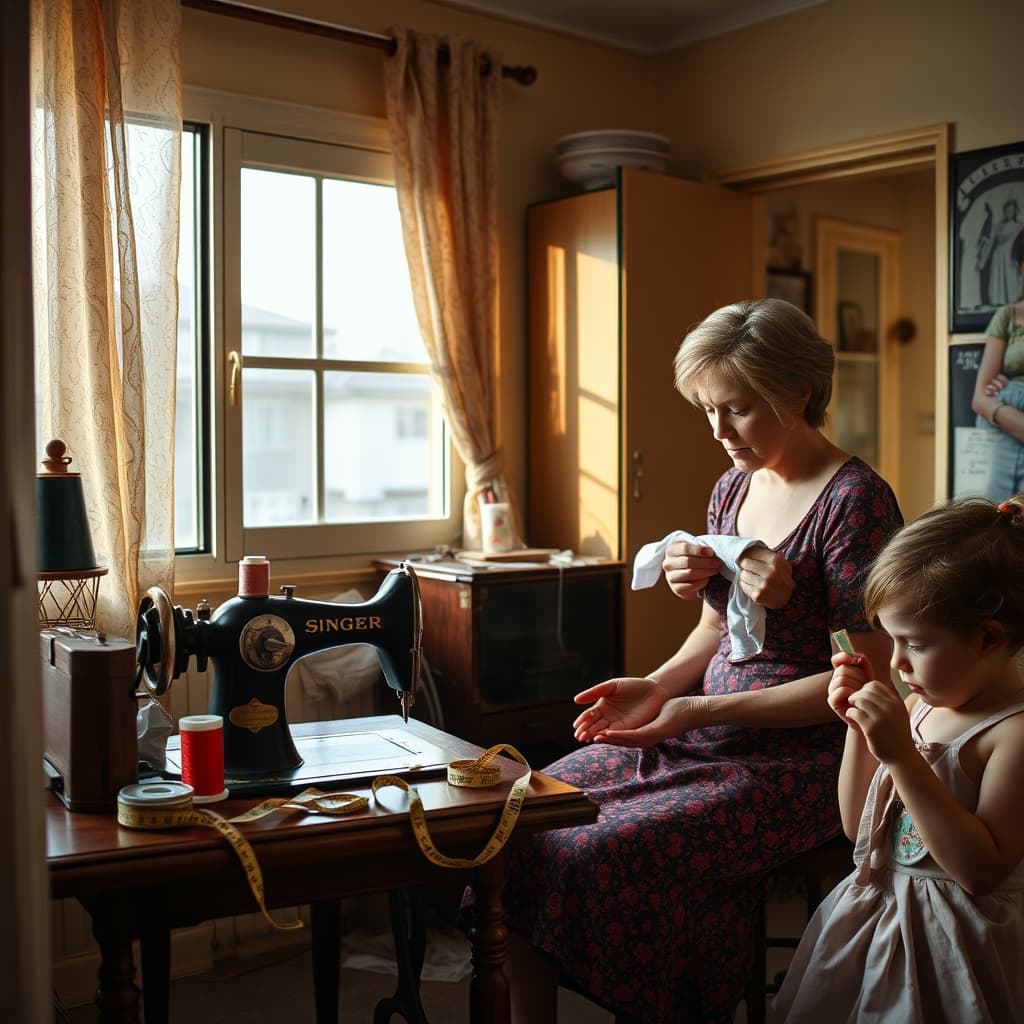
There was a time when the presence of a neighbor who knew sewing was not only a practical convenience, but one of the invisible assurances of everyday life. A shirt with a missing button, trousers with a torn hem, a dress that needed taking in before a holiday, or a school uniform needing a quick patch all found their way to those homes whose doors were knocked on without hesitation. They were the quiet points of solidarity in the neighborhood. Once inside, one immediately noticed the metallic shine of the Singer machine, the pin cushion on the side table, the spools of thread in different colors, and the faint warm scent of the pressing cloth. From the very first moment, a person moved closer to the feeling that “this can be handled.” The neighbor who knew sewing was a figure around whom not only garments but inner calm could be repaired.
From the perspective of neighborhood culture, these visits show that being neighbors was never only about exchanging greetings. In those years, expertise was spread throughout daily life. One person knew how to pickle vegetables, another how to make jam, another how to mind children, and another how to sew. Such small skills built the unseen infrastructure of a neighborhood. Going to the neighbor who knew sewing meant relying less on a purchased service than on trust. The door was usually knocked on without an appointment, someone would say, “Could you look at this for just a minute?” and the task often grew into a conversation prolonged over tea. In that way, what was repaired was not only fabric, but the bond between people themselves. Children grew up watching these scenes and learned early that in times of need there existed a circle of people to turn to.
That was exactly what nourished a generation’s sense of security: the knowledge that one would not remain alone in the face of every small disruption of life. A skirt hem coming loose on the way to school, curtains needing shortening before an engagement, or a tablecloth needing repair before guests arrived were not grand crises, but they were everyday anxieties. The neighbor who could sew created a local rhythm that soothed such anxieties. Once the machine began to work with its regular sound, the household felt not only that a task was being done, but that the world itself was settling back into place. And very often the return for such help was not simply money. A plate of pastries, a seasonal bowl of fruit, or a heartfelt thanks belonged to the same circulation. The feeling we call trust grew, in part, within this economy of familiarity and generosity.
For the children of the homes that stopped by the sewing neighbor, these visits became places of memory in themselves. Watching the foot pedal with curiosity, playing with fabric scraps, seeing the measuring tape thrown over a shoulder, or marveling at the seriousness of the chalk lines was for many children one of the first encounters with the idea of hand labor. What they saw there was a world not solved by buying everything new, but by skill. The hem of a garment was shortened, a pillowcase sewn again, a school apron made ready for the next day. For that reason, the neighbor who knew sewing was not merely a helper, but a strong sign that life itself could be mended. That is what made the feeling of security so lasting in the memory of generations.
Today many problems are overcome through fast shopping or disposable solutions. That is why the days when homes stopped by the neighbor who knew sewing are remembered with a deeper longing. Those days remind us that a sense of security is built not by grand promises, but by small forms of access. To be able to knock on a door, to hear the answer “Come in, let’s see,” and to know that a problem would be solved together was one of the strongest guarantees of neighborhood life. Here nostalgia is not only a way of looking back, but also a way of understanding how the social fabric was woven. Around needle, thread, and patience, this form of neighborliness made the world appear a little more repairable and a little safer in the heart of a generation.
The Days When Homes Stopped by the Neighbor Who Knew Sewing: How It Nourished a Generation’s Sense of Security