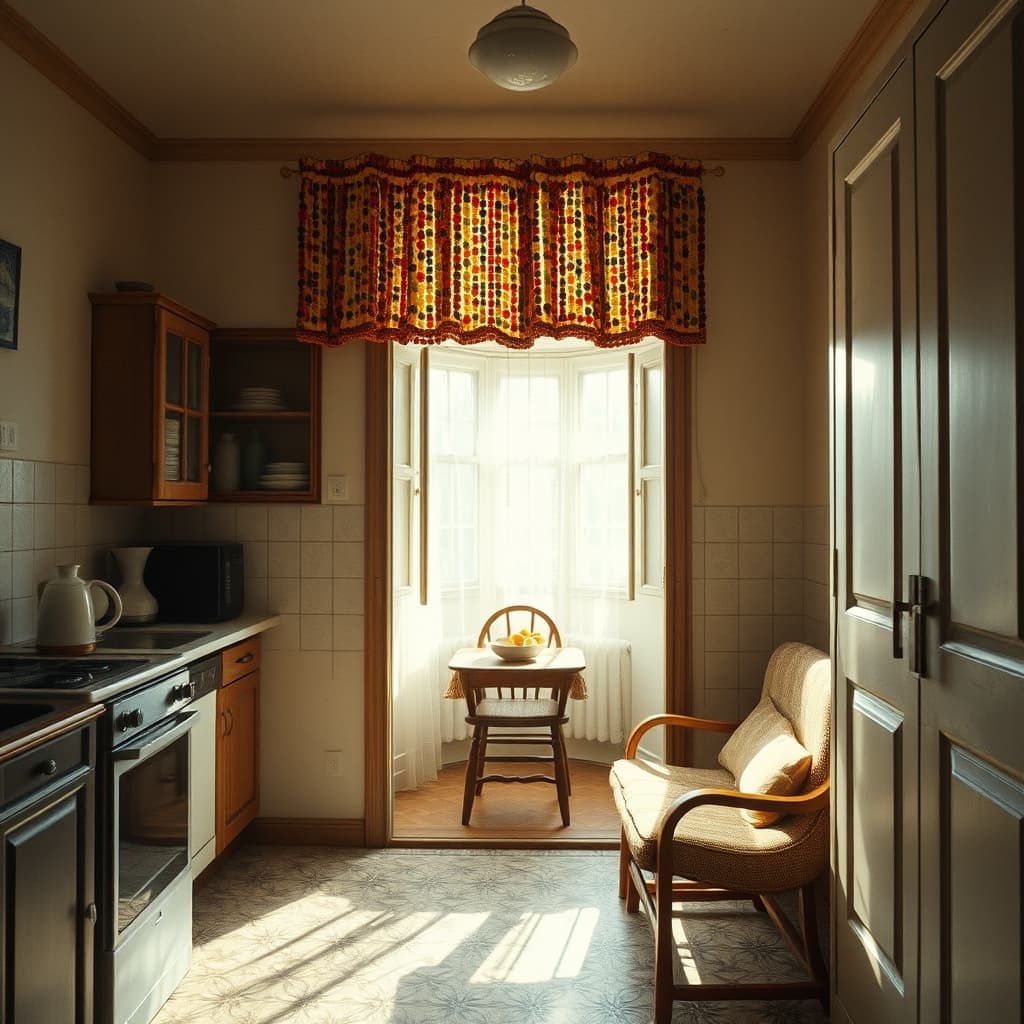
Eski Pano
Some household objects may appear simple in function, yet by the way they hang in a doorway they carry the spirit of an entire home. The beaded curtain is exactly such an object. Swaying softly on summer evenings, clicking gently as air moved through it, softening the passage between kitchen and hall or creating a delicate boundary between shadow and light at the balcony door, these curtains produced one of the most familiar sounds of older houses. As plastic, wooden, or glass beads were strung together, something more than decoration was made. A domestic aesthetic patiently built by hand came into being. That is why it is no surprise that the beaded curtain, passed from hand to hand, could become a family heirloom. It is not merely an object, but a form of memory that makes a sound when touched.
From the perspective of object stories, the value of the beaded curtain is too personal to be explained through mass production. In many homes these curtains were either made by the woman of the house or commissioned from a talented neighbor. The colors of the beads, the order in which they were arranged, the motifs added between them, and the length adjusted to the doorway made each curtain almost a singular design. Craftsmanship here was not only technical skill, but a sense of proportion. The beads should not become too heavy, the strings had to remain taut, and the curtain needed to be easy enough to pass through while still making its presence felt. Creating that balance required patience. Perhaps that is why such curtains continue to carry the attentiveness of the hands that made them, even after many years.
Its becoming a family heirloom passed from hand to hand is connected precisely to the visibility of that labor. A curtain taken down during a move and hung again in the next home, one passed from mother to daughter, or one kept in a chest even after it stopped being used occupied a special place among the quiet possessions of a family. It carried not only signs of use, but emotional transmission as well. A child might associate the sound of brushing through the beads with a grandmother’s house, while years later an old curtain found in a cupboard might bring back the coolness of a summer home at noon or the scent of lemon cologne from an old kitchen. That is where the memory of the object grows deep. It becomes not only a representative of the past, but a means of rebuilding the past through sound and touch.
Another reason the beaded curtain still carries traces of craftsmanship and patience lies in its connection to a culture of repair and preservation. Broken strings were tied again, missing beads replaced with similar ones, and when the upper strip loosened it was fixed back into place with a nail or a small repair. This approach prevented the object from becoming a temporary decoration. People did not throw a beaded curtain away simply because it had gone out of fashion. They first thought about giving it a little more life. In that way the object became a witness accompanying the time of the home itself. The fractured colors cast on the floor by beads filtering daylight, the sound raised by wind coming through open doors in summer, and the aroma of food drifting from the back room all created around it a small yet powerful atmosphere.
Today, among interiors that are minimalist, silent, and increasingly alike, the beaded curtain appears even more meaningful. It reminds us that domestic beauty can be built not only through elegance, but through labor. Its being a family heirloom passed from hand to hand shows that objects have emotional lifespans, not only material ones. Craftsmanship is sometimes hidden not in grand workshops, but in fingers growing tired while stringing beads in the evening light. Patience lies in continuing the same pattern without breaking it, in completing a missing piece, and in still recognizing the sound of an object years later. That is why the beaded curtain does more than represent the past. It makes visible the delicacy, handwork, and intergenerational transmission contained within the very idea of home.
The Beaded Curtain and Its Becoming a Family Heirloom Passed from Hand to Hand: Why Does It Still Carry the Traces of Craftsmanship and Patience