Eski Pano
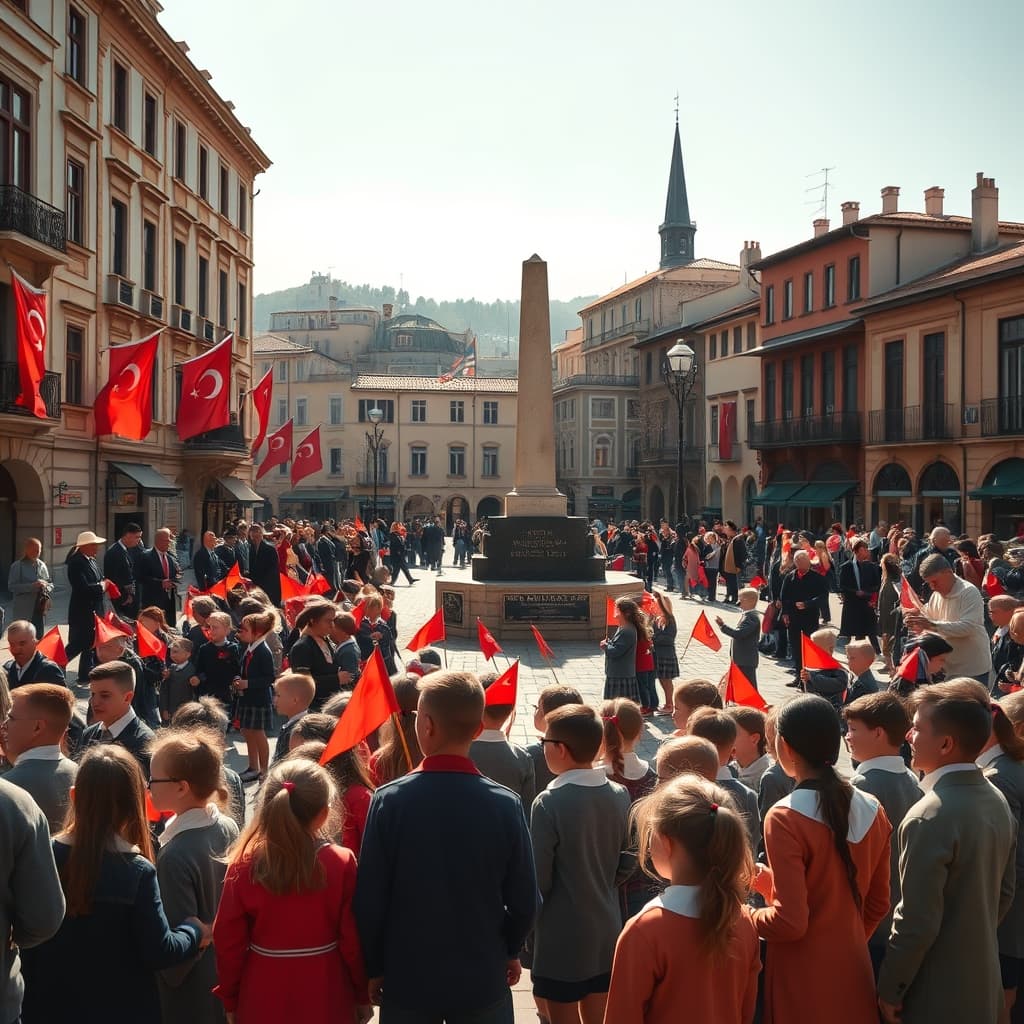
There was a time when the mornings of April 23 seemed to brighten before the day had fully opened. That brightness did not come only from the clarity of the air, but from freshly washed faces, carefully ironed school uniforms, tiny badges pinned to collars, and the hurried excitement flowing toward the squares. School roads were more crowded than usual, mothers adjusted hair one last time, fathers slipped a small camera or a handkerchief into a jacket pocket, and children repeated their memorized poems under their breath. The city square became more than an official ceremonial ground; it turned into a shared stage where a generation felt visible. In those hours when the flags moved gently in the wind, children’s voices struck the stone facades of buildings, and while shop shutters were only beginning to rise, a young, clear, hopeful sound spread through the city.
Seen through the trace of time, the unforgotten face of the joy of National Sovereignty is hidden precisely in that crowd of children. The historical meaning of the holiday is, of course, linked to the opening of parliament, the idea of popular will, and the public memory of the republic; yet in everyday life those large ideas took on flesh through the happiness carried by children. It was no coincidence that old newspapers devoted broad space in their April 23 issues to school ceremonies, celebrations in the squares, and performances prepared by students. The day stepped out of the official calendar and settled into neighborhoods, schoolyards, and family albums. Teachers held rehearsals for days, classroom boards were decorated, and crowns of cardboard, ribbons, lanterns, and small stage pieces were completed with great seriousness. The joy of the holiday grew not only in the ceremony itself, but in the long preparation that led to it.
The fact that the squares were lit by children’s voices also showed how public space was shared in older urban life. In small towns, the front of the government building, and in large cities the wide open ground between a school and a monument, would suddenly turn into a colorful current. As marching-band music mingled with the footfall of students standing in order, street vendors, photographers, and shopkeepers at the edge adapted themselves to the day’s rhythm. Elderly people watching from balconies applauded, shop owners stepped outside, and some mothers kept their eyes on their children every second so as not to lose them in the crowd. A child’s brief hesitation while approaching the microphone, the applause that followed, and the rising voice on the best-known line of a poem became signs of a feeling shared by everyone in the square. On that day children were not merely being watched; for those moments they were the ones building the city’s memory.
Another reason this joy has remained unforgettable lies in the link between the home and the square. Once the ceremony ended, the holiday did not end immediately. Children returned home carrying small flags, stopped by a neighbor’s house before removing the cards hanging around their necks, and listened on the radio to the day’s reports while retelling the school festivities of the afternoon. Even if no special meal was prepared, the air of the day settled over the table. Adults recalled the April 23 celebrations of their own childhood and said things like, “in our time there was a wooden podium,” or “we recited into microphones made from tin pipes.” In that way the holiday became not the memory of one generation alone, but a chain of recollection passed from one generation to the next. The sound from the square found its echo at home, and children’s excitement joined with the past of their families.
Looking back today, squares illuminated by children’s voices remain more than scenes from a ceremony. They are remembered as a warm summary of years in which a society saw its future in children. That is part of the unforgotten face of the joy of National Sovereignty: official language softening in the presence of children’s happiness, stone squares appearing as lively as playgrounds for a few hours, and the holiday leaving the realm of state discourse to blend into everyday joy. Those voices still live in memory together with microphone static, the smell of ironing, the chill of early morning, and the shadow of red-and-white flags. Perhaps what makes the past appear brighter is exactly this: for one day, a square beating like the heart of the whole country through the voices of children.
Squares Lit by Children's Voices: The Unforgotten Face of the Joy of National Sovereignty