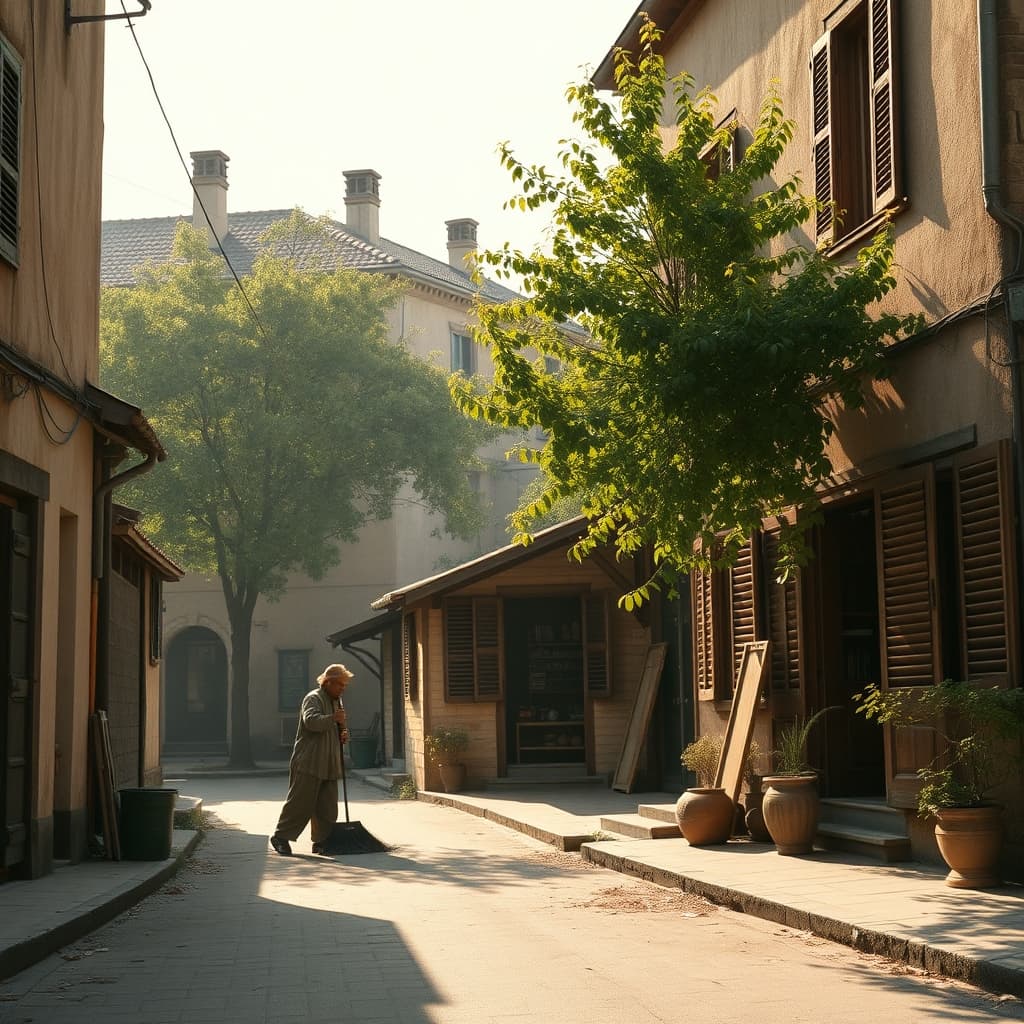
Eski Pano
Some neighborhoods kept time not by the wall calendar, but by the lifting of shop shutters. When the morning sun had only just fallen on the paving stones, the tailor's apprentice sweeping the storefront, the coppersmith's boy polishing the window, the grocer carrying crates outside, and schoolchildren watching all of it on their way to class announced exactly how the day would unfold. That is why apprenticeship culture was never only a way of learning a trade. It was the invisible discipline that gave the street its rhythm. At those hours, the scent of linden drifting from small gardens had not yet dispersed, and as dust rose lightly from the brooms at shopfronts, a soft coolness settled over the lane. If these scenes still live in memory like a quiet ache, the answer lies in that silent harmony. In those days, the street woke together with working hands.
Seen in the path of time, apprenticeship culture represented one of the most defining social orders of old urban life. It is no accident that newspaper archives so often mentioned small tradesmen, work ethics filtered through guild traditions, and the significance of the bond between master and apprentice. A boy entering a shop did not arrive only as labor. He learned how to address elders, how to stand before customers, how to value materials, and how patience belonged to craft itself. In that way the street became more than a place of commerce. It turned into the public face of discipline. Neighborhood residents knew when each shop would come alive, which master would light the workshop first, and which apprentice would return around noon with bread from the grocer. Such repetition quietly fixed the daily calendar of the quarter.
The order that apprenticeship gave to the street could be understood through details. Shoe lasts lined up outside the cobbler, the scent of sawdust spilling from the carpenter's shop, the measured ring of the blacksmith's anvil, bolts of fabric left by the draper's door, and among them apprentices moving quickly yet carefully. Each was a small but indispensable bearer of work. An apprentice might fetch coffee for the master, deliver a note, or clean the dustiest corner of the display, yet what he truly carried forward was the language of labor without interrupting the flow of the street. Children in the neighborhood grew up watching them. In that way they learned, almost without being told, that work did not only earn bread. It placed time where it belonged. Apprenticeship stood at the visible threshold between house and shop, between play and duty, between childhood and adulthood.
The gardens turning to linden scent explain why this memory remains so tender. As noon approached and the sun climbed higher, linden, soap, wood, and damp earth from courtyard homes and narrow back gardens drifted together in the air. During the lunch break, while the apprentice opened his food tin or ate the meal sent from home, leaves above the lane moved softly, the neighborhood slowed for a moment, and then activity resumed. In such moments working life did not appear harsh. It seemed woven into ordinary domestic continuity. Perhaps that is why, when people miss those years today, they remember not only the shops but the gardens behind them, the shade, and the scents. Memory often seals the deepest social structures not with images alone, but with smell.
Today the old weight of apprenticeship culture may have changed. Small shop life has thinned, and the long hours once spent in front of workshops have given way to other forms of living. Yet in the memory of a generation, that scene still hangs there like a date that never slips from the calendar. The master's voice, the apprentice hurrying along, the linden scent gathering between storefronts, and the street gaining measure through all of it formed one of the most delicate orders of urban life. That is why it is still remembered like an ache. The order it created was never only economic. It gave the neighborhood a rhythm that was dignified, warm, and deeply human.
As a Scene That Never Fell from the Neighborhood Calendar, the Times When Apprenticeship Culture Gave Order to the Streets: Why Are the Gardens Turning to Linden Scent Still Remembered Like an Ache Today?