Eski Pano
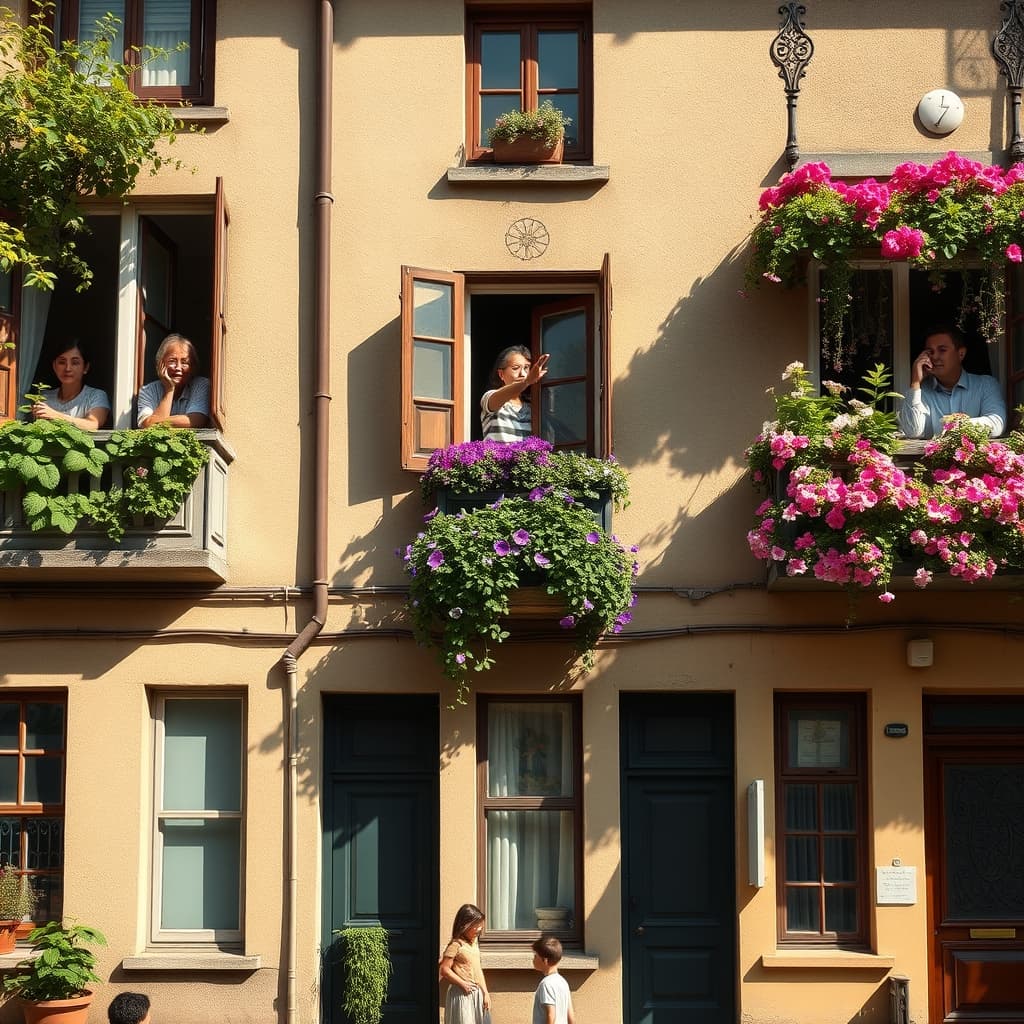
There was a time when one did not need to study a street for long to understand whether it was truly lived in. The flower pots lined along window sills were enough. Geraniums, basil, violets, and small seasonal blossoms were the quietest and most sincere greeting that homes offered to the outside world. Early in the morning curtains were parted, the soil in each pot was checked, water was poured from a copper pitcher, and dried leaves were pinched away with fingertips. In this way the window ceased to be merely an opening for light and air. It became a warm point of contact between home and street. A neighbor passing below would look up and say, “The flowers have opened again,” and a few exchanged words were enough to soften the whole day.
Within neighborhood culture, window sills were among the small stages on which everyday closeness became visible. They drew less attention than doorstep conversations, yet created an equally powerful familiarity. A building façade enlivened by different pots meant that each home revealed a little of its temperament to the street. One household preferred red geraniums, another basil, another turned a painted tin can into a planter. This modest aesthetic effort showed the unpretentious yet careful side of neighborhood life. People did not organize the place they lived only from within. They also gave care to the face that appeared outside. The window sill was therefore not simply an architectural detail, but a delicate language of neighborliness.
The reason that same warmth feels missing in today’s housing complexes is not only architectural change. In older streets, the window was not a firm barrier separating people from the outside, but a half-open place through which voices, scents, greetings, and curiosity could pass. While children played below, the shadows of flower pots fell over the pavement; mothers leaned out to call someone; in late afternoon the smell of dinner mingled with flower soil. In contemporary residential compounds, balconies are enclosed in glass, façades resemble one another, and shared outdoor beauty is handed over to professional landscaping. Plants are still present, but personal traces are fewer. Once the pot is replaced by uniform lawn and the spontaneous greeting by a security gate, warmth begins to feel institutional. What has diminished is not the flower itself, but the network of everyday relations around it.
The difference becomes clearer in daily scenes. In earlier times, while someone watered flowers at the window in the morning, a recipe for jam might be shouted from the opposite building. Near noon, an older woman would move a pot a little to the right to catch the sun. In the evening, a child who had lost a ball would look upward and call before ringing the bell. The flowers seemed to provide an excuse for these exchanges, yet they were also nourishing the social flow that made them possible. People knew one another’s window sills almost by heart and could tell which house kept what plant alive best. The neighborhood thus gained vitality not only from addresses, but from visible habits.
What shines in nostalgia is partly this visible labor. Placing flower pots on a window sill was not a grand investment, but a small, continuous act of attention. Changing the soil, wiping the leaves, tying a broken branch, and adjusting the pot with the season were among the graceful responsibilities a household carried toward the street. Today housing complexes may offer cleanliness, order, and security, but the older warmth came from individual gestures entering a shared view. People could move closer to one another through a single flower, and understand something about a home simply by seeing its sill. That is why the same sincerity is not always found on today’s neat façades.
In the end, the days when window sills were decorated with flower pots were not only an attractive neighborhood detail. They were a visible discipline of living together. Every pot placed on that ledge was a form of domestic care extended into public sight. If the same warmth is missing today, the reason is not the absence of flowers, but the thinning of the relationship between window and street, neighbor and resident, inside and outside. Old neighborhoods often lived in the red of a geranium, the smell of wet soil, or a brief greeting dropped from above.
The Days of Window Sills Decorated with Flower Pots: Why Is the Same Warmth Missing in Today’s Housing Complexes?