 Eski Pano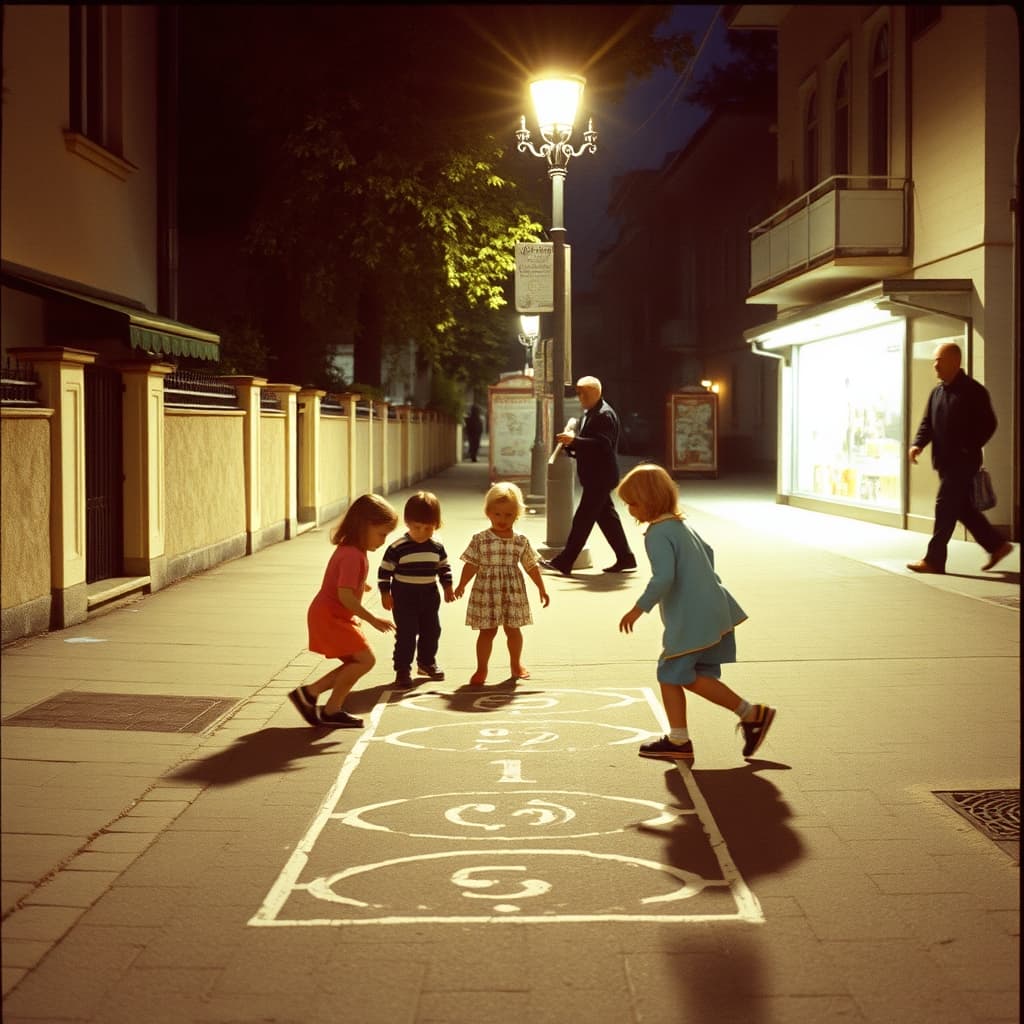
A few chalk lines could turn an ordinary pavement into a game with rules, turns, arguments, and spectators. Children numbered squares, chose a marker, tested the surface, and began hopping while neighbours stepped around the drawing. The court cost little and disappeared with rain or sweeping. Its temporary nature made the pavement feel available for invention, even though the space still belonged to many users.
Hopscotch patterns and names vary across regions and generations. The number of squares, throwing sequence, resting places, and penalties are not universal. Children learned from siblings, schoolmates, or neighbours and modified the game to fit available ground. Oral histories should record an actual diagram and rules instead of assuming every remembered seksek followed the same form.
The Drawing Was a Negotiation
Players needed a surface flat enough to land but positioned away from traffic, shop entrances, drains, stairs, and fragile property. A resident might permit chalk near a wall while objecting to blocked access. Children erased or moved the court when deliveries arrived. These interactions taught that public space could be used creatively only by noticing other people's routes.
The game trained balance, counting, throwing accuracy, memory, and turn-taking, but participation was not automatically inclusive. Uneven stone, narrow pavements, mobility impairments, visual differences, clothing rules, age, or peer exclusion could keep children out. Variants with larger squares, seated throwing, partners, tactile boundaries, or alternative scoring can widen participation without pretending every body moves alike.
Informal Supervision Had Limits
Shopkeepers, relatives, and residents recognised the players and sometimes warned of vehicles or conflict. That network could offer quick help. It was not a complete safeguarding system. Familiar adults are not always safe, and children need trusted guardians, clear boundaries, and ways to report harmful behaviour. Community warmth should not become a reason to ignore formal protection.
Road traffic increasingly narrowed possible play. Parked cars blocked sightlines; a thrown marker or ball could draw a child toward danger. Speed reduction, continuous pavements, safe crossings, lighting, and dedicated play areas are adult responsibilities. Nostalgia for agile street children is not an argument for unsafe urban design.
Why New Housing Can Feel Different
Gated developments may provide playgrounds, security, landscaping, and vehicle separation, but rules can restrict chalk, noise, gathering, or unsupervised movement. Towers and parking layouts may reduce visual connection between home and play. Families also have different schedules and fewer long-term neighbour relationships. Warmth does not come automatically from old masonry or disappear automatically behind a gate; it emerges from access, repetition, and permission.
Better design can support both safety and improvisation. Durable chalk surfaces, flexible courtyards, shade, seating for caregivers, inclusive equipment, toilets, drinking water, and routes children can reach independently all matter. Management rules should recognise low-risk creative play rather than treating every mark as damage. Children also deserve a voice in planning the spaces they use.
A Digital Nostalgia Archive can connect pavement photographs, hand-drawn rule diagrams, chalk boxes, school memories, traffic maps, housing plans, and testimony from players and residents. Images of children require consent. Hopscotch made the pavement feel shared because its boundaries were visible yet temporary. The lines invited a game while leaving room for the next person, the next rain, and a different drawing tomorrow.