 Eski Pano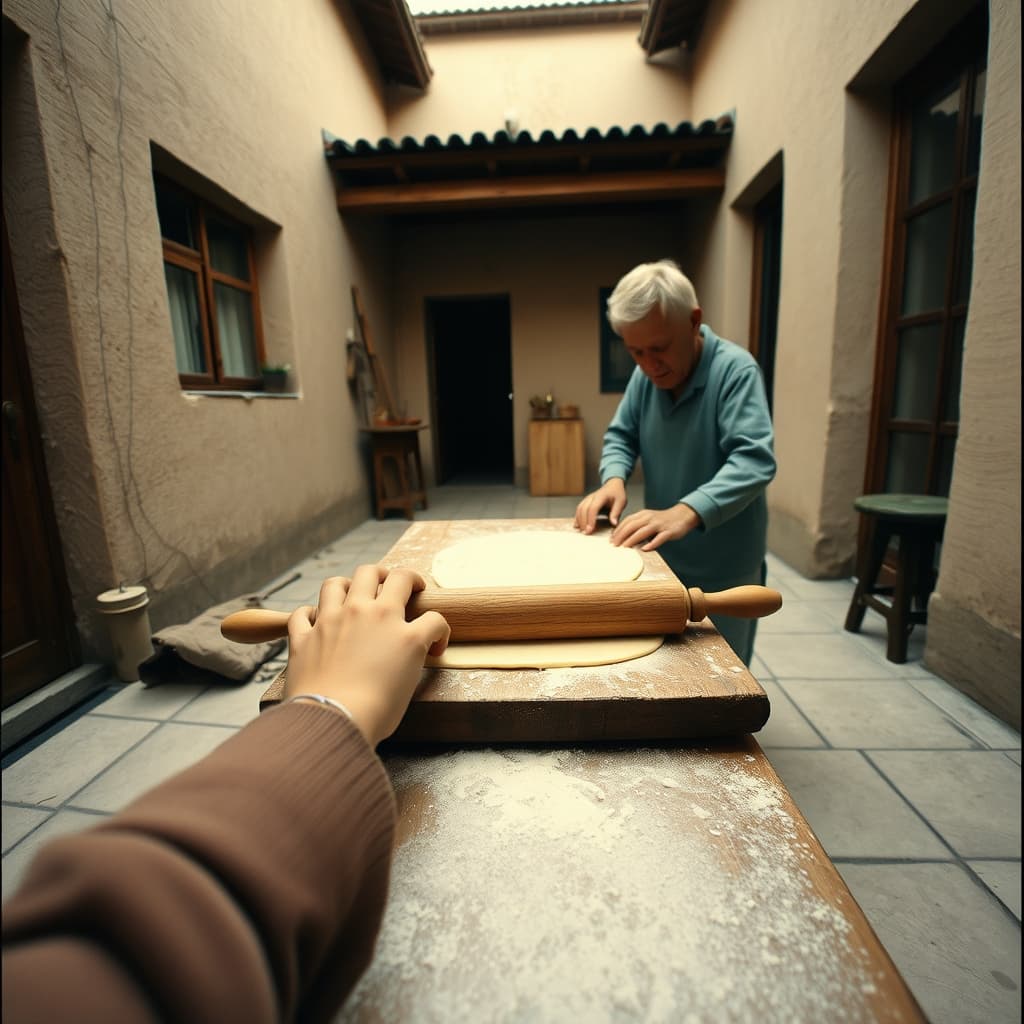
From a child’s height, a courtyard yufka morning could be a scene of hands and moving wood before it was understood as bread-making. The rolling pin travelled across the dough, the sheet changed shape, and another person reached for something beside the work surface. The adults knew the task. The child first encountered its visible rhythm.
This viewpoint helps explain why the morning could remain memorable long after the exact conversation was forgotten. A repeated movement gave attention somewhere to settle. The child did not need to understand quantities or the whole sequence to recognise the return of the pin and the widening sheet beneath it.
The Work Surface Framed the View
A low table or board brought the rolling closer to a small observer than a high kitchen counter would. The exact arrangement depended on the household and courtyard. Where the child stood or sat determined which movements were visible and which were hidden behind the workers.
A hand placed at the far edge might disappear from view, while the nearer end of the rolling pin came forward again. The same action looked different from another side. A remembered courtyard scene is therefore also a memory of position, not simply a record of what all participants could see.
A Round of Dough Did Not Stay the Same
The dough’s outline changed as the work continued. A smaller piece became broader, and its surface offered new areas for the pin to pass over. The observer could follow the change without knowing how the baker judged thickness or readiness.
The adults’ adjustments mattered alongside the repeated motion. Turning or repositioning the sheet prevented the scene from becoming a simple back-and-forth image. These decisions belonged to the person making that yufka. They should not be presented as a complete method for every regional version of the bread.
Neighbours Spoke around the Movement
Conversation could continue while hands stayed with the task. A reply might be delayed until a movement was finished, or another person answer from a different part of the courtyard. The child heard a social exchange whose pace was partly set by work.
A familiar voice and a familiar movement could become linked in memory even without a remembered sentence. That connection does not justify inventing dialogue. It shows another way the scene remained recognisable: the people were known through what they did and how their presence fitted into the morning.
Watching Was Not Automatically Helping
A child nearby might observe without taking part. Another could be given a suitable small task, but the roles varied. It is important not to turn every childhood recollection into a story of instruction or participation simply because adults were working together.
The observer’s attention could also wander. A return to the work surface might reveal a new sheet or a different person in the same place. The continuity belonged to the group’s activity even when the child did not watch every stage. What survived in memory could be a few close views rather than the entire production.
Courtyard yufka mornings joined bread-making and neighbourly presence at a scale a child could see. The lasting image might be the rolling pin coming towards the near edge, a widening sheet or a voice heard while hands remained busy. These details preserve a particular encounter with skilled work. The morning mattered not because childhood understood everything, but because ordinary movements offered something precise to remember.