Eski Pano
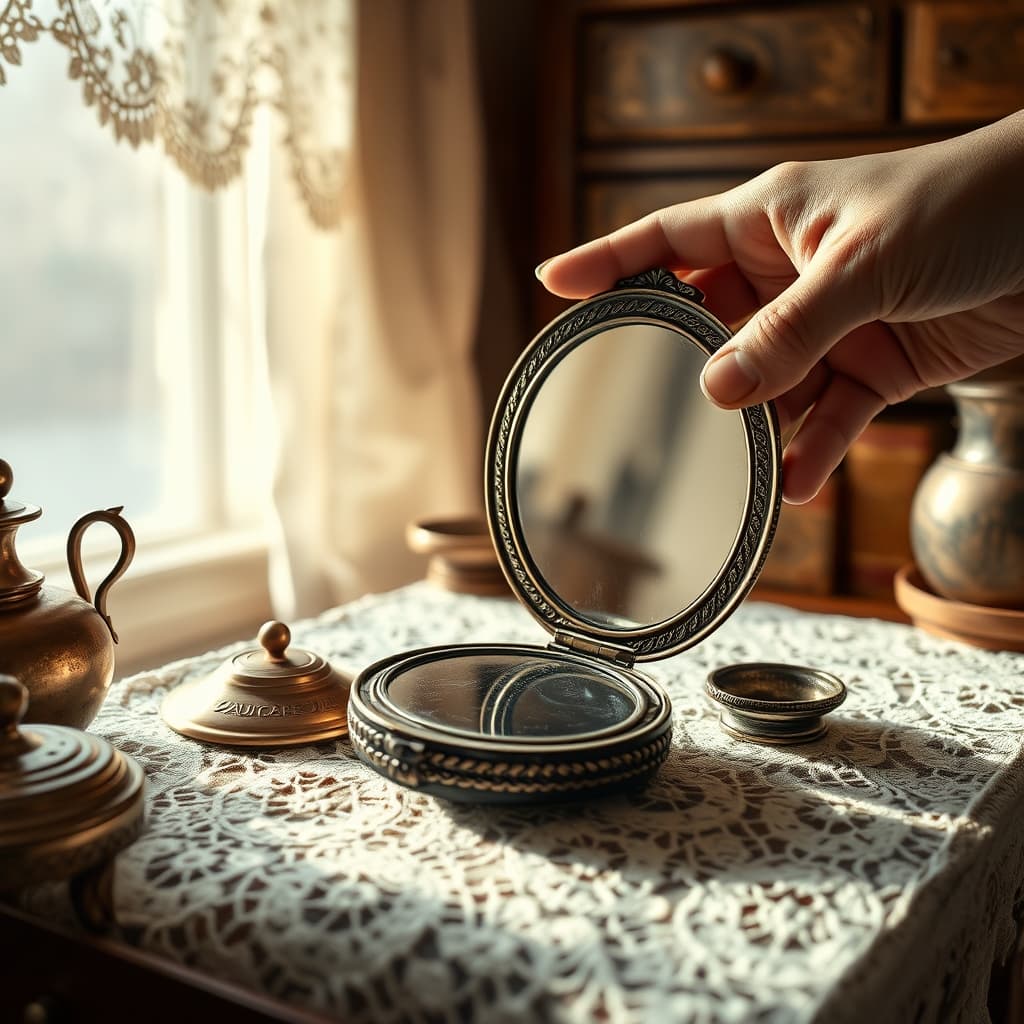
Some objects continue moving through a home even after they have withdrawn from daily use. The pocket mirror is exactly such an object. Once kept quietly in the inner pocket of a handbag, beside the sewing box, or inside a bedroom drawer, this small mirror would show its face again during pre-holiday cleaning days. Cupboards were opened, drawers aired, thin covers shaken out, and then the mirror taken from a small box would be wiped and polished. In that moment, it was not only a metal rim or glass surface being cleaned. The way older generations had once looked at themselves became visible again. Light scratches, delicate work around the lid, sometimes an old photograph or dried flower petal tucked behind it all worked like silent records of a family story.
Seen as an object story, the pocket mirror is one of the most elegant examples of use value and emotional value meeting in the same form. Mirrors kept from the girlhood years of mothers or grandmothers were not used only to retouch makeup or straighten a scarf. They carried the small etiquette of giving oneself one last glance before stepping outside. That made the pocket mirror more than an object. It was a cultural sign of everyday care. Holiday cleaning was the moment when that sign became visible again. The deep cleaning done before a holiday was never only about removing dust. It refreshed the house's arrangement of memory. In that ceremony, the pocket mirror caught light once more, emerging from the darkness of a trunk or drawer and returning for a few minutes to the family's shared memory.
What helps turn this small mirror into a family heirloom is the intimacy passed by hand from one generation to another. A little girl watches her mother or grandmother hold the mirror, adjust her hair, or examine the edge of her lips. Years later, when the same mirror rests in her own palm, she inherits not only the object, but the discipline of that gesture. In older homes, a mirror was a modest yet meaningful companion. It was tucked into a bag, carried on holiday visits, included in a bridal bundle, or kept near the sewing box. What made it valuable was not expense, but the fact that it accompanied someone's daily rhythm. For that reason, even a scratched pocket mirror could not easily be replaced with a new one. The small flaws on its surface held the touch of years.
The polishing of the mirror during holiday cleaning feels like a symbolic scene from domestic life of the past. As windows were washed and light entered the room, it multiplied differently on copper trays, porcelain sets, and the little mirror. Children might not understand at the time why these things were handled with such care, yet the seriousness in adult hands taught respect for objects. Suddenly the mirror ceased to be only something looked into and became a surface that prompted memory. Phrases such as "this belonged to your grandmother when she was young" or "she used this on her wedding day" formed a small family tree around the object. In this way the pocket mirror stopped being an unused old item and became a tangible carrier of the narrative moving through the family.
In a modern life shaped by fast consumption, it may be harder to understand the long emotional weight of such small objects. Today people often look at themselves in a phone screen, an elevator panel, or a shop window. Yet the feeling given by a pocket mirror was something else. It represented a portable courtesy of self-regard. The person who took it from a pocket or bag reserved a brief moment of attention for themselves before joining the world. That is why the face that shone again during holiday cleaning was never only the glass itself. It was the family memory catching light for a short while. The reflection inside the mirror changed, but the gesture of holding it remained strikingly similar across generations.
The pocket mirror becomes a family heirloom precisely through these repeating but never ordinary gestures. The object changes hands over time, yet never fully loses its meaning. Each new owner adds another story, while the voice, scent, morning routine, and holiday hurry of the earlier owner remain invisibly present upon it. Cultural heritage sometimes survives not in large furniture or heavy trunks, but in such delicate items that fit into a palm. The pocket mirror quietly keeps together the family's culture of care, attention, and remembrance. Perhaps that is why the small surface polished before the holiday can cast light, if only for a moment, across the whole past of a household.
The Pocket Mirror and the Face That Shone Again During Holiday Cleaning: How Did It Turn into a Family Heirloom?