Eski Pano
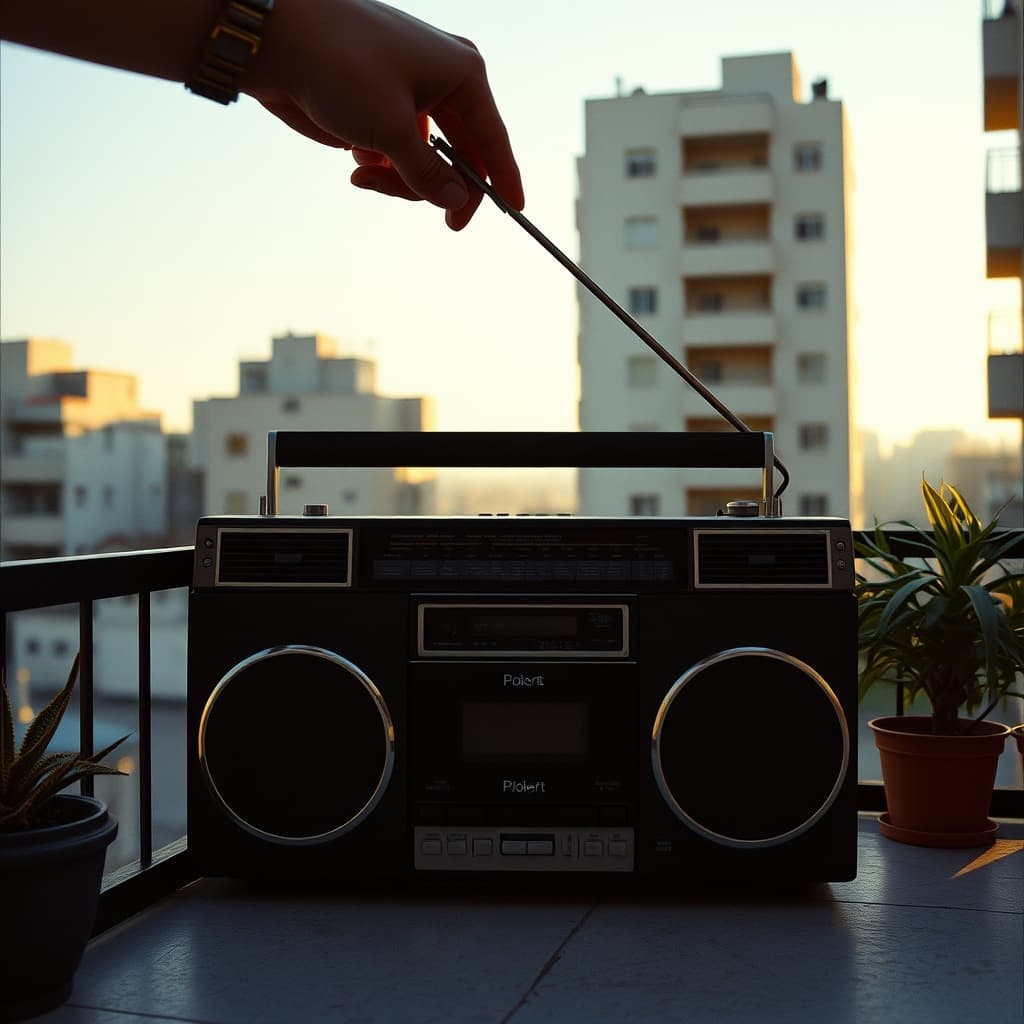
There was a time when music was not simply something to hear. It had to be found, caught, adjusted, and almost invited into the house or the street through a small effort of care. As afternoon shadows lengthened along apartment walls, the boombox standing near the balcony or window suddenly became the center of domestic life. The cassette door might be open, the batteries freshly checked, the antenna slowly extended. Then the truly ceremonial movement began: the device was turned a little, the antenna shifted millimeter by millimeter, and a clean sound was searched for inside the static. In that moment, a small but real expectation appeared on every face. Would it be the news bulletin, a beloved song, or the familiar host of an evening program? That is why using a boombox never felt like an ordinary encounter with a machine. It was a modest ritual that organized the rhythm from day toward night.
As technological heritage, the boombox stands as one of the liveliest symbols of how portable sound entered neighborhood life. Bringing together radio, cassette player, and often powerful speakers in one object, it reflected both the practical ingenuity and the social desires of the analog age. Hearing sound was not enough; it had to be assembled in the right frequency, at the right moment, within the right atmosphere. The angle of the antenna, the strength of the batteries, the surface the machine stood on, even whether the window was open or shut could change the result. Because of that, the minutes spent with a boombox were as much a lesson in patience and attention as a technical adjustment. Teenagers slung it over a shoulder and carried it into the street, children danced in alleyways, adults leaned in during radio news hours. The same object performed a different social role at each hour of the day.
Part of what made it ceremonial was the fact that it was shared. More important than hearing a song alone was the collective thrill of saying, "there, it's clear now," when the sound sharpened for everyone at once. Siblings leaned on balcony railings, a mother called out from the kitchen, a father asked from the living room for the volume to go a little higher. All gathered around the same frequency. The cassette era added another layer to this rhythm. If a favorite song began on the radio, everyone fell silent for a second so the host's voice would not spill into the recording. The result was rarely perfect. A little static might remain at the beginning, or an announcement might overlap at the end. Yet those imperfections were exactly what made the song belong to that household, binding the memory of the machine to the memory of the family.
The long shadows of late afternoon hold a special place in this story because the boombox was often most meaningful at that hour. The work of the day had finished, but the silence of evening had not yet fully begun. The city was still active, yet ready to listen. Cool air entered through the balcony door, children shouted in the street below, a minibus engine passed somewhere in the distance, and melodies from the radio mixed into all of it. The boombox created a bridge between inside and outside, sending rhythm not only against the wall, but into the air itself. Perhaps that is the feeling missing from today's flawless digital audio: once, reaching music meant searching a little, waiting a little, and hoping a little.
The reason the boombox is remembered now as a ceremony in itself lies exactly there. It did more than play songs. It arranged how people shared time. The sound clearing as the antenna turned was also the sound of living together finding its balance. A song caught before evening, a clean frequency found in time for the news, a track successfully recorded onto tape all brought a small but unforgettable sense of accomplishment. For that reason, the boombox remains in memory not merely as one of the loud devices of the analog world, but as one of its most ritual-filled.
Why Using a Boombox with Hope Growing Clearer as the Antenna Was Turned Became a Ceremony in Itself, with a Rhythm Stretching from Day into Night Through Lengthening Afternoon Shadows