 Eski Pano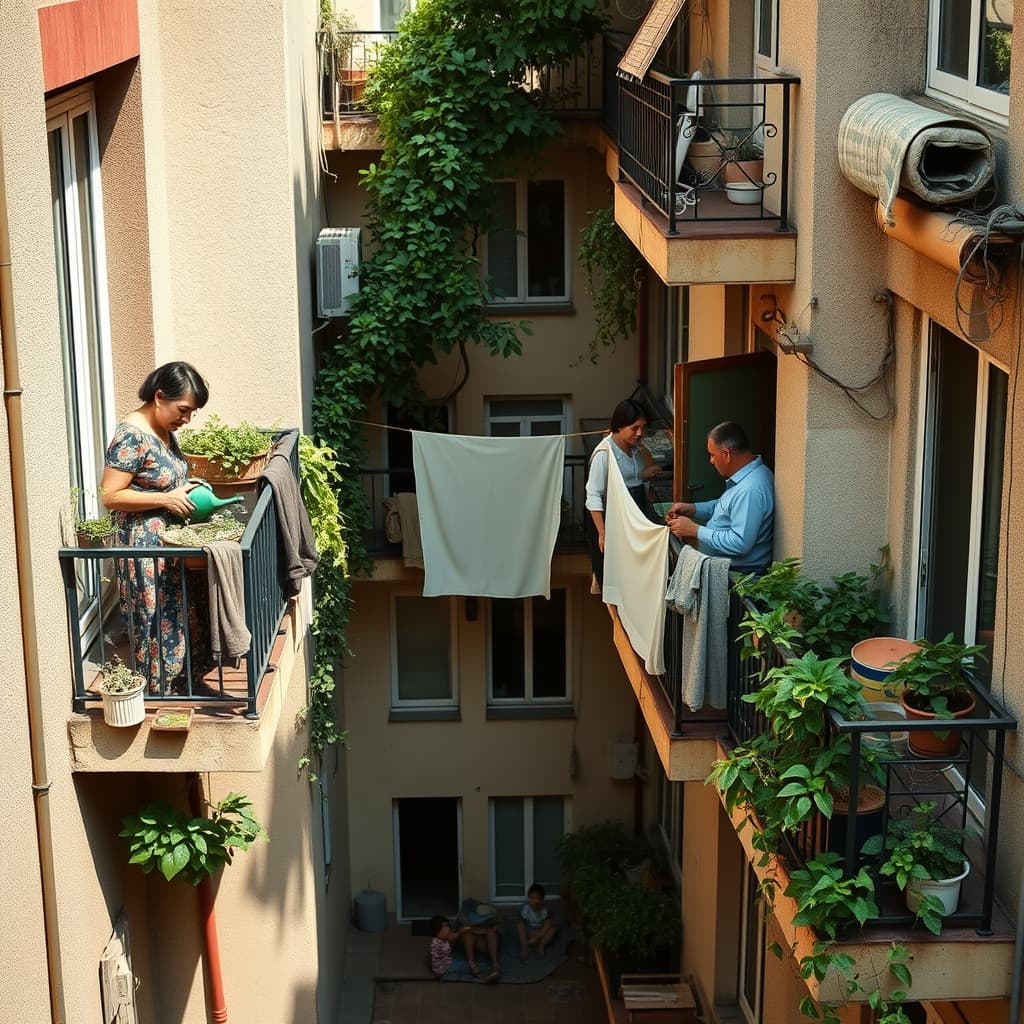
Neighbouring balconies allowed friendship to grow in intervals too short to qualify as visits. A greeting while hanging laundry, a question asked over watering plants or a few sentences exchanged before someone returned inside could accumulate across weeks. The people involved saw one another without arranging a meeting. This repeated visibility created familiarity, but familiarity became trust only when it was joined by discretion and respect.
The physical setting shaped the relationship. Balconies could face one another across a narrow street, sit side by side with a dividing wall or rise in stacked rows around a courtyard. Voice travelled differently in each arrangement. A conversation might remain between two households or become audible to several floors. Residents learned how loudly to call, when to continue indoors and when a closed curtain meant that no exchange was wanted.
Small Requests Tested Everyday Trust
Balcony contact often led to practical help. A neighbour could watch whether washing was getting wet, warn that a delivery had arrived, pass a small item through an adjoining edge or keep an eye on children playing below. Plants might be watered during an absence. Such favours were modest, yet repetition made them dependable. They also created obligations, and not every household had equal time or ability to respond.
Children experienced the balcony as a point between supervision and independence. An adult could call them home from above, answer a question from the street or coordinate with another parent. Older residents used the space to follow the changing sounds of the day. Shop shutters, school departures and evening cooking became common reference points. The balcony was private property, but it opened onto a shared sensory environment.
Closeness Needed A Boundary To Survive
Older neighbourhood life is often remembered as effortlessly intimate, yet proximity could also produce scrutiny, noise and unwanted advice. Looking across did not grant a right to report everything seen. Strong relationships depended on knowing which matters required help and which required silence. Gossip could damage the same trust that regular greetings created. Balcony friendship was therefore an informal social skill, not simply an architectural effect.
Domestic labour was visible in this setting. Laundry, cleaning, food preparation and childcare appeared at the building's edge, often revealing work performed by women that remained unnoticed elsewhere. Mutual support could lighten the burden, but it could also reinforce expectations that a particular person would always be available. A complete memory keeps companionship and unequal labour in the same frame.
Air conditioning, enclosed balconies, traffic, privacy concerns and digital communication have changed this contact. Many people now message a neighbour they can no longer hear across the street. The older balcony friendship belongs in a Digital Nostalgia Archive because it shows trust growing through repeated, low-intensity encounters. Its strength came neither from constant access nor from ideal harmony. It came from recognising another household's rhythm, offering help at the right moment and allowing a few metres of open air to remain a respectful distance as well as a bridge.
Season also influenced the rhythm. Summer extended conversations into the evening, while cold and rain shortened them without necessarily ending the relationship. Continuity depended less on constant talk than on returning to the exchange when circumstances allowed.