 Eski Pano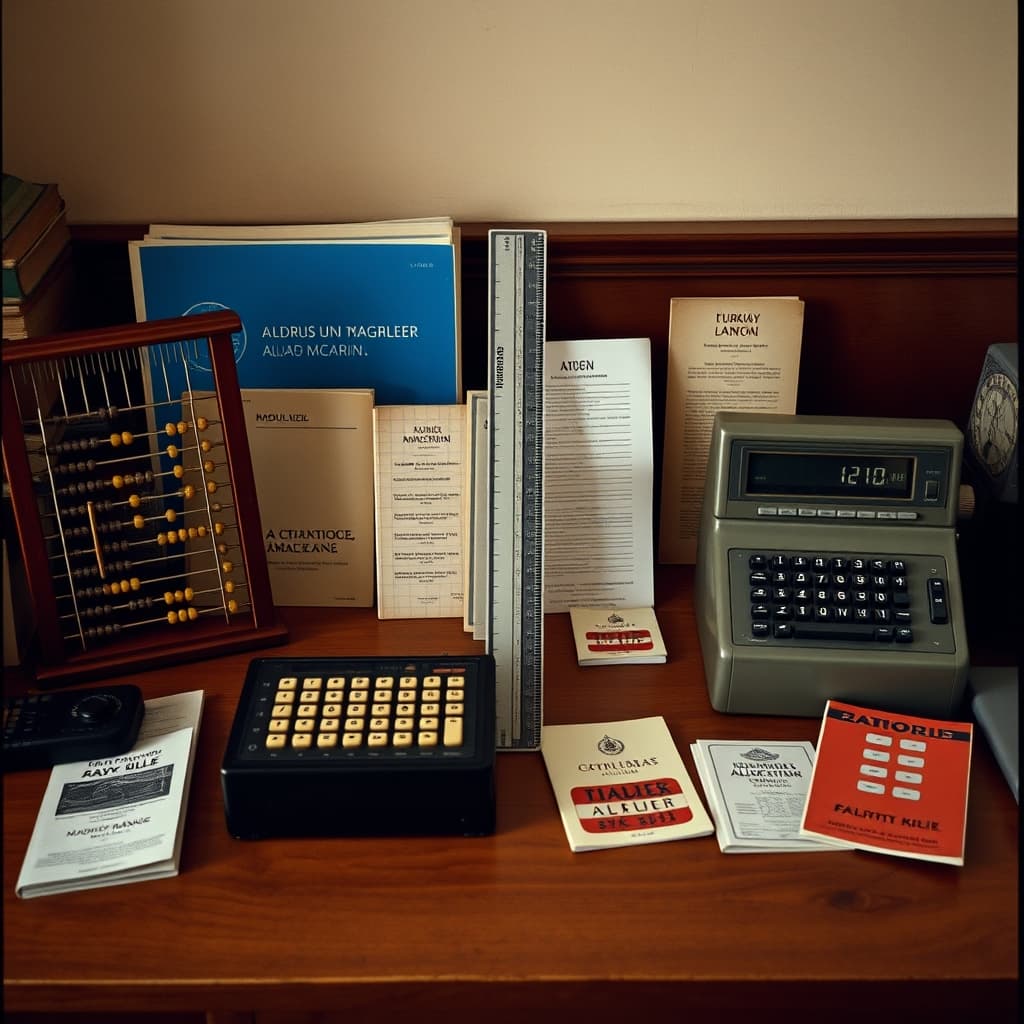
A family may remember an old object as a desk calculation ruler even when it is an abacus, slide rule, mechanical adding machine, ready reckoner, or teaching aid. The name matters because each device encodes a different method of thinking. Identification should begin with what moves, what is marked, and how a result appears, not with a vague resemblance to modern calculators.
Analogue calculators vary by country, profession, school system, maker, date, scale design, numeric base, and intended operation. Commercial desk models, engineering instruments, shop counters, classroom aids, and children's toys can look related. Maker plates, patents, catalogues, manuals, advertisements, invoices, photographs, and user testimony help establish purpose.
Movement Reveals the Calculation Method
An abacus represents value through beads moved along rods or wires. A slide rule aligns logarithmic or specialised scales with a sliding body and sometimes a cursor. An adding machine uses keys, levers, gears, registers, or printed paper to perform arithmetic. A printed table or circular calculator may have no internal mechanism at all.
Look for scale labels, decimal markers, units, key legends, carry mechanisms, reset levers, stylus holes, cursor lines, and result windows. Photograph every side before cleaning. A missing cursor, crank, stylus, paper roll, or bead may make the function seem different from the original design.
Maker Marks Need Context
A trademark may identify a distributor rather than the manufacturer, while a patent number may cover one mechanism used across several models. Serial ranges and address changes can support dating, but reused cases and repairs complicate the story. Family claims about occupation or school use are valuable when recorded with their source and confidence.
Do not assume that a familiar-looking scale follows the same convention as another instrument. Slide rules may use specialised scales for engineering, finance, navigation, chemistry, or trade. Abaci can differ in bead grouping and place value. An incorrect demonstration teaches the wrong calculation and may damage stops or fragile parts.
Cleaning Should Follow Identification
Water, solvents, oils, metal polish, and abrasive cloths can erase printed scales, swell wood, cloud plastic, stain paper, or carry dirt into gears. Loose dust should be addressed cautiously, and corrosion, mould, flaking labels, or seized mechanisms may require a conservator. Unknown devices should never be forced to produce a result.
Mechanical machines may contain pinch points, sharp edges, heavy carriages, springs, and unstable bases. Electric adding machines add brittle wiring, unsuitable voltage, and degraded insulation. Disconnect power and obtain qualified inspection before operation. Children should use a replica or supervised demonstration suited to their age.
A catalogue should record dimensions, weight, materials, marks, serial and patent numbers, scale or key layout, moving parts, output method, missing elements, repairs, owner, occupation, storage, and identification sources. A short video of a safe operation can preserve technique, but it should explain uncertainty rather than present a guess as fact.
A Digital Nostalgia Archive can connect the desk calculator with manuals, patents, maker history, family user, calculations, training, condition, conservation, and demonstration. The object stayed in memory because numbers became physical movement beneath the hand. Correct identification restores that movement's meaning and prevents an abacus, slide rule, and adding machine from becoming one interchangeable symbol of the past.