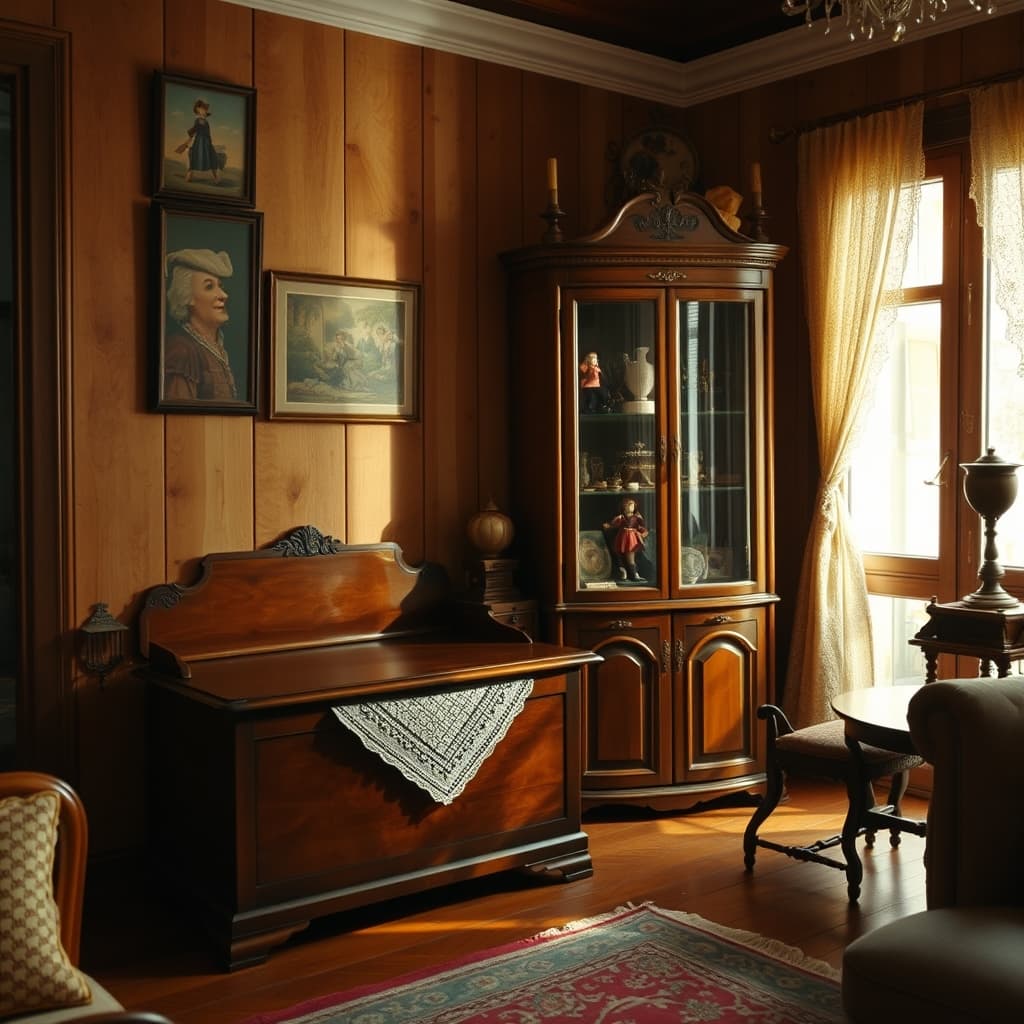
Eski Pano
There was a time when the most visible corners of living rooms were arranged not only to impress guests, but to quietly express how a family wished to remember itself. Inside glass-fronted display cabinets stood lace covers, holiday teacup sets, a few carefully preserved figurines, and very often a wooden toy chest, or small objects that had once come from it, poised between childhood and domestic order. When daylight struck the glass, the soft glow gathering on the polished wood gave the room the seriousness of a private exhibition. It is no accident that such a scene shines immediately in the eyes of nostalgia enthusiasts. What becomes visible there is not only an old object, but the interior aesthetic of the past, the habit of preserving, and the emotional discipline once formed around household things.
From the perspective of object stories, the wooden toy chest is a special item because it places the temporary disorder of childhood inside the lasting order of the family home. Toys scatter through daily use, yet when evening comes or guests are expected, they are gathered back into the chest, the lid is closed, and the world of play is turned once again into an organized whole. The most visible corner of the living room cabinet, by contrast, was both the most public and the most controlled face of the home. When these two elements stand side by side, we understand how earlier generations balanced childhood with representation. The toy chest stores not only the hours of play, but also a household's education in caring for objects. The durable body of the wood, the sound of its metal hinge, and the cloth dolls, tin cars, or colorful marbles inside all connect the world of the child to the wider frame of family memory.
One reason nostalgia enthusiasts respond so quickly to these items is that they do not see them as merely functional. A wooden chest carries the marks of years of touch: a slight wear along the edge, a sticker left on the lid, the scent of soap or mothballs absorbed into the interior become tangible evidence of the past. The living room cabinet works in a similar way, revealing what the household considered worthy of preservation. The object placed in the most visible corner was never random; it was often something the family felt proud of, had received as a gift, or wished to save for children yet to come. That is why the radiance is not simply light on glass. What shines is the intergenerational meaning held by the object. Looking at such a display, one senses, even without sharing the exact same childhood, how a home was loved and arranged.
In old urban life there was another unseen relation between the toy chest and the cabinet corner: both domesticated memory. The toy chest gathered scattered days back into order, while the cabinet kept selected memories visible. The objects moved during holiday cleaning, the new toys added to the chest, the pieces put away carefully so they would not break all show that things were not used and discarded without thought. They were maintained, narrated, and given new meanings within family life. Today, in a culture of rapid consumption, many possessions are replaced with ease. The wooden chest and the display cabinet remind us that objects were once imagined as long-term companions. Perhaps that is why they shine so quickly in the eyes of those who love nostalgia: they touch the human desire to arrange one's own past.
When we encounter such a chest today in an antique shop or in an old family house, what affects us is not only its form or material. What moves us is the way it summons the joy once felt when the lid was opened, the ordered world seen through the cabinet glass, and the silent rules and warmth of domestic life. The wooden toy chest and the visible corner of the living room display cabinet still seem luminous today because both represent a vanished household rhythm. The bond between childhood and play, adulthood and order, family and remembrance becomes concrete inside these objects. Looking at them, we see not only old things, but the carefully composed interior world of the past. The true brightness of nostalgia is born exactly there: not on the glass, varnish, or wood itself, but in the sense of lived time that settled inside them.
The Wooden Toy Chest and the Most Visible Corner of the Living Room Display Cabinet: Why Does It Shine Instantly in the Eyes of Nostalgia Enthusiasts?