Eski Pano
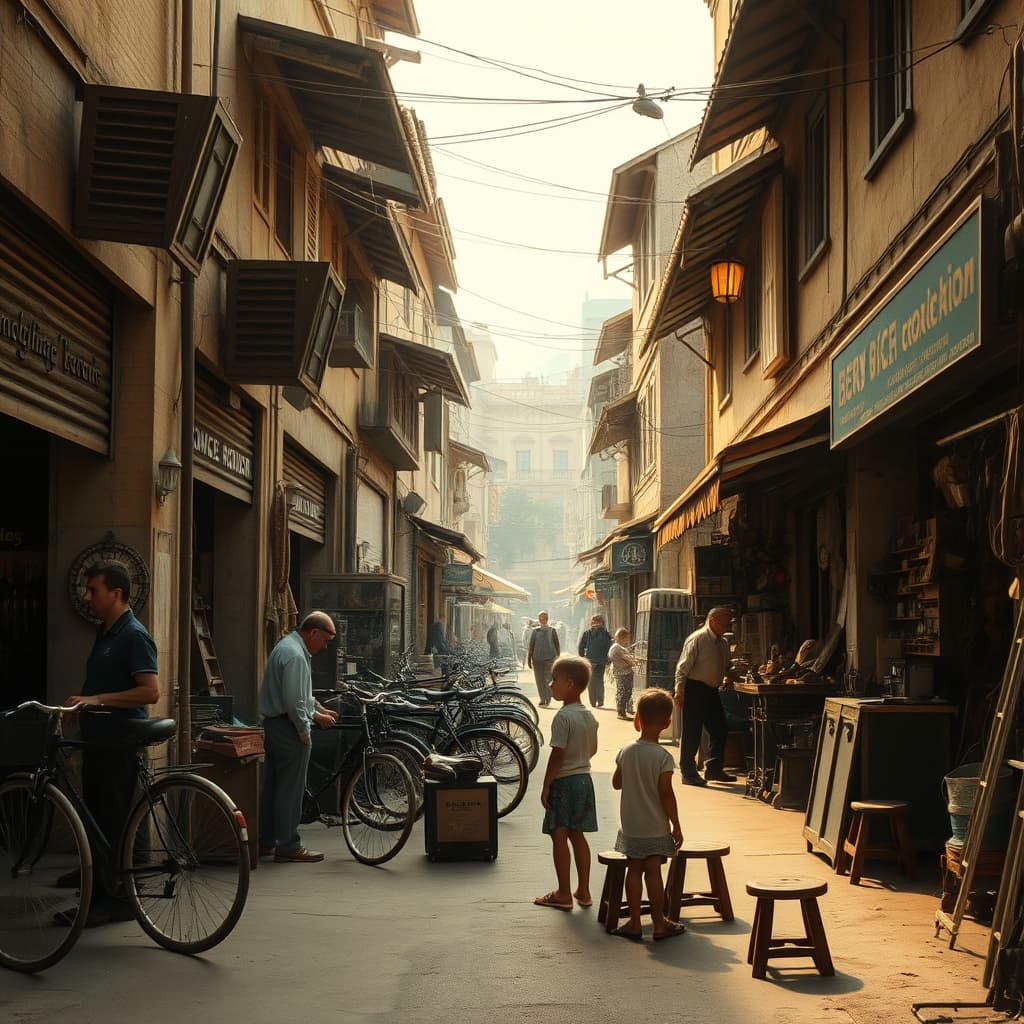
There was once, in the memory of every neighborhood, a street whose very name brought relief. In some places it was the tailors’ market, in others the coppersmiths’ row, and elsewhere the long industrious line that everyone simply called the repairmen’s street. Even when the languor of holidays spread through the district, that street never fell entirely silent. Shutters stood half-open, and from within came the sounds of keys, screwdrivers, the smell of oil, and light music leaking from a radio. Children stopped by to show a loose screw on a bicycle, fathers asked for a watch strap to be replaced, and mothers wanted to know whether a broken kitchen appliance could still be saved. Each shop there was more than a point of service; it was like a common defense line the neighborhood had built against breakdown itself. Knowing that a broken thing would not be thrown away at once gave people not only economic relief, but emotional comfort as well.
Within neighborhood culture, the repairmen’s street is one of the clearest public spaces in which a sense of security became tangible. For on that street, not only objects but relationships were repaired. A master knew his customers, remembered a child’s name, recalled the iron brought in the week before, and sometimes offered tea while a repair was underway. The simple fact that there was movement in the shops even on a holiday made people feel that the neighborhood had not dissolved. Sitting at home, they knew that a few streets away there were still working hands. That knowledge created an invisible yet powerful social assurance. In a world where everything could feel fragile, the possibility of repair made life itself seem capable of being gathered back together. Perhaps that is why a generation’s sense of safety grew first in these small islands of craftsmanship before it ever grew in official institutions.
Another reason the repairmen’s street remains so vivid in memory is the productive looseness it carried on holidays. Formal seriousness faded, yet labor did not disappear. A tradesman would set a stool outside, chat with the neighbor from the next shop, and still keep one hand on pliers, sandpaper, or the sewing machine. For a child, it was a field of discovery: open watch backs, light bulbs lined on shelves, coils of cable, bicycle bells, sewing-machine belts, metal parts, and the quickness of skilled hands. For adults, it was a place where problems remained solvable. Everything brought into the home did not belong to the fate of single use; it could be taken to a craftsman, examined, discussed, perhaps waited on, and finally returned to life. This culture depended less on consumption than on care and continuity.
What we miss when we think of the repairmen’s street today is not merely the appearance of the shops. What is really missed is the widely shared belief that breakdown was not an ending, but a temporary state. That was what nourished a generation’s sense of security: there were people nearby who could produce solutions. Even in the slow mood of a holiday, that busy crowd whispered the same thing to the neighborhood: life may falter, but it does not wholly fall apart. A screw can be tightened, a cable renewed, a lock adjusted, a shoe stitched. These small interventions gave resilience not only to objects, but to daily life itself. That is why the repairmen’s street was more than an economic habit; it was a concrete map of trust, craftsmanship, and the culture of living together. Those who grew up in such streets could believe, for a while longer, that the world might always remain repairable.
The Industrious Crowd of the Repairmen’s Street in the Ease of Holiday Days: How Did It Nourish a Generation’s Sense of Security?