Eski Pano
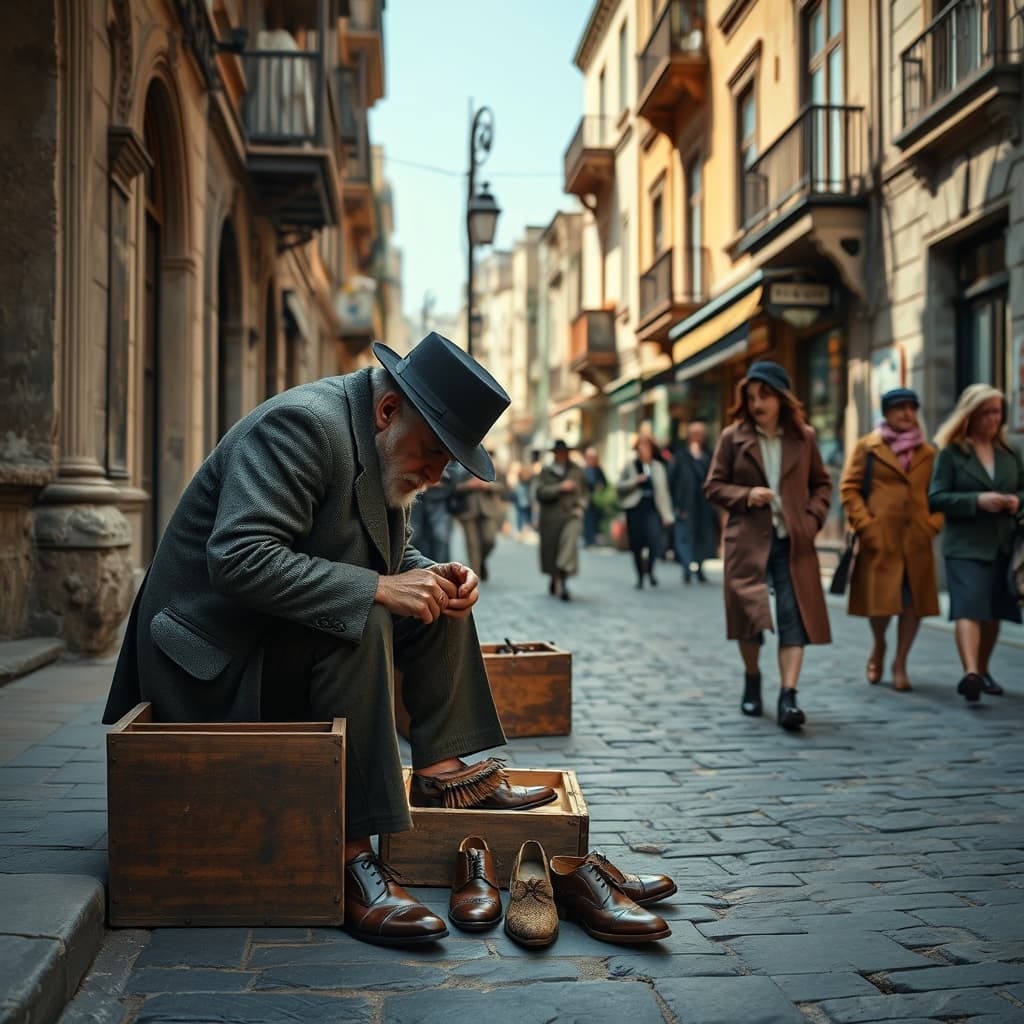
There was a time when one of the most familiar sights in the city was the shoeshiner waiting patiently on the corner. Early in the morning he set down his stool, brushes, polish, and small wooden box in the same place and created his own rhythm within the passing crowd. His presence was not as official as a shop sign, yet it remained in the neighborhood’s memory just as deeply. The shoeshiner’s vigil on the corner was not only an effort to make a living; it was the visible ethic of labor in old urban life. The clerk passing by, the shopkeeper hurrying to market, the child dressed for a holiday, the young man preparing for a wedding, all joined the city’s daily order for a moment by sitting on his stool. The shine left by the cloth on a shoe mattered, but so did the brief and measured conversation formed between worker and customer.
From the perspective of neighborhood culture, the shoeshiner was one of those figures who both served the street and quietly gathered its news. Which part of town had a wedding, which store had just opened, which official had been transferred, which child had outgrown a pair of shoes, all these small pieces of city knowledge passed through his corner. The shoeshine box was also a kind of observation point. He recognized people by the way they walked, by the wear on their shoes, by the urgency of their morning. The customer, in turn, placed not only shoes but also a little of the day’s fatigue or joy before him. That is why the shoeshiner’s place in the heart of the city was not merely a physical corner. It was a living threshold of social contact.
In old urban life, shoes had a language of their own. A polished leather shoe spoke of seriousness, a dusty child’s shoe of movement, a pair worn at the heel of the burden of working life. The shoeshiner read this language before anyone else. As he moved the brush in firm but careful strokes, he also gathered clues about the customer’s life. One would say in haste, “I have something important today.” Another would silently watch the polish deepen. A third might sit down only to catch a breath in the street. Those few minutes spent on the corner were like a pause that gently slowed the city’s pace. That is why the shoeshiner’s vigil is remembered: he created a small station of human scale in the hard flow of urban life.
The image of a family memory that never fades on windy balconies is not accidental either. For many children, the shoeshiner was part of city walks taken with a father or grandfather. A hand would lead them to the corner, someone would say, “Let’s have them shined first,” and the child would watch the gleam of the polish tins, the rhythm of the brushes, the final motion of the cloth over the shoe. When they returned home, the polished shoes taken off by the balcony door carried the order of the street back inside. In that way, the shoeshiner did not remain only a figure of the street; he entered family memory as well. Many old walks, holiday preparations, and Sunday mornings hold the trace of his labor somewhere along their edge.
Today, shoeshiners on street corners have become rare. Fast consumption, ready-made care products, and the changing structure of the city have pushed the profession toward invisibility. Yet what remains in memory is not only nostalgia for a disappearing occupation. It is also the recollection of how public life was once built through face-to-face encounters, brief but real. The shoeshiner’s vigil belonged in the heart of old urban life because he polished more than shoes. He polished the care with which a person stepped into the street, their visibility within the neighborhood, and the dignity of everyday labor. That is why the small box at the corner holds such an unexpectedly large place in the memory of the old city.
Why Did the Shoeshiner’s Vigil on the Corner Take Its Place in the Heart of Old Urban Life Like a Family Memory That Never Fades on Windy Balconies