Eski Pano
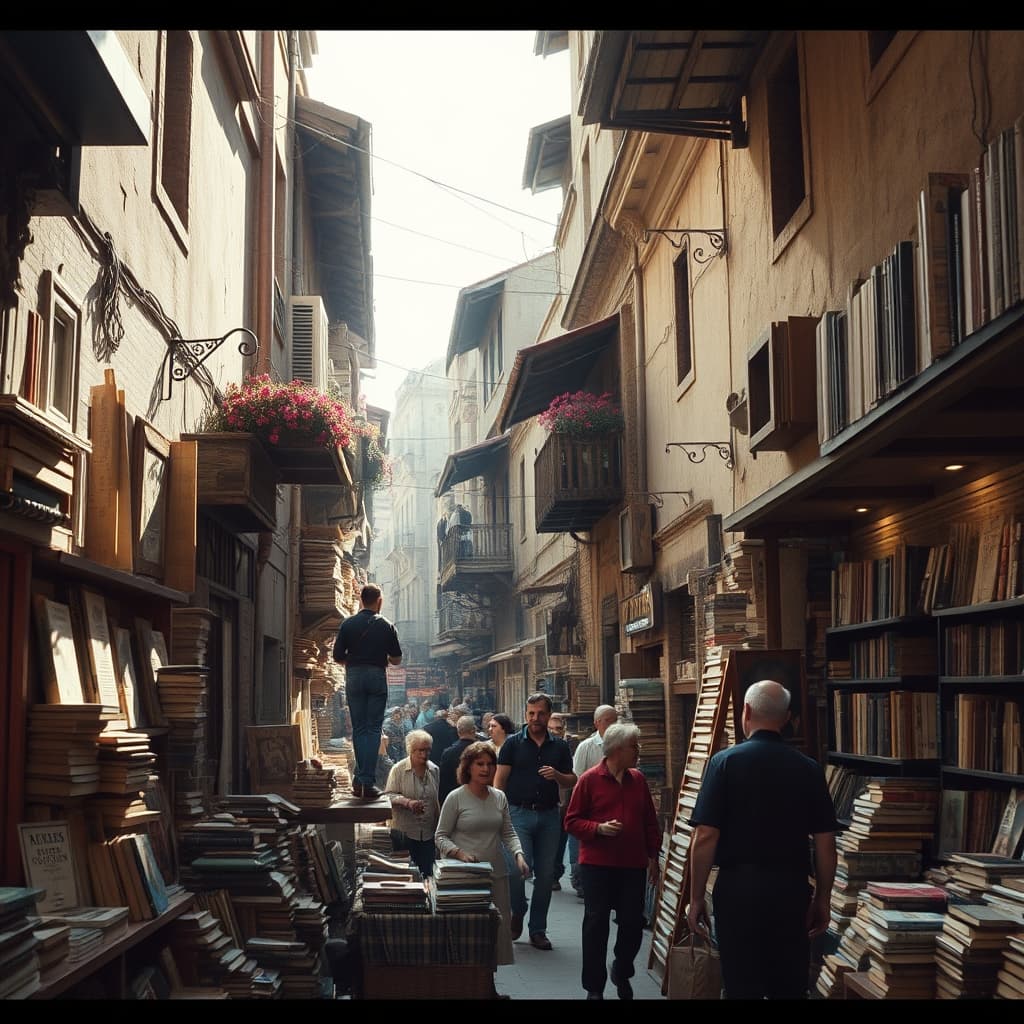
There was a time when afternoons did not resemble any other hour of the city. Sunlight fell at an angle over the stone pavement, and the scent of carnations, jasmine, and damp soil drifting from the florists mixed with the dry dust of books at the entrance to the secondhand book bazaar. The spines of old volumes stood in rows, their faded lettering half erased by years, and the slowing footsteps in front of the shops felt like a small objection to the haste of daily life. Whoever entered the bazaar was not merely looking for a book, but for the trace of something that resembled memory itself. A postcard left between pages, a volume of poems marked in the margin, or an encyclopedia with a loosened cover made the past feel still touchable. That is why the afternoons of these bazaars are remembered as hours in which a quiet yet deep curiosity gathered and lingered.
Seen along the trail of time, secondhand book bazaars were not only places where used goods circulated, but also places where cultural memory was protected at neighborhood scale. The windows of new bookstores showed the present, while the shelves of the secondhand dealer opened the layered accumulation of time. Old schoolbooks, yellowed magazines, calendar pages, city guides, and novels no longer in print revealed what a society had read, what it had kept, and what it could not bear to forget. In these shops, a purchase rarely ended with money changing hands or a brief bargain. Stories were told about which homes the books had come from, whose hands had once turned their pages, and on what shelves they had waited for years. In that sense, the bookseller was not merely a merchant, but a modest historian of the city, a keeper of forgotten details.
Among the quiet habits carried into the present, one of the strongest is the habit of approaching an object not as something to be consumed quickly, but as a companion bearing traces. Generations who grew up with these bazaars learned to notice not only the content of a book, but also its physical life. Looking at worn corners, dried flowers left between pages, or signatures from former owners meant touching an object while imagining its journey. Perhaps the renewed interest in secondhand books, records, and old notebooks today also rises from that habit. The culture of the secondhand bazaar taught people to value not what was flawless and shining, but what had been used, lived with, and filled with memory. That sensibility extended beyond books into household objects, inherited letters, and even the tone with which people spoke of the past.
The image of flower-scented streets becomes meaningful here. The road to the book bazaar often passed through a narrow arcade, a shaded courtyard, or a lane where small tradesmen stood door to door. On one side there might be a haberdashery, on the other a framer, and a little further on someone asking for a gramophone needle. This mixture did not separate books from the rest of life; on the contrary, it placed them inside the fabric of the everyday. Writing the date on the first page after returning home, wrapping a newly found volume in newspaper to carry it carefully, or lending it to a friend with the words, "I thought of you when I saw this," are quiet habits that still survive. Choosing slowly, keeping things attentively, and telling one another the stories of meaningful objects all descend from those old afternoons.
Today digital catalogs and rapid deliveries make life easier, yet the afternoons when secondhand book bazaars gathered curious spirits still leave a cool and delicate mark in memory. What is missed is not only the smell of old books. More deeply, it is the feeling of a life in which finding something depended a little on chance, a little on patience, and a little on walking through the city. Time spent before dusty shelves did not only lead people toward the past; it also taught them how to look at the present. Perhaps that is why many people still examine a book's cover, paper, and inherited traces before deciding to take it home. Secondhand book bazaars quietly left us this lesson: the most valuable parts of life are often not the newest ones, but the ones laden with meaning, and some streets are not merely walked through, but remembered.
The Afternoons When Secondhand Book Bazaars Gathered Curious Souls on the Dusty Shelves of Memory: Which Quiet Habits Did They Leave to Today in Flower-Scented Streets?