Eski Pano
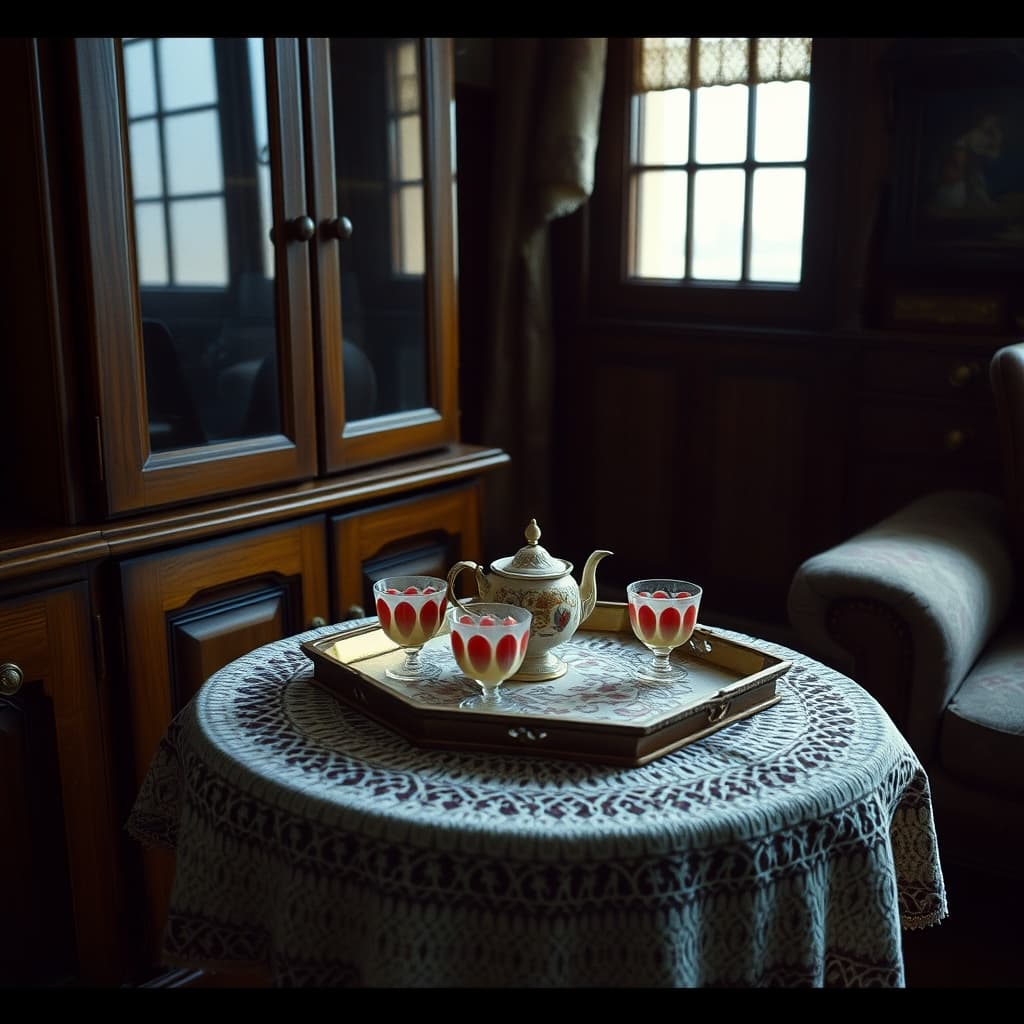
Some objects seem ordinary at first glance, yet they occupy a surprisingly deep place in the memory of a home. The patterned tea tray was one of them. Resting always in the same corner of grandmother's sitting room or parlor, sometimes atop a lace cover, sometimes on a small table near the cabinet, it was never only an object for carrying glasses. Its floral patterns, the lightly scratched metal surface, and the shine on its handles earned through years of being held by hand all carried traces of every guest who had visited and every generation that had sat around the family table. When the hour for tea approached and the tray emerged from the kitchen, it seemed to gather together all the sounds of the house, setting the rhythm of conversation with the delicate clinking of tulip-shaped glasses.
Seen as an object story, what gives a tea tray its value is less the material than the use collected around it. In older homes, objects were not quickly replaced; most kept the same place and function for years. That is why the unchanging corner of grandmother's house represented a sense of order. Where the tray was stored, with which glasses it was brought to which guest, how it was placed in the middle of a crowded holiday table, all of these belonged to the silent knowledge of the home. A child looking at its pattern did not see it merely as decoration, but as part of the reassuring continuity of the house itself. As time passed and the same tray was carried into another home, its memory became more visible than its function.
Its transformation into a family heirloom begins precisely there. Not every inheritance is made of precious metals, large chests, or official papers. Sometimes the most lasting transfer is hidden in the emotional weight of an object used every day. The patterned tea tray gathers within itself crowded days before weddings, holiday visits, late afternoon conversations, treats sent to neighbors, and the soft question, "shall I pour one more glass?" Even the faint circular marks left by tea glasses become part of the family's language over time. For younger generations, the object turns into a concrete sign that recalls grandmother's hands, her walk from the kitchen into the room, and the small pauses of politeness between conversations. So when one day it is taken from a cupboard and moved into a new house, what travels with it is not only a kitchen item, but also a household etiquette, a way of offering hospitality, and a tone of relationship.
Today many objects are lighter, shinier, and easier to replace. Yet the reason an old tea tray can still be cherished within a family lies less in its durability than in the quiet feeling of continuity it carries. The unchanging corner of grandmother's house is in truth an unchanging scene in the shared memory of the whole family. In that scene tea is always brewed, guests are always welcomed, children grow, and conversations keep adding themselves to one another. The patterned tray stands as the visible witness to that flow. Perhaps that is why, when it appears again in a cabinet or on a kitchen shelf today, it reminds a person not only of the past, but of how the past is carried forward. A family heirloom can be exactly this: a loyalty to an object that passes from generation to generation without grand declarations, simply by moving through the life of each day.
The Patterned Tea Tray and the Unchanging Corner of Grandmother's House: How Did It Become a Family Heirloom?