 Eski Pano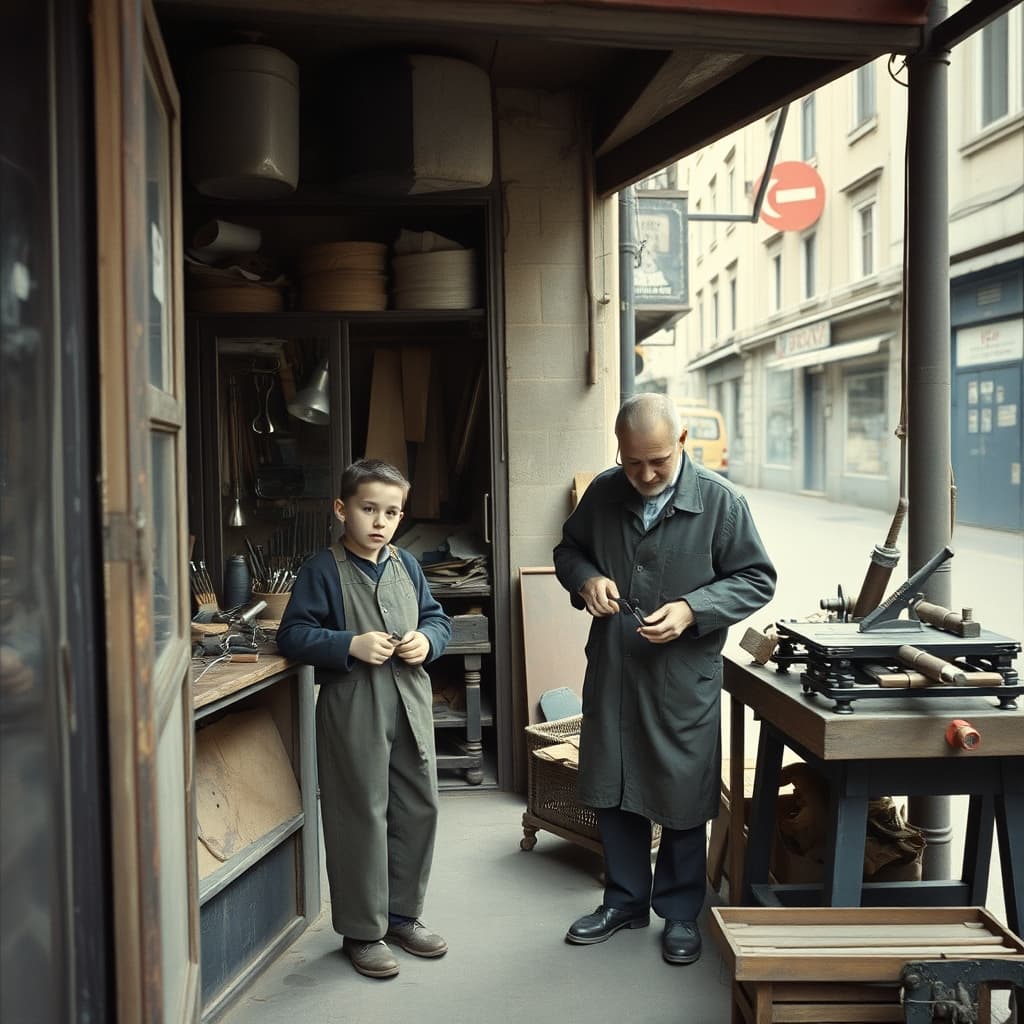
In an old commercial street, an apprentice was visible before mastering the trade. He might lift shutters, sweep the threshold, carry tea, fetch a missing part or deliver a repaired object to a nearby customer. These movements connected workshops, suppliers, cafés and homes. Repetition gave the street a recognisable working rhythm, but the apprentice's activity should not be mistaken for decoration in a nostalgic scene.
Apprenticeship could provide structured access to knowledge that was difficult to learn from books alone. A young person watched how a craftsperson held a tool, listened to the sound of a machine and learned the order in which a job should be attempted. Good teaching gradually linked simple duties to explanation, supervised practice and responsibility. The value lay in instruction, not merely obedience.
The Street Functioned as an Informal Classroom
Workshops were often small and open to the pavement. A metalworker's hammer, a tailor's machine or a mechanic's diagnosis could be observed from the doorway. Neighbouring masters borrowed tools and referred customers. An apprentice learned the geography of materials: which wholesaler stocked a particular screw, who sharpened blades and where waste could be handled safely.
This local network trained judgement as well as memory. The apprentice learned to describe a fault accurately, compare quality and return with the correct item. Mistakes cost time and money, so a responsible master corrected them without humiliation or danger. Trust grew when teaching was consistent and the young worker could ask questions.
Romance Must Not Hide Risk
Historical apprenticeship also included long hours, low or absent pay, interrupted schooling, hazardous machinery and harsh discipline. Children carrying loads or working near chemicals were vulnerable. Family poverty could turn “learning a trade” into a phrase that concealed exploitation. The fact that some apprentices built successful careers does not erase those who were injured, undereducated or unable to leave.
Modern documentation should therefore distinguish age, hours, compensation, schooling, protective equipment and the actual skills taught. Labour law and occupational safety matter to the history. A workshop that transmitted craft responsibly is not equivalent to one that used a child as permanent cheap labour.
Tools Carry Traces of Teaching
A worn handle, practice piece or notebook can show how skill moved between generations. Marks made by a beginner may sit beside later, confident work. Oral histories should ask masters how tasks were introduced and former apprentices what they were allowed to practise. Women and girls, whose training often occurred in homes or less visible trades, must be actively included.
As production, schooling and retail changed, many street workshops closed or moved. Formal vocational programmes replaced parts of the old system, while some crafts continued through master-apprentice relationships. Neither model is automatically superior; quality depends on real teaching, safety, dignity and the ability to carry knowledge forward.
A Digital Nostalgia Archive can map workshops, record tool sounds, scan certificates, preserve account books and connect testimony from both sides of the workbench. The apprenticeship street remains vivid because learning moved through public space in errands, greetings and repeated tasks. Its legacy is worth preserving most carefully when admiration for skill is paired with clear evidence about the conditions under which that skill was acquired.