Eski Pano
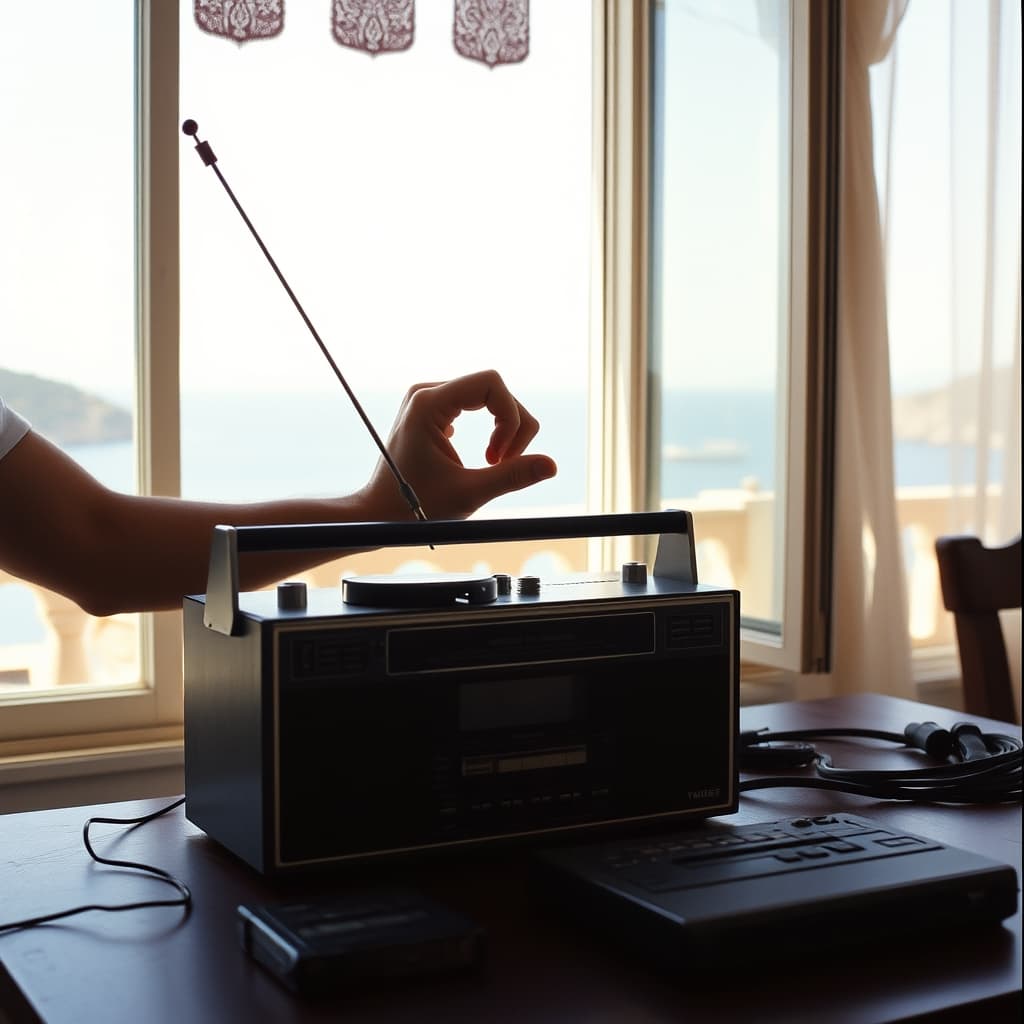
There was a time when listening to music in summer houses, boarding rooms, or living rooms with the balcony door open was not an ordinary act done by pressing a button and moving on. The cassette player would be placed on the table, its antenna carefully extended, and small manual adjustments would be made until the cleanest sound could be found inside the crackle. Sometimes a radio broadcast was caught, sometimes a favorite tape was rewound and started again, and sometimes moving back and forth between those two possibilities became the rhythm of the day itself. In the loosened time of a holiday, everyone moved a little more slowly. One person would say, “now it is clearer,” and another would change the position of the machine. That was exactly what it meant for hope to grow sharper as the antenna turned: together with the sound, the day itself came into focus.
Seen as technological heritage, the cassette player was not only a device that carried sound, but one of the everyday objects of the analog age that demanded patience, practiced hands, and shared attention. Today digital playlists open in seconds, yet in those years one had to establish real contact with the device in order to reach music or news. The direction of the telescopic antenna, the way the tape was wound, the weakness of the batteries, the stiffness of the buttons, and the hiss coming from the speaker all formed inseparable parts of the experience. Even if the sound was not perfect, the effort made to reach it gave the melody greater value. That may be why using a cassette player ceased to be a technical action and turned into a small ceremony.
In the languor of holiday time, that ceremony had its own distinct scene. People had returned from the sea, towels were hanging on the balcony, glasses of lemonade had been left half finished. As the sun slowly heated the house, the cassette player would be set up in one corner. Favorite songs would play, the distant but familiar voice of a radio announcer would drift in, and children would hover nearby asking for the same song again. These small labors, rewinding a tape with a pencil, nudging a sticky button, bending the antenna toward the window, kept the technology from feeling mechanical. In the middle of family or friends, the device worked like a center that tuned shared time itself.
The reason this memory has been carried from tongue to tongue is that nearly everyone preserves a similar soundscape in his or her own memory of summer. For some it was arabesque tapes listened to in the noon heat; for others a foreign music station caught toward evening; for others still, the soft interference heard before the news bulletin. The same machine accompanied different feelings in different houses, yet left behind one common sensation: when sound did not come easily, music was listened to more carefully. Inside turning the antenna a little farther to the right, rewinding the tape, and adjusting the volume so as not to trouble the neighbors, the everyday manners of the era were also hidden.
Today cassette players may stand silent in many homes, as objects or collector's pieces, yet the memory attached to them is still alive. That is because the device symbolizes a time when technology called people not toward haste, but toward ritual. The hope that became clearer as the antenna turned described not only the quality of the signal, but the spirit of the moment. This memory, spreading from one person to another in the middle of a holiday, reminds us that sound was once not only heard; it was arranged, awaited, and shared together. That is why using a cassette player was a ceremony in itself: a ceremony woven from small technical details, but warmed above all by people.
Why Was Using a Cassette Player, Accompanied by Hope Growing Clearer as the Antenna Was Turned, a Ceremony in Itself, Like a Memory Passed from Tongue to Tongue in the Languor of a Holiday